Zou Weijie, Du Yuanyuan, Ji Xiaoyan, Zhang Ji, Ding Hongping, Chen Jingqiao, Wang Tao, Ji Fangfang, Huang Jiang
Department of Ophthalmology, Second Affiliated Hospital of Soochow University, Suzhou, China.
Department of Ophthalmology, Changshu No.1 People's Hospital, Suzhou, China.
Front Pharmacol. 2022 Jul 22;13:948852. doi: 10.3389/fphar.2022.948852. eCollection 2022.
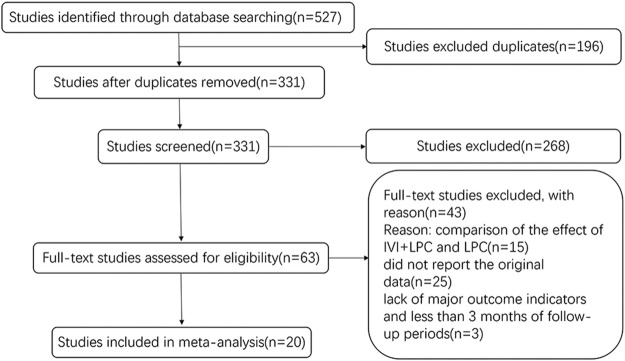
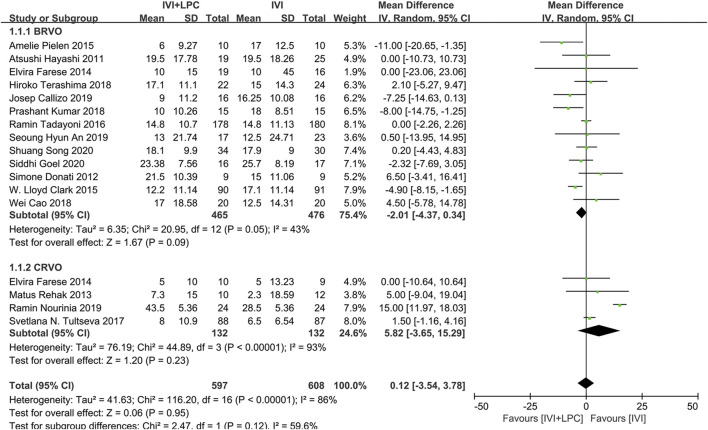
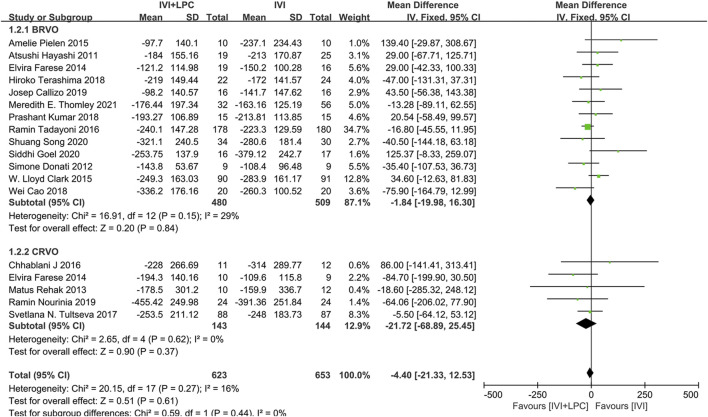
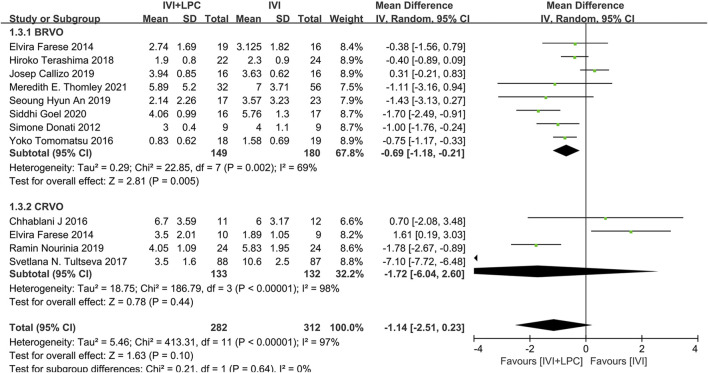
To compare the efficiency of anti-VEGF drugs intravitreal injections(IVI) treatment with or without retinal laser photocoagulation(LPC) for macular edema(ME) secondary to retinal vein occlusion(RVO). The randomized controlled trials and retrospective studies including anti-VEGF drug IVI combined with retinal LPC and single IVI in the treatment of macular edema secondary to RVO were collected in PubMed, Medline, Embase, Cochrane Library, and Web of Science. We extracted the main outcome indicators including the best corrected visual acuity (BCVA), central macular thickness(CMT), the number of injections and the progress of retinal non-perfusion areas(NPAs) for systematic evaluation, to observe whether IVI + LPC could be more effective on the prognosis of RVO. We use Review Manager 5.4 statistical software to analyze the data 527 articles were initially retrieved. We included 20 studies, with a total of 1387 patients who were divided into the combination(IVI + LPC) treatment group and the single IVI group. All the patients completed the ocular examination including BCVA, slit-lamp test, fundus examination and Optical Coherence Tomography(OCT) test before and after each treatment. There was no statistical difference between the combination treatment group and single IVI group on BCVA( = 0.12,95% -3.54-3.78, = 0.95),CMT( = -4.40,95% -21.33-12.53, = 0.61) and NPAs( = 0.01,95% -0.28-0.30, = 0.94).However, the number of IVI was decreased significantly in the combination treatment group in BRVO patients, compared to that in the single IVI group( = -0.69,95% -1.18∼-0.21, = 0.005). In the treatment of RVO patients with macular edema, the combination of IVI and retinal LPC neither improves BCVA nor reduces CMT significantly compared with the single IVI treatment. However, the combination treatment can decrease the number of intravitreal injections in patients with BRVO, while it is not observed in CRVO patients.
比较抗血管内皮生长因子(VEGF)药物玻璃体腔内注射(IVI)联合或不联合视网膜激光光凝(LPC)治疗视网膜静脉阻塞(RVO)继发黄斑水肿(ME)的疗效。在PubMed、Medline、Embase、Cochrane图书馆和科学网中收集随机对照试验和回顾性研究,这些研究包括抗VEGF药物IVI联合视网膜LPC和单纯IVI治疗RVO继发黄斑水肿。我们提取主要结局指标,包括最佳矫正视力(BCVA)、中心黄斑厚度(CMT)、注射次数和视网膜无灌注区(NPAs)进展情况进行系统评价,以观察IVI + LPC对RVO预后是否更有效。我们使用Review Manager 5.4统计软件分析数据。最初检索到527篇文章。我们纳入20项研究,共1387例患者,分为联合治疗组(IVI + LPC)和单纯IVI组。所有患者在每次治疗前后均完成眼科检查,包括BCVA、裂隙灯检查、眼底检查和光学相干断层扫描(OCT)检查。联合治疗组和单纯IVI组在BCVA( = 0.12,95%可信区间 -3.54 - 3.78, = 0.95)、CMT( = -4.40,95%可信区间 -21.33 - 12.53, = 0.61)和NPAs( = 0.01,95%可信区间 -0.28 - 0.30, = 0.94)方面无统计学差异。然而,与单纯IVI组相比,BRVO患者联合治疗组的IVI次数显著减少( = -0.69,95%可信区间 -1.18∼ -0.21, = 0.005)。在治疗RVO继发黄斑水肿患者时,与单纯IVI治疗相比,IVI联合视网膜LPC既不能显著提高BCVA,也不能显著降低CMT。然而,联合治疗可减少BRVO患者的玻璃体腔内注射次数,而在CRVO患者中未观察到这一现象。