Damena Tadewos, Alem Mamaru Bitew, Zeleke Digafie, Desalegn Tegene, Eswaramoorthy Rajalakshmanan, Demissie Taye B
Department of Applied Chemistry, Adama Science and Technology University, P.O. Box 1888 Adama, Ethiopia.
Department of Chemistry, Salale University, P.O. Box 245 Fitche, Ethiopia.
ACS Omega. 2022 Jul 19;7(30):26336-26352. doi: 10.1021/acsomega.2c02205. eCollection 2022 Aug 2.
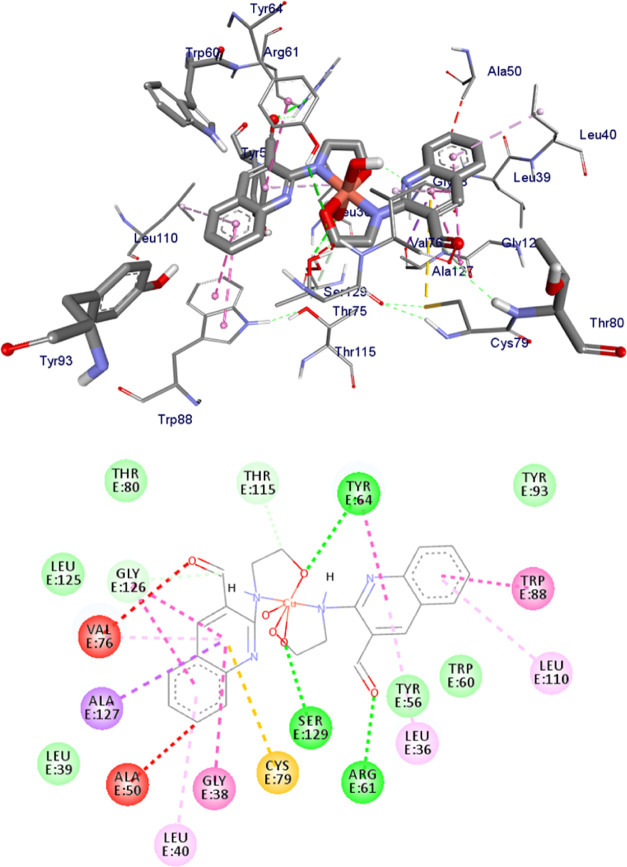
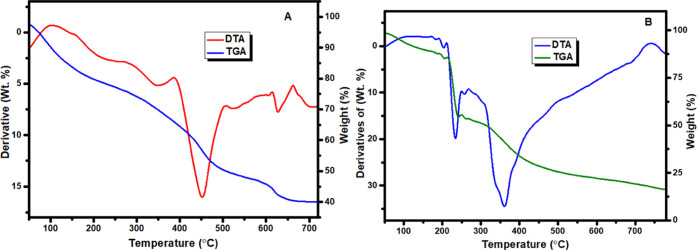
In the present work, two novel complexes of zinc(II) and copper(II) were synthesized from the ligand 2-((2-hydroxyethyl)amino)quinoline-3-carbaldehyde ( ) in a 1:2 metal-to-ligand ratio in methanol. The complexes were characterized by UV-visible spectroscopy, fluorescence spectroscopy, Fourier transform infrared (FT-IR) spectroscopy, powder X-ray diffraction (XRD), scanning electron microscopy-energy-dispersive X-ray spectroscopy (SEM-EDX), mass spectrometry (MS), nuclear magnetic resonance (NMR) spectroscopy, and thermogravimetric analysis (TGA) experimental techniques and density functional theory (DFT) calculations. The spectral data revealed that the mono-deprotonated () ligand acted as a bidentate ligand, which bound to both Zn(II) and Cu(II) ions the nitrogen atom of the amine (N-H) and the hydroxyl (O-H) groups through the deprotonated oxygen atom. Formation constants and thermal analysis indicated that both metal complexes are stable up to 100 °C with thermodynamically favored chemical reactions. The Cu(II) complex showed antibacterial activities with the zones of inhibition of 20.90 ± 2.00 mm against , 19.69 ± 0.71 mm against , and 18.58 ± 1.04 mm against . These results are relatively higher compared with the Zn(II) complex at the same concentration. The minimum inhibitory concentration (MIC) results for the complexes also showed similar trends against the three bacteria. On the other hand, radical scavenging activities of both Cu(II) and Zn(II) complexes showed half-maximal inhibitory concentrations (IC) of 4.72 and 8.2 μg/mL, respectively, while ascorbic acid (a positive control) has a value of 4.28 μg/mL. The Cu(II) complex exhibited better communication with the positive control, indicating its potential use for biological activities. The calculated and molecular docking results also strongly support the experimental results.
在本研究中,以2 - ((2 - 羟乙基)氨基)喹啉 - 3 - 甲醛( )为配体,在甲醇中以金属与配体1:2的比例合成了两种新型锌(II)和铜(II)配合物。通过紫外 - 可见光谱、荧光光谱、傅里叶变换红外(FT - IR)光谱、粉末X射线衍射(XRD)、扫描电子显微镜 - 能量色散X射线光谱(SEM - EDX)、质谱(MS)、核磁共振(NMR)光谱以及热重分析(TGA)等实验技术和密度泛函理论(DFT)计算对配合物进行了表征。光谱数据表明,单去质子化的( )配体作为双齿配体,通过去质子化的氧原子,通过胺基(N - H)的氮原子和羟基(O - H)基团与Zn(II)和Cu(II)离子结合。形成常数和热分析表明,两种金属配合物在高达100°C时都很稳定,化学反应在热力学上是有利的。Cu(II)配合物表现出抗菌活性,对 的抑菌圈直径为20.90±2.00 mm,对 的抑菌圈直径为19.69±0.71 mm,对 的抑菌圈直径为18.58±1.04 mm。与相同浓度的Zn(II)配合物相比,这些结果相对更高。配合物的最低抑菌浓度(MIC)结果对这三种细菌也显示出类似的趋势。另一方面,Cu(II)和Zn(II)配合物的自由基清除活性的半数抑制浓度(IC)分别为4.72和8.2 μg/mL,而作为阳性对照的抗坏血酸的值为4.28 μg/mL。Cu(II)配合物与阳性对照表现出更好的一致性,表明其在生物活性方面的潜在应用。计算结果和分子对接结果也有力地支持了实验结果。