Clinical Epidemiology Research Office, The First Affiliated Hospital of Hunan Normal University, Changsha, China.
Key Laboratory of Molecular Epidemiology, Hunan Normal University, Changsha, China.
Front Public Health. 2022 Jul 22;10:950805. doi: 10.3389/fpubh.2022.950805. eCollection 2022.
Previous studies have explored the relationship between body fat percentage (BFP) and hypertension or homocysteine. However, evidence on the constancy of the association remains inconclusive in postmenopausal women. The aim of this study was to investigate the association between BFP and H-type hypertension in postmenopausal women.
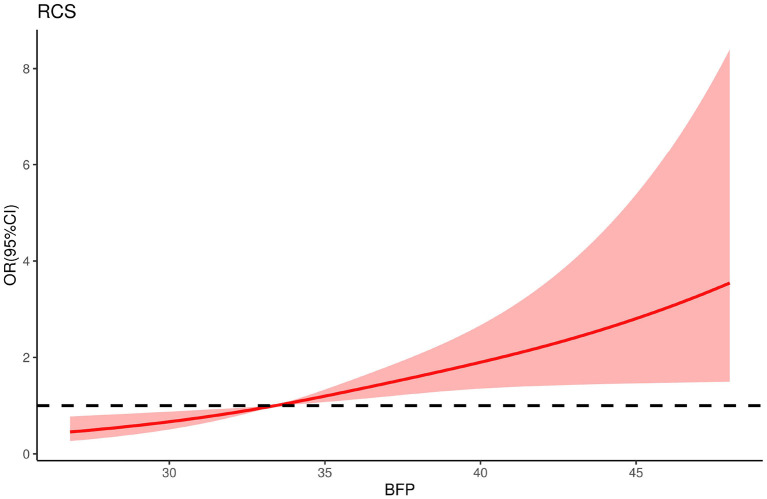
This cross-sectional study included 1,597 eligible female patients with hypertension. Homocysteine levels ≥10 mmol/L were defined as H-type hypertension. BFP was calculated by measuring patients' physical parameters. Subjects were divided into 4 groups according to quartiles of BFP (Q1: 33.4% or lower, Q2: 33.4-36.1%, Q3: 36.1-39.1%, Q4: >39.1%). We used restricted cubic spline regression models and logistic regression analysis to assess the relationship between BFP and H-type hypertension. Additional subgroup analysis was performed for this study.
Among 1,597 hypertensive patients, 955 (59.8%) participants had H-type hypertension. There were significant differences between the two groups in age, BMI, educational background, marital status, exercise status, drinking history, WC, TG, LDL, Scr, BUN, and eGFR ( < 0.05). The prevalence of H-type hypertension in the Q1 to Q4 groups was 24.9, 25.1, 24.9, and 25.1%, respectively. After adjusting for relevant factors, we found that the risk of H-type hypertension in the Q4 group had a significantly higher than the Q1 group (OR = 3.2, 95% CI: 1.3-7.5).
BFP was positively associated with the risk of H-type hypertension in postmenopausal women. Postmenopausal women should control body fat to prevent hypertension.
既往研究探索了体脂百分比(BFP)与高血压或同型半胱氨酸之间的关系。然而,绝经后女性中关于这种关联的稳定性的证据仍不确定。本研究旨在探讨绝经后女性 BFP 与 H 型高血压之间的关系。
这是一项横断面研究,纳入了 1597 名符合条件的高血压女性患者。同型半胱氨酸水平≥10mmol/L 定义为 H 型高血压。通过测量患者的身体参数计算 BFP。根据 BFP 的四分位数(Q1:<33.4%,Q2:33.4%-36.1%,Q3:36.1%-39.1%,Q4:>39.1%)将患者分为 4 组。我们使用限制性立方样条回归模型和逻辑回归分析评估 BFP 与 H 型高血压之间的关系。本研究进行了额外的亚组分析。
在 1597 名高血压患者中,955 名(59.8%)患者患有 H 型高血压。两组在年龄、BMI、教育背景、婚姻状况、运动状况、饮酒史、WC、TG、LDL、Scr、BUN 和 eGFR 方面存在显著差异(<0.05)。Q1 至 Q4 组的 H 型高血压患病率分别为 24.9%、25.1%、24.9%和 25.1%。在调整了相关因素后,我们发现 Q4 组发生 H 型高血压的风险明显高于 Q1 组(OR=3.2,95%CI:1.3-7.5)。
BFP 与绝经后女性 H 型高血压的风险呈正相关。绝经后女性应控制体脂以预防高血压。