Medical quality management office, Ningbo Medical Center Lihuili Hospital, Ningbo, Zhejiang 315040, China.
Physical examination center, Ningbo Medical Center Lihuili Hospital, Ningbo, Zhejiang, 315040, China.
Clinics (Sao Paulo). 2021 Jan 20;76:e2233. doi: 10.6061/clinics/2021/e2233. eCollection 2021.
To explore the risk factors of essential hypertension with hyperhomocysteinemia (H-type hypertension) and design a nomogram to predict this risk.
A hospital-based study was conducted on 1,712 individuals, including 282 patients with H-type hypertension, 105 patients with simple hypertension, 645 individuals with hyperhomocysteinemia, and 680 healthy controls. Logistic regression and nomogram models were applied to evaluate the risk factors.
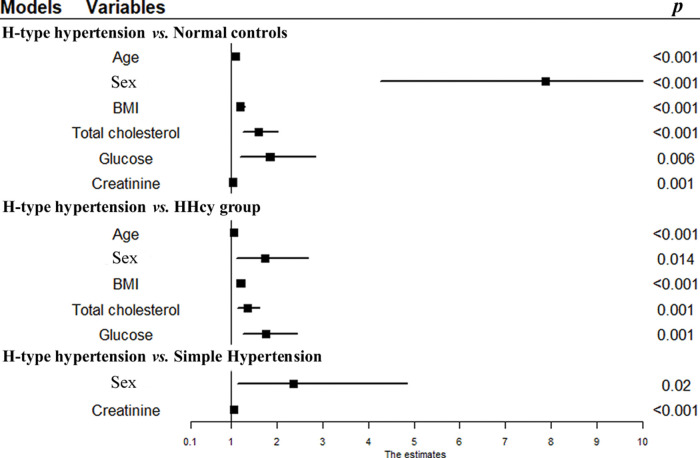
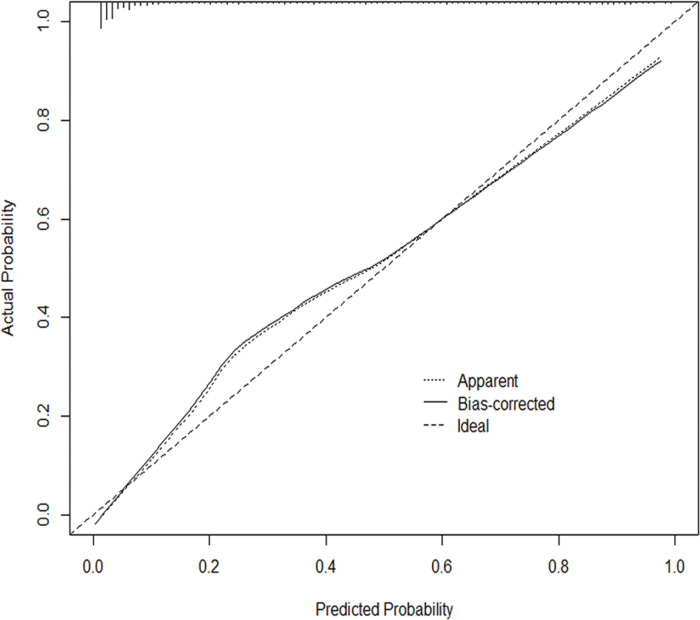
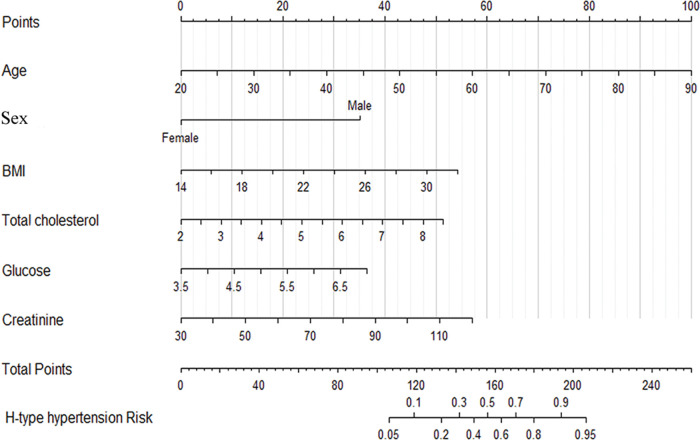
Logistic regression showed that advanced age, male sex, high body mass index (BMI), high total cholesterol levels, high glucose levels, and high creatinine levels were risk factors of H-type hypertension in the healthy population and were integrated into the nomogram model. Advanced age, male sex, high BMI, high total cholesterol levels, and high glucose levels were shown to be risk factors of H-type hypertension in the hyperhomocysteinemia population. Male sex and high creatinine levels were shown to be risk factors of H-type hypertension in the hypertension population. Nomogram analysis showed that the total factor score ranged from 106 to 206, and the corresponding risk rate ranged from 0.05 to 0.95.
Men are more likely to have H-type hypertension, and advanced age, high BMI, high total cholesterol levels, and high glucose levels are risk factors of H-type hypertension in healthy and hyperhomocysteinemia populations. Furthermore, high creatinine level is a risk factor of H-type hypertension in healthy and hypertension populations. Nomogram models may be used to intuitively evaluate H-type hypertension risk and provide a basis for personalized interventions.
探讨伴有高同型半胱氨酸血症(H 型高血压)的原发性高血压的危险因素,并设计预测该风险的列线图。
采用医院为基础的研究方法,纳入 1712 例个体,包括 282 例 H 型高血压患者、105 例单纯高血压患者、645 例高同型半胱氨酸血症患者和 680 例健康对照者。应用 logistic 回归和列线图模型评估危险因素。
logistic 回归显示,年龄较大、男性、较高的体重指数(BMI)、较高的总胆固醇水平、较高的血糖水平和较高的肌酐水平是健康人群中 H 型高血压的危险因素,并被纳入列线图模型。年龄较大、男性、较高的 BMI、较高的总胆固醇水平和较高的血糖水平是高同型半胱氨酸血症人群中 H 型高血压的危险因素。男性和较高的肌酐水平是高血压人群中 H 型高血压的危险因素。列线图分析显示,总因子评分范围为 106206,对应的风险率范围为 0.050.95。
男性更易发生 H 型高血压,年龄较大、较高的 BMI、较高的总胆固醇水平和较高的血糖水平是健康人群和高同型半胱氨酸血症人群中 H 型高血压的危险因素。此外,较高的肌酐水平是健康人群和高血压人群中 H 型高血压的危险因素。列线图模型可用于直观评估 H 型高血压风险,并为个性化干预提供依据。