Shahbazian Negin, Romero David A, Forbes Thomas L, Amon Cristina H
Department of Mechanical and Industrial Engineering, University of Toronto, Toronto, ON, Canada.
Division of Vascular Surgery, Peter Munk Cardiac Centre, University Health Network, Department of Surgery, University of Toronto, Toronto, ON, Canada.
JVS Vasc Sci. 2022 Jun 24;3:259-273. doi: 10.1016/j.jvssci.2022.05.056. eCollection 2022.
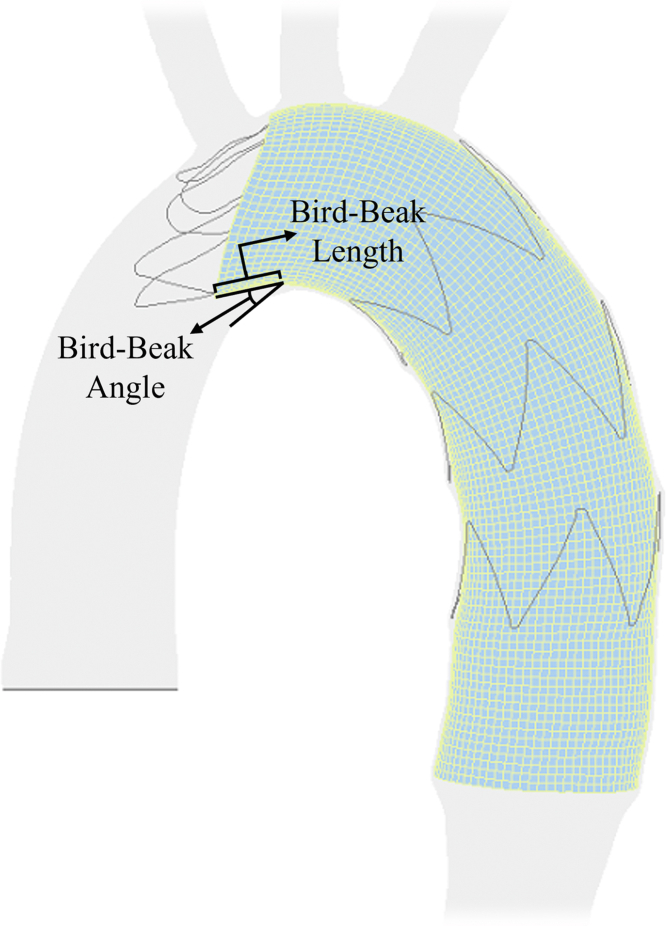
Formation of a bird-beak configuration in thoracic endovascular aortic repair (TEVAR) has been shown to be influenced by various factors. However, the main cause of bird-beak formation remains poorly understood. The hypothesis has been that the geometric and mechanical properties of both the aorta and the stent graft contribute to the formation and extent of a bird-beak configuration. The goal of the present study was to use parameter-based computational simulations of TEVAR to predict for bird-beak formation and identify its most significant contributing factors.
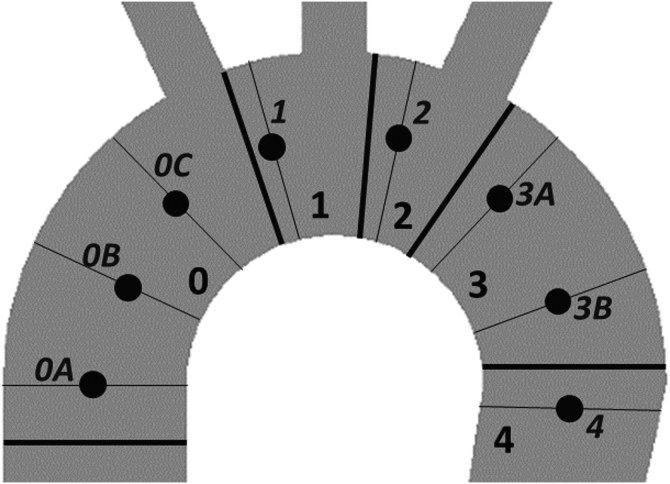
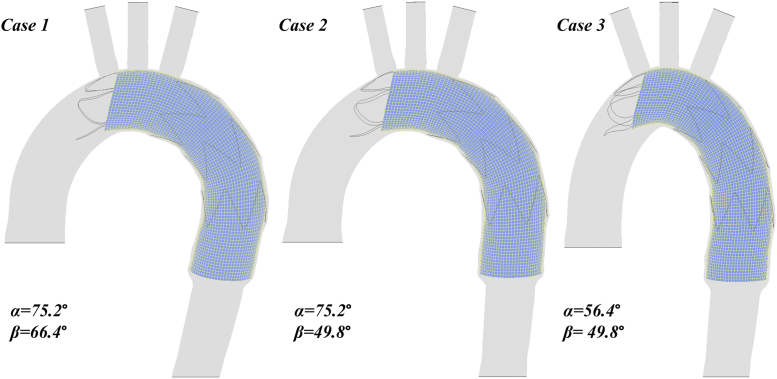
In the present study, we considered five parameters for the computational simulations of TEVAR, including aortic curvature, aortic arch angle, age as a surrogate for thoracic aortic tissue properties, TEVAR landing zone, and stent graft oversizing. Using an experimental design approach, computational models for 160 TEVAR scenarios were developed by varying the values of the simulation parameters within clinically relevant ranges. The bird-beak length and angle were used as metrics to evaluate the simulation results. Statistical analysis of the simulation data using a random forest model was conducted to identify significant parameters and interactions.
The mean ± standard deviation of the bird-beak length and angle across 160 simulations were 4.32 ± 4.87 mm and 9.16° ± 12.21°, respectively. The largest mean bird-beak length and angle were found in the most distal location in zone 0 (10.04 mm) and zone 2 (21.48°), respectively. An inverse correlation was found between the aortic arch angle and the bird-beak length and angle. In ∼75% of the scenarios, increased stent graft oversizing either fully resolved the presence of the bird-beak configuration or had reduced its size. In the remaining 25%, oversizing minimally changed the bird-beak length and enlarged the bird-beak angle, which mainly occurred in cases with a smaller aortic arch angle and landing zones near the arch apex. This was justified by the mechanism of stent graft bending in the arch angulation. The aortic curvature and tissue properties were shown to be statistically insignificant in relation to bird-beak formation.
Significant parameters predictive of a bird-beak configuration in TEVAR were identified, and the trends in which each parameter influenced the bird-beak size were determined. The findings from the present study can inform the surgical planning and device selection process with the goal of minimizing bird-beak formation.
胸主动脉腔内修复术(TEVAR)中鸟嘴状结构的形成已被证明受多种因素影响。然而,鸟嘴状结构形成的主要原因仍知之甚少。有一种假设认为,主动脉和支架移植物的几何及力学特性均对鸟嘴状结构的形成及其程度有影响。本研究的目的是利用基于参数的TEVAR计算模拟来预测鸟嘴状结构的形成,并确定其最重要的影响因素。
在本研究中,我们在TEVAR计算模拟中考虑了五个参数,包括主动脉曲率、主动脉弓角度、作为胸主动脉组织特性替代指标的年龄、TEVAR着陆区以及支架移植物的尺寸过大情况。采用实验设计方法,通过在临床相关范围内改变模拟参数的值,开发了160种TEVAR场景的计算模型。鸟嘴状结构的长度和角度用作评估模拟结果的指标。使用随机森林模型对模拟数据进行统计分析,以确定显著参数和相互作用。
160次模拟中鸟嘴状结构长度和角度的平均值±标准差分别为4.32±4.87毫米和9.16°±12.21°。在0区最远端(10.04毫米)和2区(21.48°)分别发现了最大的平均鸟嘴状结构长度和角度。发现主动脉弓角度与鸟嘴状结构长度和角度呈负相关。在约75%的场景中,增加支架移植物尺寸过大要么完全消除了鸟嘴状结构的存在,要么减小了其尺寸。在其余25%的场景中,尺寸过大对鸟嘴状结构长度的影响最小,但增大了鸟嘴状结构角度,这主要发生在主动脉弓角度较小且着陆区靠近弓顶的情况下。这通过支架移植物在弓部成角处的弯曲机制得到了解释。结果表明,主动脉曲率和组织特性与鸟嘴状结构的形成在统计学上无显著关联。
确定了预测TEVAR中鸟嘴状结构的显著参数,并确定了每个参数影响鸟嘴状结构大小的趋势。本研究结果可为手术规划和器械选择过程提供参考,以尽量减少鸟嘴状结构的形成。