Centre for Psychedelic Research, Imperial College London, London, UK.
Acer Integration, London, UK.
Psychopharmacology (Berl). 2022 Nov;239(11):3461-3483. doi: 10.1007/s00213-022-06187-5. Epub 2022 Aug 8.
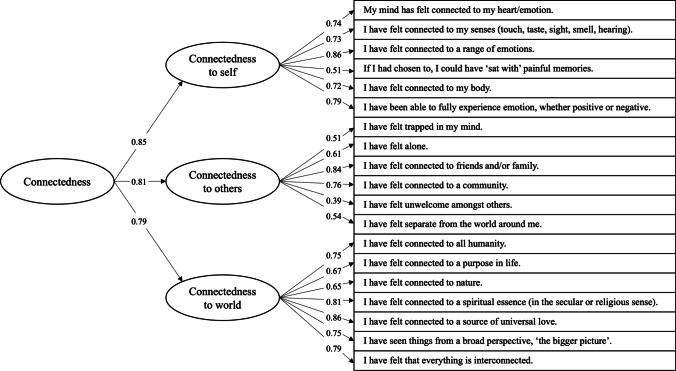
A general feeling of disconnection has been associated with mental and emotional suffering. Improvements to a sense of connectedness to self, others and the wider world have been reported by participants in clinical trials of psychedelic therapy. Such accounts have led us to a definition of the psychological construct of 'connectedness' as 'a state of feeling connected to self, others and the wider world'. Existing tools for measuring connectedness have focused on particular aspects of connectedness, such as 'social connectedness' or 'nature connectedness', which we hypothesise to be different expressions of a common factor of connectedness. Here, we sought to develop a new scale to measure connectedness as a construct with these multiple domains. We hypothesised that (1) our scale would measure three separable subscale factors pertaining to a felt connection to 'self', 'others' and 'world' and (2) improvements in total and subscale WCS scores would correlate with improved mental health outcomes post psychedelic use.
To validate and test the 'Watts Connectedness Scale' (WCS).
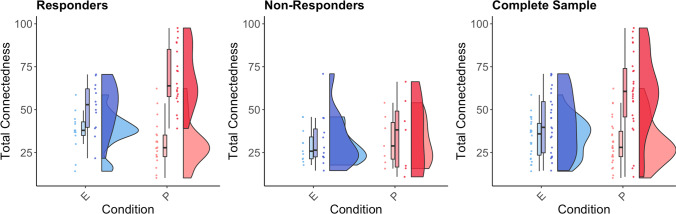
Psychometric validation of the WCS was carried out using data from three independent studies. Firstly, we pooled data from two prospective observational online survey studies. The WCS was completed before and after a planned psychedelic experience. The total sample of completers from the online surveys was N = 1226. Exploratory and confirmatory factor analysis were performed, and construct and criterion validity were tested. A third dataset was derived from a double-blind randomised controlled trial (RCT) comparing psilocybin-assisted therapy (n = 27) with 6 weeks of daily escitalopram (n = 25) for major depressive disorder (MDD), where the WCS was completed at baseline and at a 6-week primary endpoint.
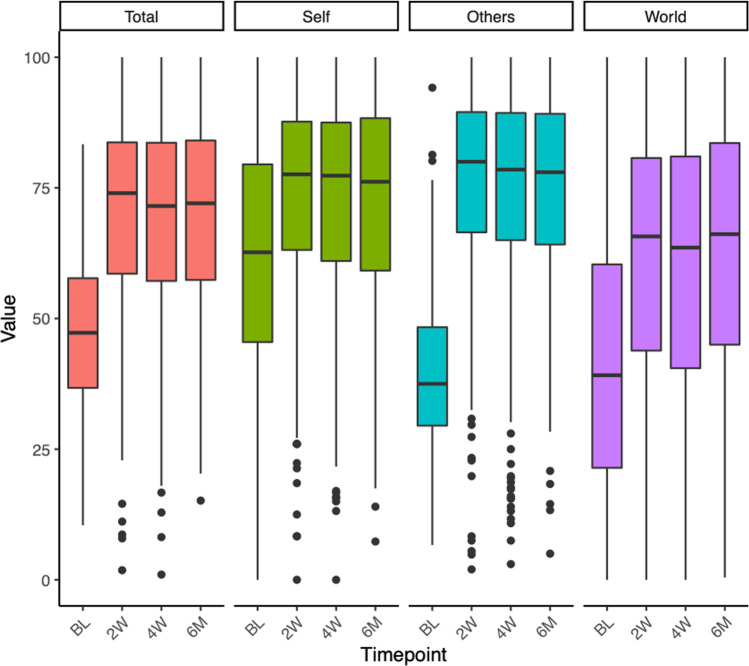
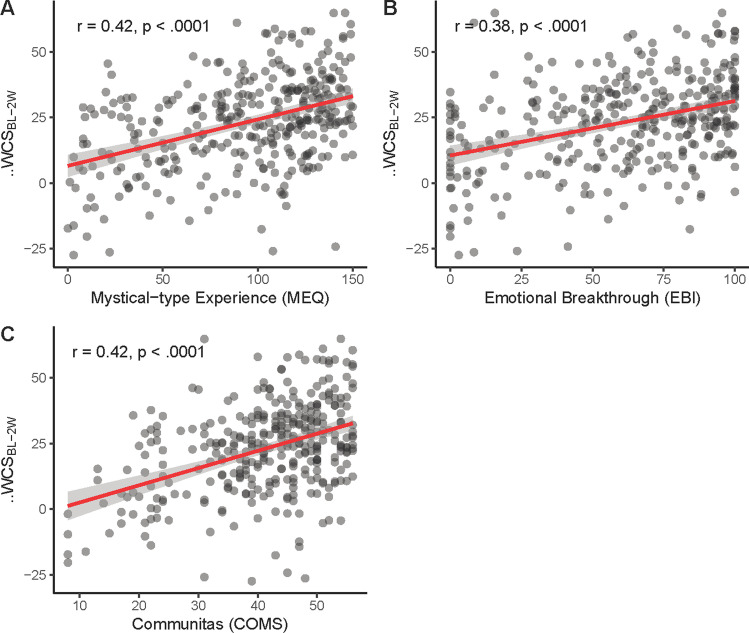
As hypothesised, factor analysis of all WCS items revealed three main factors with good internal consistency. WCS showed good construct validity. Significant post-psychedelic increases were observed for total connectedness scores (η2 = 0.339, p < 0.0001), as well as on each of its subscales (p < 0.0001). Acute measures of 'mystical experience', 'emotional breakthrough', and 'communitas' correlated positively with post-psychedelic changes in connectedness (r = 0.42, r = 0.38, r = 0.42, respectively, p < 0.0001). In the RCT, psilocybin therapy was associated with greater increases in WCS scores compared with the escitalopram arm (η2 = 0.133, p = 0.009).
The WCS is a new 3-dimensional index of felt connectedness that may sensitively measure therapeutically relevant psychological changes post-psychedelic use. We believe that the operational definition of connectedness captured by the WCS may have broad relevance in mental health research.
与精神和情感痛苦相关的是一种普遍的脱节感。在迷幻疗法的临床试验中,参与者报告了自我、他人和更广泛世界的联系感的改善。这些描述使我们将“联系”的心理结构定义为“一种与自我、他人和更广泛世界联系的感觉状态”。现有的联系感衡量工具侧重于联系感的特定方面,例如“社交联系感”或“自然联系感”,我们假设这些是联系感的共同因素的不同表现。在这里,我们试图开发一种新的量表来衡量联系感作为一种具有多个领域的结构。我们假设 (1) 我们的量表将衡量与“自我”、“他人”和“世界”的联系感有关的三个可分离的子量表因素,以及 (2) 总 WCS 和子量表分数的提高将与迷幻后心理健康结果的改善相关。
验证和测试“瓦特联系量表”(WCS)。
使用来自三个独立研究的数据对 WCS 进行心理测量学验证。首先,我们汇总了两项前瞻性在线观察性研究的数据。WCS 在计划的迷幻体验前后完成。来自在线调查的完成者的总样本量为 N=1226。进行了探索性和验证性因素分析,并测试了结构和标准效度。第三个数据集来自一项双盲随机对照试验(RCT),比较了迷幻辅助治疗(n=27)与 6 周每日依西酞普兰(n=25)治疗重度抑郁症(MDD),其中 WCS 在基线和 6 周主要终点时完成。
正如假设的那样,对所有 WCS 项目的因素分析显示出三个主要因素,具有良好的内部一致性。WCS 具有良好的结构效度。观察到迷幻后总联系感评分显著增加(η2=0.339,p<0.0001),以及每个子量表的评分均显著增加(p<0.0001)。急性的“神秘体验”、“情感突破”和“社区感”测量值与迷幻后联系感的变化呈正相关(r=0.42、r=0.38、r=0.42,p<0.0001)。在 RCT 中,与依西酞普兰组相比,迷幻疗法与 WCS 评分的更大增加相关(η2=0.133,p=0.009)。
WCS 是一种新的 3 维感觉联系指数,可敏感地衡量迷幻后使用的治疗相关心理变化。我们认为,WCS 捕捉的联系感操作性定义可能在心理健康研究中具有广泛的相关性。