Department of Occupational and Environmental Health, Key Laboratory of Environment and Health, Ministry of Education and State Key Laboratory of Environmental Health (Incubating), School of Public Health, Tongji Medical College, Huazhong University of Science and Technology, Wuhan, China.
School of Public Health, Guangzhou Medical University, Guangzhou, China.
JAMA Netw Open. 2022 Aug 1;5(8):e2225876. doi: 10.1001/jamanetworkopen.2022.25876.
Although numerous studies have separately investigated the associations of changes in weight or waist circumference with mortality risk, few studies have examined the associations of concurrent changes in these 2 anthropometric parameters with all-cause mortality.
To assess the associations of changes in body weight, waist circumference, or both, combined with all-cause mortality.
DESIGN, SETTING, AND PARTICIPANTS: This cohort study used data from 2 longitudinal cohort studies in Dongfeng-Tongji and Kailuan, China. Participants included 58 132 adults (aged 40 years and older) with measures of weight and waist circumference at baseline and follow-up visit. Statistical analysis was performed from June 2020 to September 2021.
Changes in weight and waist circumference between 2 visits (2008-2010 to 2013 in the Dongfeng-Tongji cohort, and 2006-2007 to 2010-2011 in the Kailuan study). Stable weight was defined as change in weight within 2.5 kg between the 2 visits and stable waist circumference was defined as changes within 3.0 cm. Changes were categorized as loss, stable, or gain for weight and waist circumference separately, and created a 9-category variable to represent the joint changes.
All-cause mortality from follow-up visit (2013 in Dongfeng-Tongji cohort and 2010-2011 in Kailuan study) until December 31, 2018. Cox proportional hazard regression models were used to estimate the associations with adjustment for potential confounders. Results were obtained in the 2 cohorts separately and pooled via fixed-effect meta-analysis.
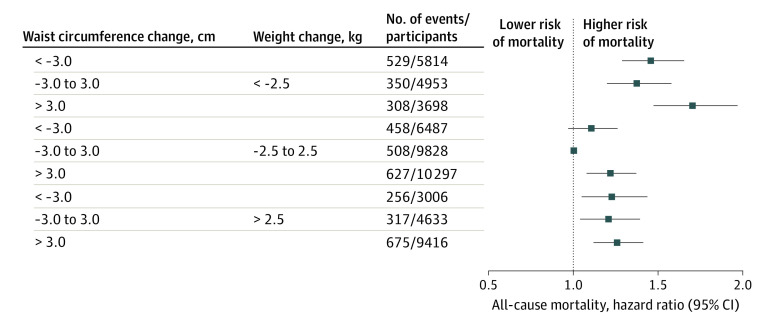
A total of 10 951 participants in the Dongfeng-Tongji cohort (median [IQR] age, 62 [56-66] years; 4203 [38.4%] men) and 47 181 participants in the Kailuan study (median [IQR] age, 51 [46-58] years; 36 663 [77.7%] men) were included in the analysis. During 426 072 person-years of follow-up, 4028 deaths (523 in the Dongfeng-Tongji cohort and 3505 in the Kailuan study) were documented. When changes in weight and waist circumference were examined separately, U-shape associations were found: both gain and loss in weight (weight loss: pooled hazard ratio [HR], 1.33; 95% CI, 1.23-1.43; weight gain: HR, 1.10; 95% CI, 1.02-1.19) or waist circumference (waist circumference loss: HR, 1.14; 95% CI, 1.05-1.24; waist circumference gain: HR, 1.11; 95% CI, 1.03-1.21) were associated with higher mortality risk compared with stable weight or waist group. When changes in weight and waist circumference were jointly assessed, compared with participants with stable weight and waist circumference (16.9% of the total population [9828 of 58 132] with 508 deaths), participants with different combinations of weight and waist circumference change all had higher mortality risks except for those with stable weight but significant loss in waist. Notably, those who lost weight but gained waist circumference (6.4% of the total population [3698 of 58 132] with 308 deaths) had the highest risk of all-cause mortality (HR, 1.69; 95% CI, 1.46-1.96; absolute rate difference per 100 000 person-years in the Dongfeng-Tongji cohort: 414; 95% CI, 116-819; and in the Kailuan study: 333; 95% CI, 195-492) among the joint subgroups.
In this cohort study, weight loss with concurrent waist circumference gain was associated with a higher mortality risk in middle-aged and older Chinese adults. This study's findings suggest the importance of evaluating the changes in both body weight and waist circumference when assessing their associations with mortality.
尽管有许多研究分别调查了体重或腰围变化与死亡风险的关联,但很少有研究探讨这两个人体测量参数同时变化与全因死亡率的关系。
评估体重、腰围或两者同时变化与全因死亡率的关系。
设计、地点和参与者:这项队列研究使用了来自中国东风-同济和开滦的两项纵向队列研究的数据。参与者包括 58132 名年龄在 40 岁及以上的成年人,他们在基线和随访时测量了体重和腰围。统计分析于 2020 年 6 月至 2021 年 9 月进行。
两次就诊(东风-同济队列的 2008-2010 年至 2013 年,以及开滦研究的 2006-2007 年至 2010-2011 年)之间体重和腰围的变化。稳定体重定义为两次就诊之间体重变化在 2.5 公斤以内,稳定腰围定义为变化在 3.0 厘米以内。体重和腰围分别单独分为减轻、稳定或增加,创建了一个 9 分类变量来表示联合变化。
随访(东风-同济队列的 2013 年和开滦研究的 2010-2011 年)至 2018 年 12 月 31 日的全因死亡率。使用 Cox 比例风险回归模型调整潜在混杂因素后,估计其相关性。分别在两个队列中获得结果,并通过固定效应荟萃分析进行汇总。
在东风-同济队列中,共有 10951 名参与者(中位数[IQR]年龄,62[56-66]岁;4203[38.4%]名男性)和开滦研究中,共有 47181 名参与者(中位数[IQR]年龄,51[46-58]岁;36663[77.7%]名男性)纳入分析。在 426072 人年的随访期间,记录了 4028 例死亡(东风-同济队列 523 例,开滦研究 3505 例)。当分别检查体重和腰围的变化时,发现了 U 形关联:体重(体重减轻:汇总危险比[HR],1.33;95%置信区间[CI],1.23-1.43;体重增加:HR,1.10;95%CI,1.02-1.19)或腰围(腰围减少:HR,1.14;95%CI,1.05-1.24;腰围增加:HR,1.11;95%CI,1.03-1.21)的变化均与较高的死亡率风险相关,而体重或腰围稳定组则较低。当联合评估体重和腰围的变化时,与体重和腰围稳定的参与者(总人群的 16.9%[58132 人中的 9828 人,508 人死亡])相比,除了体重稳定但腰围显著减少的参与者外,所有其他组合的体重和腰围变化的参与者都有更高的死亡风险。值得注意的是,体重减轻但腰围增加的参与者(总人群的 6.4%[58132 人中的 3698 人,308 人死亡])的全因死亡率风险最高(HR,1.69;95%CI,1.46-1.96;在东风-同济队列中每 100000 人年的绝对死亡率差异:414;95%CI,116-819;在开滦研究中:333;95%CI,195-492),在联合亚组中最高。
在这项队列研究中,体重减轻伴腰围增加与中国中年及以上成年人的死亡率风险增加相关。本研究结果表明,在评估体重和腰围与其死亡率的关联时,评估两者的变化非常重要。