School of Cancer and Pharmaceutical Sciences, Translational Oncology and Urology Research (TOUR), King's College London, London, United Kingdom.
Department of Surgical Sciences, Uppsala University, Uppsala, Sweden.
JAMA Netw Open. 2022 Aug 1;5(8):e2225600. doi: 10.1001/jamanetworkopen.2022.25600.
Men with type 2 diabetes have an increased risk of cardiovascular disease (CVD). Meanwhile, gonadotropin-releasing hormone (GnRH) agonists used in prostate cancer (PCa) are associated with increased risk of CVD.
To evaluate the association between GnRH agonist use, PCa diagnosis per se, and CVD risk in men with type 2 diabetes.
DESIGN, SETTING, AND PARTICIPANTS: This nationwide population-based cohort study identified men with type 2 diabetes by use of data in the Prostate Cancer Data Base Sweden version 4.1 and the Swedish National Diabetes Register, with longitudinal data from 2006 to 2016. These data were used to create 2 cohorts, 1 including men with and without PCa and the other including men with PCa who received and did not receive GnRH agonists. Data analysis was conducted from January 2006 to December 2016.
Treatment with GnRH agonists and PCa diagnosis were the primary exposures.
Primary outcome was a 10% increase in predicted 5-year CVD risk score. Secondary outcome was worsening hypertension as defined by the European Society of Hypertension Guidelines. Cox proportional hazards regression models were used to analyze the association.
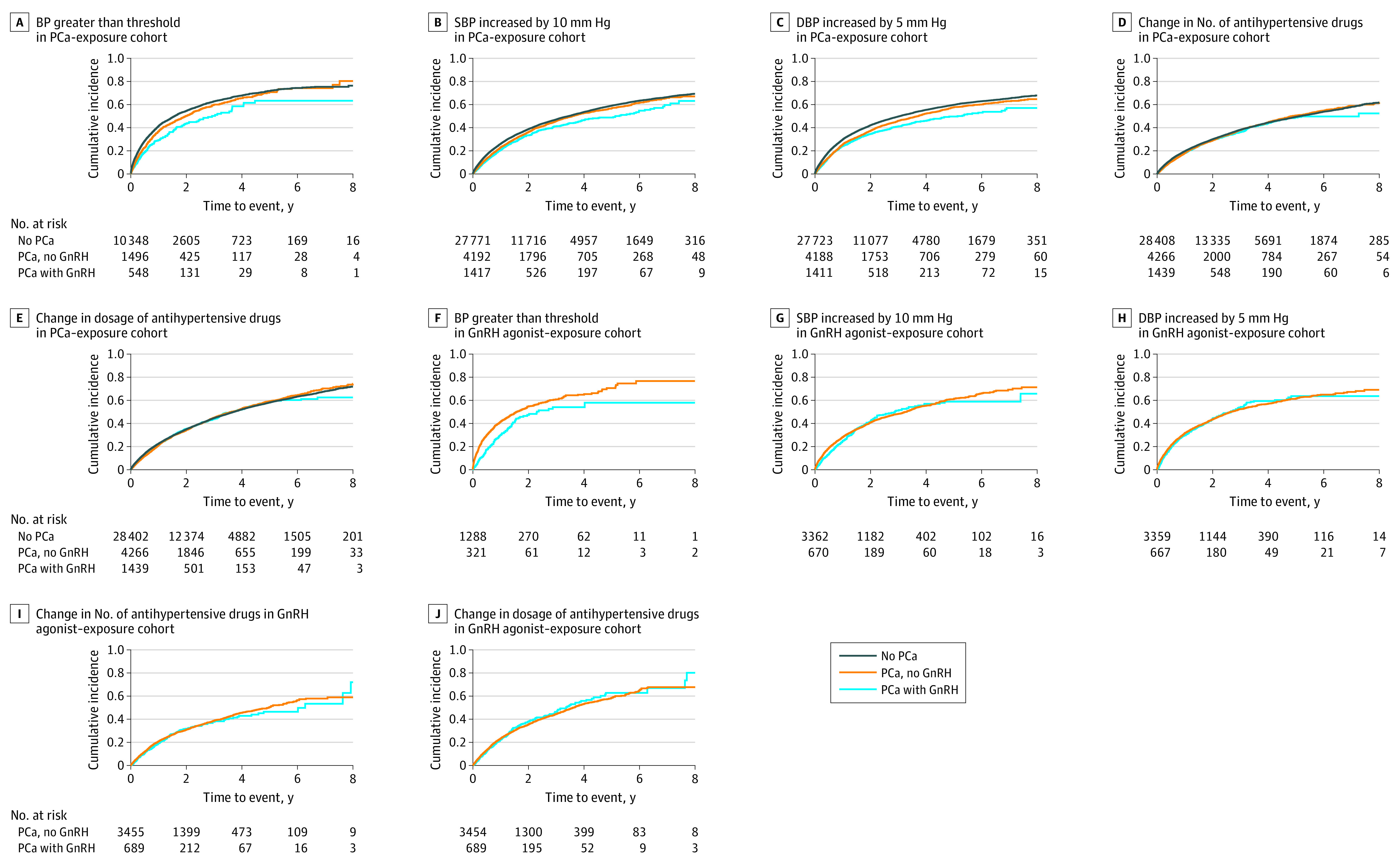
The PCa exposure cohort included 5714 men (median [IQR] age, 72.0 [11.0]), and the non-PCa cohort included 28 445 men without PCa (median [IQR] age, 72.0 [11.0]). The GnRH agonist-exposure cohort included 692 men with PCa who received a GnRH agonist, compared with 3460 men with PCa who did not receive a GnRH agonist. Men with PCa receiving GnRH agonists had an increased estimated 5-year CVD risk score compared with men without PCa (hazard ratio [HR], 1.25; 95% CI, 1.16-1.36) and compared with men with PCa not receiving GnRH agonists (HR, 1.53; 95% CI, 1.35-1.74). Men receiving GnRH agonists had decreased blood pressure compared with men without PCa (HR, 0.70; 95% CI, 0.61-0.80) and compared with men with PCa not receiving GnRH agonists (HR, 0.68; 95% CI, 0.56-0.82).
In this population-based cohort study, there was an increased risk of CVD in men with type 2 diabetes who received a GnRH agonist for PCa. These findings highlight the need to closely control CVD risk factors in men with type 2 diabetes treated with GnRH agonists. The association between GnRH agonist use and decreased blood pressure levels warrants further study.
2 型糖尿病男性患心血管疾病(CVD)的风险增加。与此同时,用于前列腺癌(PCa)的促性腺激素释放激素(GnRH)激动剂与 CVD 风险增加相关。
评估 GnRH 激动剂的使用、PCa 的诊断本身以及 2 型糖尿病男性的 CVD 风险之间的关联。
设计、地点和参与者:这项全国性基于人群的队列研究通过使用前列腺癌数据库瑞典版 4.1 和瑞典国家糖尿病登记处的数据来识别 2 型糖尿病男性,数据时间从 2006 年至 2016 年。这些数据用于创建 2 个队列,一个队列包括患有和不患有 PCa 的男性,另一个队列包括接受和未接受 GnRH 激动剂治疗的患有 PCa 的男性。数据分析于 2006 年 1 月至 2016 年 12 月进行。
使用 GnRH 激动剂和 PCa 诊断是主要暴露因素。
主要结果是预测的 5 年 CVD 风险评分增加 10%。次要结果是根据欧洲高血压学会指南定义的高血压恶化。使用 Cox 比例风险回归模型来分析关联。
PCa 暴露队列包括 5714 名男性(中位数[IQR]年龄,72.0[11.0]),非 PCa 队列包括 28445 名没有 PCa 的男性(中位数[IQR]年龄,72.0[11.0])。GnRH 激动剂暴露队列包括 692 名接受 GnRH 激动剂治疗的患有 PCa 的男性,与 3460 名未接受 GnRH 激动剂治疗的患有 PCa 的男性相比。与未接受 GnRH 激动剂治疗的 PCa 男性相比,接受 GnRH 激动剂治疗的 PCa 男性的估计 5 年 CVD 风险评分较高(HR,1.25;95%CI,1.16-1.36),与未接受 GnRH 激动剂治疗的 PCa 男性相比(HR,1.53;95%CI,1.35-1.74)。与未患有 PCa 的男性相比,接受 GnRH 激动剂治疗的男性血压降低(HR,0.70;95%CI,0.61-0.80),与未接受 GnRH 激动剂治疗的 PCa 男性相比(HR,0.68;95%CI,0.56-0.82)。
在这项基于人群的队列研究中,患有 2 型糖尿病且接受 GnRH 激动剂治疗 PCa 的男性发生 CVD 的风险增加。这些发现强调了需要密切控制接受 GnRH 激动剂治疗的 2 型糖尿病男性的 CVD 风险因素。GnRH 激动剂的使用与血压降低水平之间的关联需要进一步研究。