BIH QUEST Center for Responsible Research, Berlin Institute of Health at Charité - Universitätsmedizin Berlin, Berlin, Germany.
Department of Sport and Health Sciences, University of Potsdam, Potsdam, Brandenburg, Germany.
BMJ Open. 2022 Aug 8;12(8):e059347. doi: 10.1136/bmjopen-2021-059347.
Transparent reporting of clinical trials is essential to assess the risk of bias and translate research findings into clinical practice. While existing studies have shown that deficiencies are common, detailed empirical and field-specific data are scarce. Therefore, this study aimed to examine current clinical trial reporting and transparent research practices in sports medicine and orthopaedics.
Exploratory meta-research study on reporting quality and transparent research practices in orthopaedics and sports medicine clinical trials.
The sample included clinical trials published in the top 25% of sports medicine and orthopaedics journals over 9 months.
Two independent reviewers assessed pre-registration, open data and criteria related to scientific rigour, like randomisation, blinding, and sample size calculations, as well as the study sample, and data analysis.
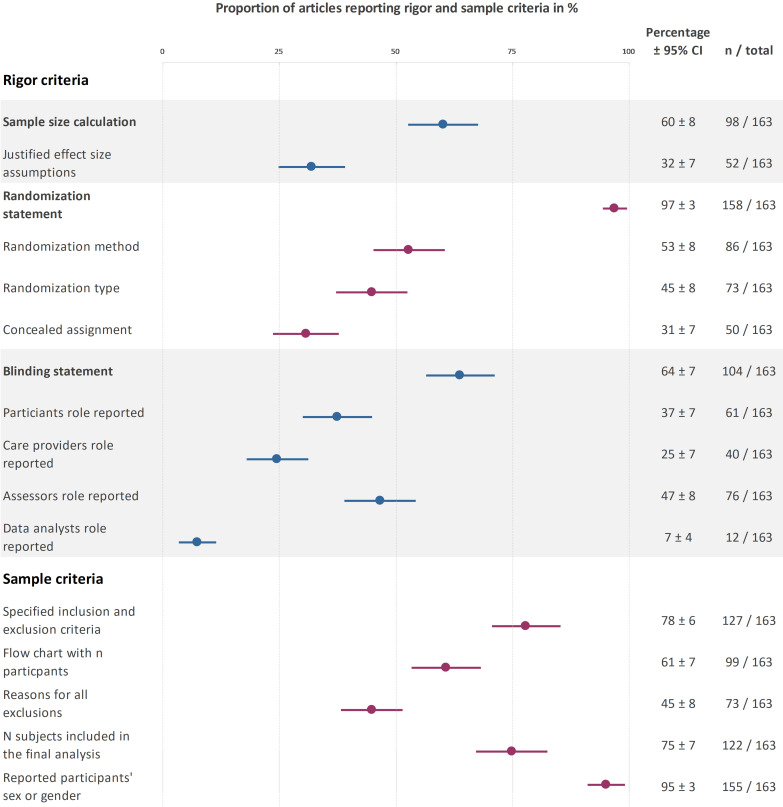
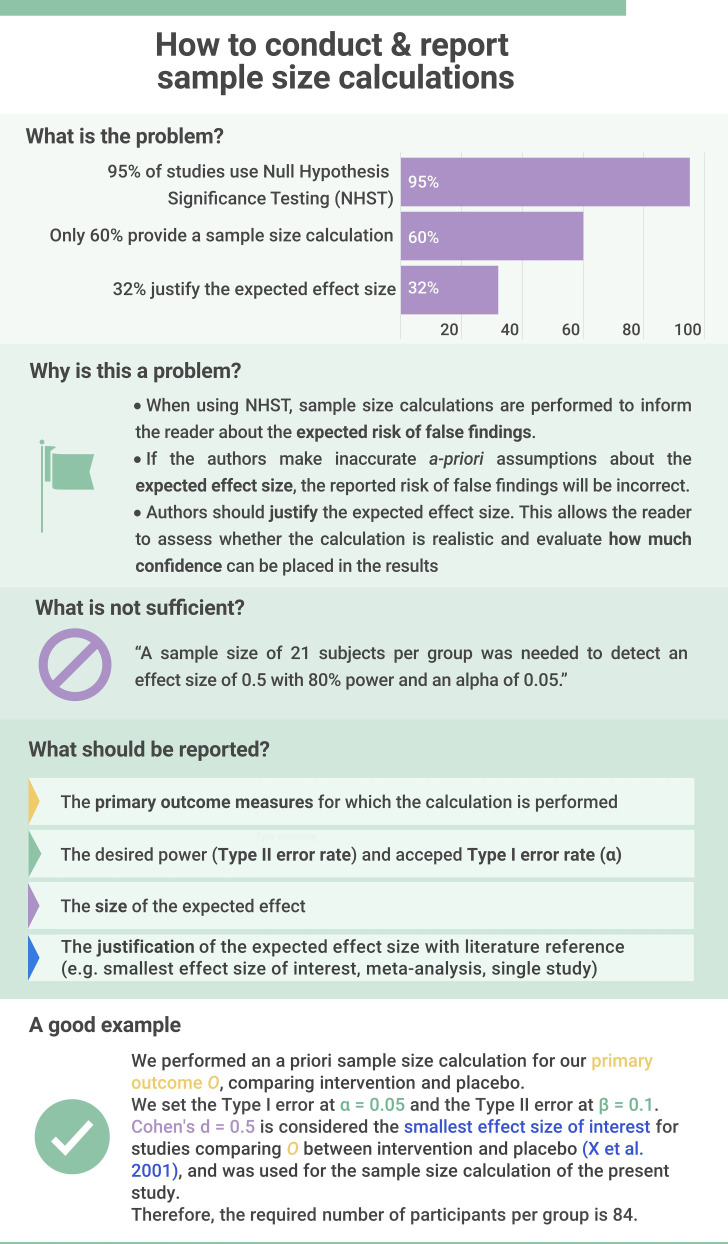
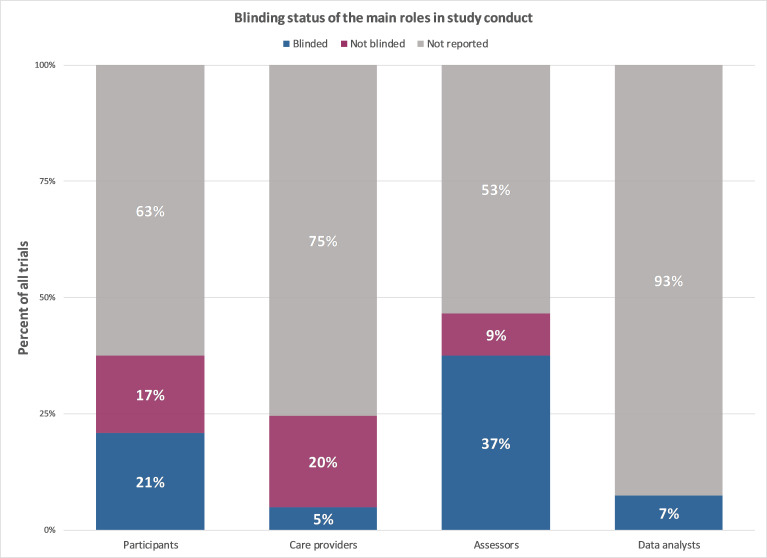
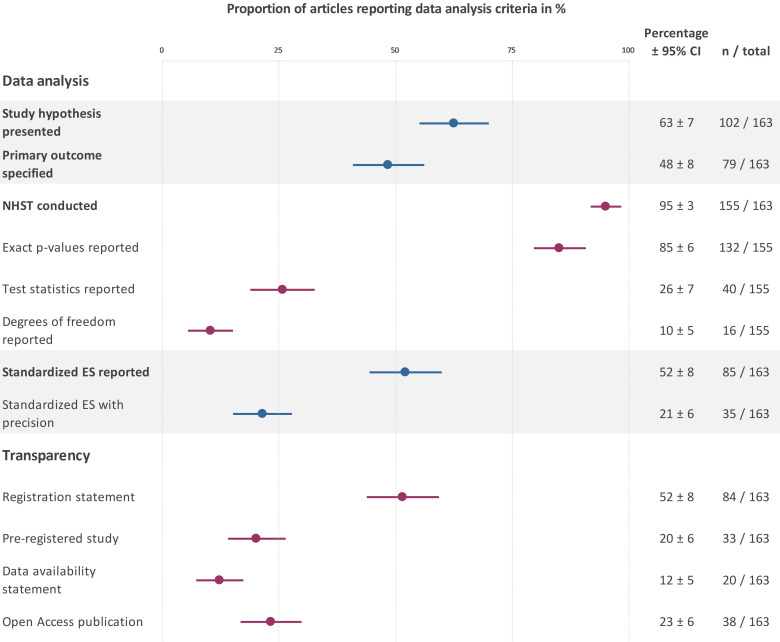
The sample included 163 clinical trials from 27 journals. While the majority of trials mentioned rigour criteria, essential details were often missing. Sixty per cent (95% confidence interval (CI) 53% to 68%) of trials reported sample size calculations, but only 32% (95% CI 25% to 39%) justified the expected effect size. Few trials indicated the blinding status of all main stakeholders (4%; 95% CI 1% to 7%). Only 18% (95% CI 12% to 24%) included information on randomisation type, method and concealed allocation. Most trials reported participants' sex/gender (95%; 95% CI 92% to 98%) and information on inclusion and exclusion criteria (78%; 95% CI 72% to 84%). Only 20% (95% CI 14% to 26%) of trials were pre-registered. No trials deposited data in open repositories.
These results will aid the sports medicine and orthopaedics community in developing tailored interventions to improve reporting. While authors typically mention blinding, randomisation and other factors, essential details are often missing. Greater acceptance of open science practices, like pre-registration and open data, is needed. As these practices have been widely encouraged, we discuss systemic interventions that may improve clinical trial reporting.
透明报告临床试验对于评估偏倚风险并将研究结果转化为临床实践至关重要。尽管现有研究表明缺陷很常见,但缺乏详细的实证和特定领域的数据。因此,本研究旨在检查运动医学和矫形外科临床试验中当前的临床试验报告和透明研究实践。
对矫形外科和运动医学临床试验报告质量和透明研究实践进行探索性元研究。
该样本包括在 9 个月内发表在运动医学和矫形外科顶级期刊前 25%的临床试验。
两名独立评审员评估了预先登记、开放数据以及与科学严谨性相关的标准,如随机化、盲法和样本量计算,以及研究样本和数据分析。
该样本包括来自 27 种期刊的 163 项临床试验。虽然大多数试验都提到了严谨性标准,但重要细节往往缺失。60%(95%置信区间(CI)53%至 68%)的试验报告了样本量计算,但只有 32%(95% CI 25%至 39%)证明了预期的效应量。很少有试验指明了所有主要利益相关者的盲法状态(4%;95% CI 1%至 7%)。只有 18%(95% CI 12%至 24%)的试验包括随机化类型、方法和隐藏分配的信息。大多数试验报告了参与者的性别(95%;95% CI 92%至 98%)和纳入和排除标准的信息(78%;95% CI 72%至 84%)。只有 20%(95% CI 14%至 26%)的试验预先登记。没有试验将数据存入开放存储库。
这些结果将帮助运动医学和矫形外科学会制定有针对性的干预措施来改善报告。尽管作者通常提到了盲法、随机化和其他因素,但重要细节往往缺失。需要更大程度地接受开放科学实践,如预先登记和开放数据。由于这些实践已被广泛鼓励,我们讨论了可能改善临床试验报告的系统干预措施。