Alvenfors Adam, Velic Mersiha, Marklund Bertil, Kylén Sven, Lingström Peter, Bernson Jenny
Department of Cariology, Institute of Odontology, Sahlgrenska Academy, University of Gothenburg, Gothenburg, Sweden.
Public Dental Service in Region Västra Götaland, Folktandvården Trädgårdsgatan, Skövde, Sweden.
BDJ Open. 2022 Aug 8;8(1):24. doi: 10.1038/s41405-022-00115-7.
The "difficult" patient is a well-known and potentially negative character in various care contexts.
This study aimed to generate a conceptual framework explaining the main concerns about "difficult" dental patients, and obtain a deeper understanding of their characteristics, how they affect the dental staff and how the staff think and act in order to manage these patients.
Ten interviews were conducted with professional dental caregivers, including dentists, dental hygienists, and dental nurses. The audio-recorded interviews were transcribed and analyzed in accordance with the principles of grounded theory.
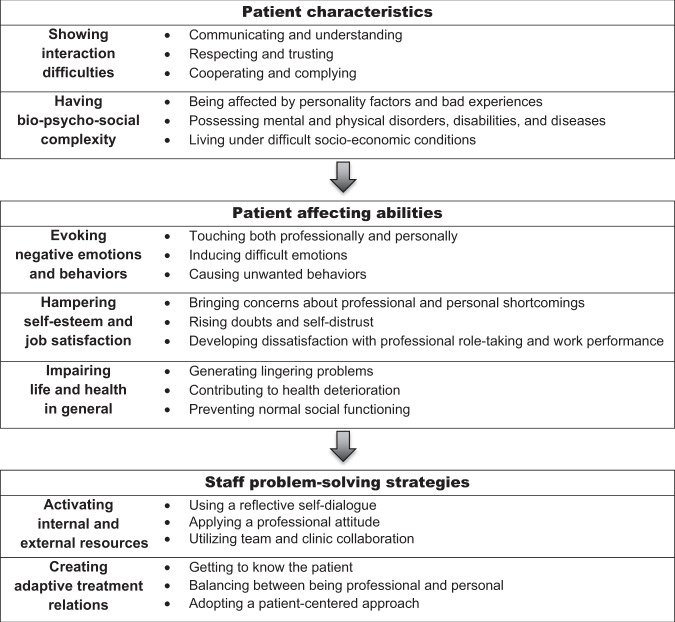
The main concern regarding "difficult" dental patients generated a framework of seven descriptive interrelated lower-level categories grounded in the data, subsumed in the core category "balancing subjective difficulties". The informants perceived the possession of "showing interaction difficulties" and "having bio-psycho-social complexity", as characteristic features of "difficult" patients, who could further adversely affect the dental staff by "evoking negative emotions and behaviors", "hampering self-esteem and job satisfaction", and "impairing life and health in general". To manage the dental care of these patients, the staff used strategies aimed at "activating internal and external resources" and "creating adaptive treatment relations" with patients.
The dental staff's meaning of the phenomenon of "difficult" dental patients points to specific characteristics, effects, and handling strategies. The core category captures the contradictory dynamics of characteristics and affects as these concepts seem interrelated to the caregivers' handling capacity. The dental staff's possibility of handling the main concern through balancing subjective difficulties depends on contextual conditions regarding time, to bring the patient and/or oneself at the center of attention. This indicates a need for further research regarding dental interactions and studies generalizing the outlook on "difficult" dental patients.
“难缠”患者在各种护理环境中都是一个广为人知且可能产生负面影响的角色。
本研究旨在构建一个概念框架,用以解释对“难缠”牙科患者的主要担忧,并更深入地了解他们的特征、他们如何影响牙科工作人员,以及工作人员为管理这些患者而进行的思考和采取的行动。
对包括牙医、口腔保健员和牙科护士在内的专业牙科护理人员进行了10次访谈。对录音访谈进行转录,并根据扎根理论的原则进行分析。
对“难缠”牙科患者的主要担忧产生了一个基于数据的由七个描述性相互关联的较低层次类别组成的框架,这些类别归入核心类别“平衡主观困难”。受访者认为,具有“表现出互动困难”和“具有生物心理社会复杂性”是“难缠”患者的特征,这些患者可能会通过“引发负面情绪和行为”、“损害自尊和工作满意度”以及“总体上损害生活和健康”进一步对牙科工作人员产生不利影响。为管理这些患者的牙科护理,工作人员采用了旨在“激活内部和外部资源”以及与患者“建立适应性治疗关系”的策略。
牙科工作人员对“难缠”牙科患者现象的理解指向了特定的特征、影响和处理策略。核心类别捕捉了特征和影响的矛盾动态,因为这些概念似乎与护理人员的处理能力相关。牙科工作人员通过平衡主观困难来处理主要担忧的可能性取决于时间等背景条件,即将患者和/或自己置于关注中心。这表明需要进一步研究牙科互动,并对“难缠”牙科患者的观点进行概括性研究。