Departments of Oral and Maxillofacial Surgery, The First Affiliated Hospital of Zhengzhou University, No. 1 Jianshedong Road, Erqi District, Zhengzhou, 450052, China.
Sci Rep. 2022 Aug 8;12(1):13538. doi: 10.1038/s41598-022-17898-2.
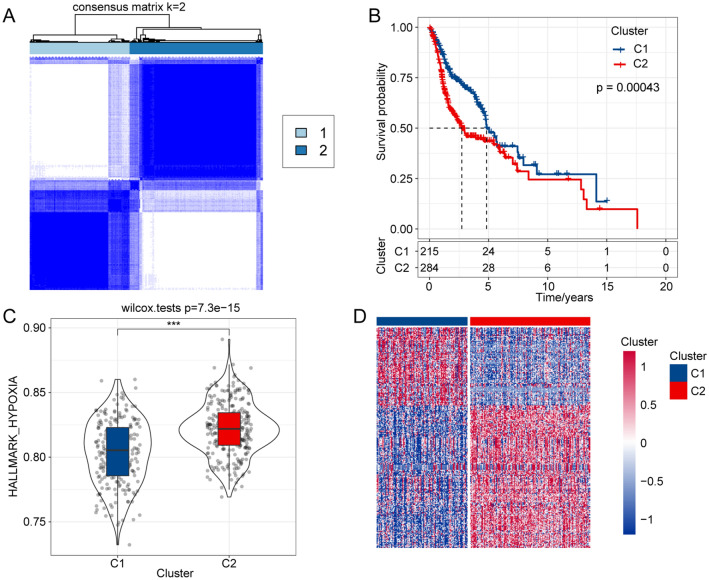
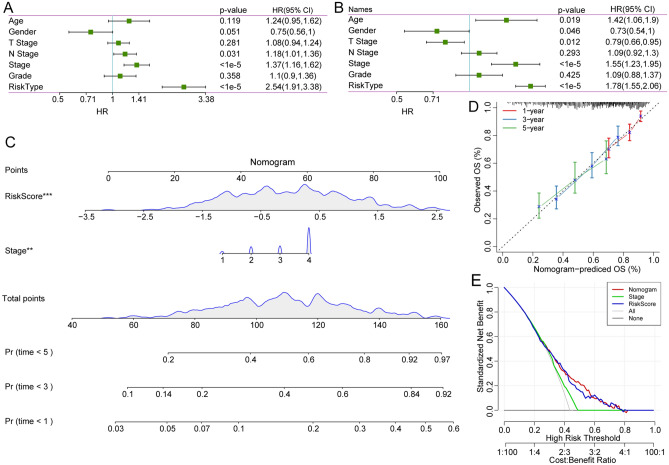
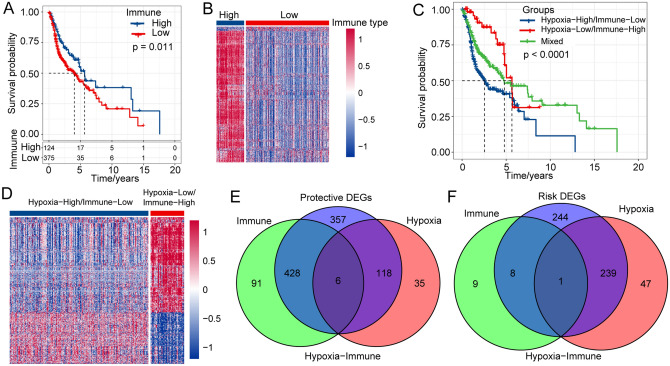
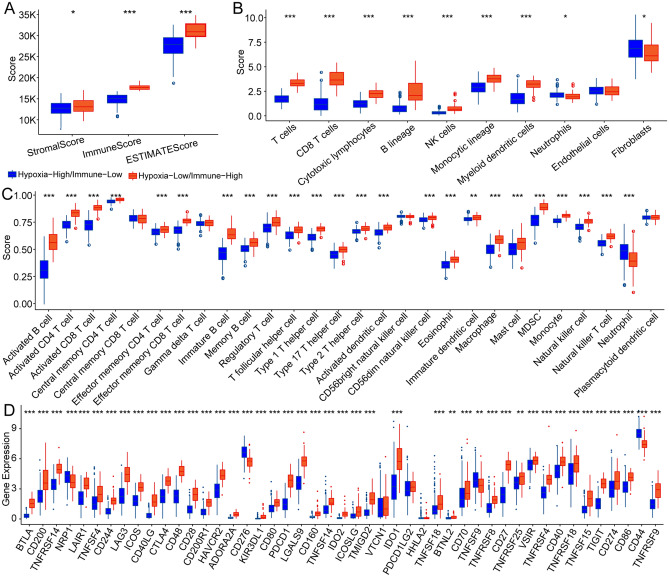
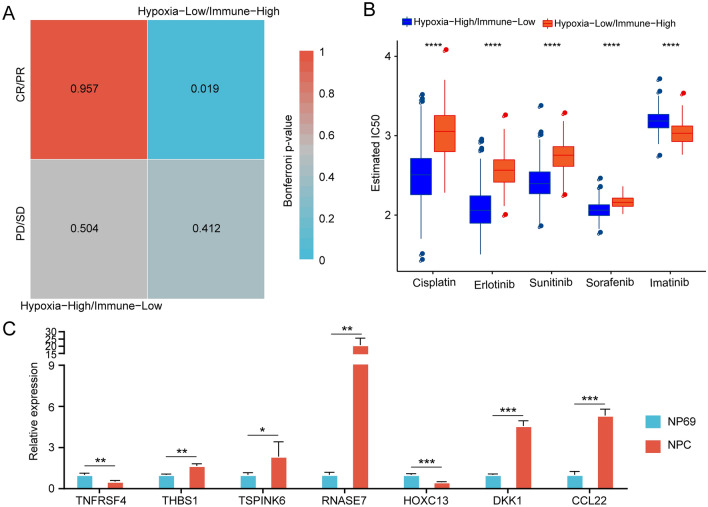
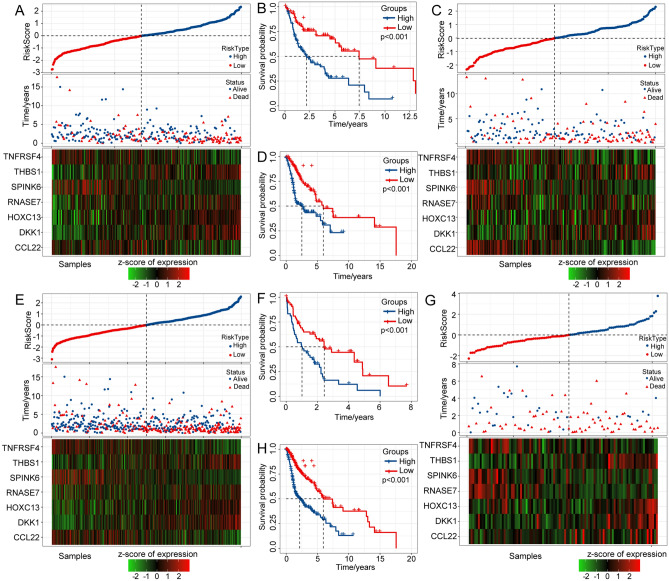
Head and neck squamous cell carcinoma (HNSCC) ranks as the sixth most common cancer worldwide and has a poor prognosis in the advanced stage. Increasing evidence has shown that hypoxia contributes to genetic alterations that have essential effects on the occurrence and progression of cancers. However, the exact roles hypoxia-related genes play in HNSCC remain unclear. In this study, we downloaded the mRNA expression profiles and clinical data of patients with HNSCC from The Cancer Genome Atlas and Gene Expression Omnibus. Two molecular subtypes were identified based on prognostic hypoxia-related genes using the ConsensusClusterPlus method. ESTIMATE was used to calculate the immune score of each patient. Kyoto Encyclopedia of Genes and Genomes and Gene Ontology were used for functional annotation. A prognostic risk model was generated by Cox regression and least absolute shrinkage and selection operator analysis. We identified two distinct molecular subtypes, cluster 1 and cluster 2, based on 200 hypoxia-related genes. Additionally, we identified three hypoxia-immune subgroups (hypoxia-high/immune-low, hypoxia-low/immune-high, and mixed subgroups). The hypoxia-high/immune-low group had the worst prognosis, while the hypoxia-low/immune-high group had the best prognosis. Patients in the hypoxia-low/immune-high group were more sensitive to anti-PD-L1 treatment and chemotherapy than those in the hypoxia-high/immune-low group. Furthermore, we constructed a prognostic risk model based on the differentially expressed genes between the hypoxia-immune subgroups. The survival analysis and time-dependent ROC analysis results demonstrated the good performance of the established 7-gene signature for predicting HNSCC prognosis. In conclusions, the constructed hypoxia-related model might serve as a promising biomarker for the diagnosis and prognosis of HNSCC, and it could predict immunotherapy and chemotherapy efficacy in HNSCC.
头颈部鳞状细胞癌(HNSCC)是全球第六大常见癌症,在晚期预后较差。越来越多的证据表明,缺氧会导致对癌症发生和发展有重要影响的遗传改变。然而,确切的缺氧相关基因在 HNSCC 中的作用仍不清楚。在这项研究中,我们从癌症基因组图谱和基因表达综合数据库下载了 HNSCC 患者的 mRNA 表达谱和临床数据。使用 ConsensusClusterPlus 方法,基于预后相关的缺氧基因识别出两种分子亚型。使用 ESTIMATE 计算每个患者的免疫评分。京都基因与基因组百科全书和基因本体论用于功能注释。通过 Cox 回归和最小绝对收缩和选择算子分析生成预后风险模型。我们根据 200 个缺氧相关基因确定了两种不同的分子亚型,簇 1 和簇 2。此外,我们还确定了三个缺氧免疫亚组(缺氧高/免疫低、缺氧低/免疫高和混合亚组)。缺氧高/免疫低组的预后最差,而缺氧低/免疫高组的预后最好。与缺氧高/免疫低组相比,缺氧低/免疫高组的患者对抗 PD-L1 治疗和化疗更敏感。此外,我们还基于缺氧免疫亚组之间的差异表达基因构建了一个预后风险模型。生存分析和时间依赖性 ROC 分析结果表明,所建立的 7 基因特征在预测 HNSCC 预后方面具有良好的性能。总之,构建的缺氧相关模型可能成为 HNSCC 诊断和预后的有前途的生物标志物,并可预测 HNSCC 患者的免疫治疗和化疗疗效。