Service of Forensic Psychiatry CURML, Geneva University Hospitals, Geneva, Switzerland.
Ross University School of Medicine, Miramar, FL, USA.
Medicine (Baltimore). 2022 Aug 5;101(31):e29633. doi: 10.1097/MD.0000000000029633.
Our objective is to provide awareness about psychotic vulnerability in patients infected with SARS-CoV-2 and to better understand the role of steroid withdrawal in manic episodes, especially with its common usage in respiratory disease caused by SARS-CoV-2.
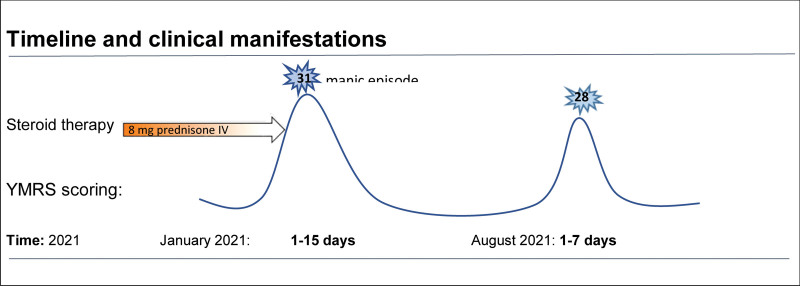
We present the case of a patient who was hospitalized twice after discontinuing steroid therapy for SARS-CoV-2 infection and presented with a manic episode despite not having a psychiatric history.
The patient tested positive on a polymerase chain reaction test for SARS-CoV-2 and developed pneumonia. Other organic differential diagnoses such as encephalitis were also investigated and excluded. Manic episodes were diagnosed according to DSM-V criteria. Subsequently, the patient was diagnosed with type I bipolar disorder.
According to the protocols, supplemental oxygen therapy, prophylactic enoxaparin and intravenous (IV) steroids were administered. Steroid dosage was gradually reduced under supervision. During the acute mania, antipsychotics and benzodiazepines were administered.
After discharge, the patient was admitted to the psychiatric consultation service. He first received mood stabilizer therapy and then received supportive psychotherapy.
Psychotic symptoms commonly occur after the discontinuation of high-dose steroid therapy; however, controlled tapering may prevent these side effects. Only a few cases have reported concomitant SARS-CoV-2 infection and manic episodes, often with an apparent relationship with steroid withdrawal syndrome. In this case, we considered psychotic vulnerability a condition that is often underestimated. In consideration of the SARS-CoV-2 pandemic, the case may represent an underlying trigger for psychotic decompensation, which, in concert with neuroinflammation, may induce a manic episode.
我们的目的是提高人们对于感染 SARS-CoV-2 后出现精神病性易感性的认识,并更好地理解类固醇停药在躁狂发作中的作用,特别是考虑到其在由 SARS-CoV-2 引起的呼吸道疾病中的常规应用。
我们报告了一例患者,该患者因 SARS-CoV-2 感染停止类固醇治疗后住院 2 次,并出现躁狂发作,尽管其无精神病史。
该患者的 SARS-CoV-2 聚合酶链反应检测结果呈阳性,并发展为肺炎。还对其他可能的器质性鉴别诊断(如脑炎)进行了研究并排除。根据 DSM-V 标准诊断为躁狂发作。随后,该患者被诊断为 I 型双相情感障碍。
根据方案,给予补充氧气治疗、预防性依诺肝素和静脉注射(IV)类固醇。在监督下逐渐减少类固醇剂量。在急性躁狂期间,给予抗精神病药和苯二氮䓬类药物。
出院后,该患者被转至精神科会诊服务。他首先接受了心境稳定剂治疗,然后接受了支持性心理治疗。
大剂量类固醇治疗停药后常出现精神病性症状;然而,逐渐减少类固醇剂量可能预防这些副作用。仅有少数病例报告同时发生 SARS-CoV-2 感染和躁狂发作,且常与类固醇停药综合征有明显关系。在本例中,我们认为精神病性易感性是一种经常被低估的情况。考虑到 SARS-CoV-2 大流行,该病例可能代表了精神病性失代偿的潜在触发因素,这与神经炎症一起可能导致躁狂发作。