Department of Medicine, All India Institute of Medical Sciences, New Delhi, India.
Department of Pulmonary Medicine, Postgraduate Institute of Medical Education & Research, Chandigarh, India.
Indian J Med Res. 2022 Mar;155(3&4):380-386. doi: 10.4103/ijmr.ijmr_2221_21.
BACKGROUND & OBJECTIVES: Several studies have been conducted globally to assess the impact of usage of mobile phones on quality and duration of sleep as also on day time sleepiness. The objective of the present study was to assess the effect of mobile phone usage on the quality and composition of sleep in a sample from Indian population.
The study was conducted at two tertiary care hospitals in north India from July 2014 to September 2019. A total of 566 participants were recruited in this study from both the centres. Sleep quality was assessed with the help of the Pittsburgh Sleep Quality Index (PSQI) questionnaire. Subsequently, actigraphy was done in 96 participants and polysomnography in 95 participants.
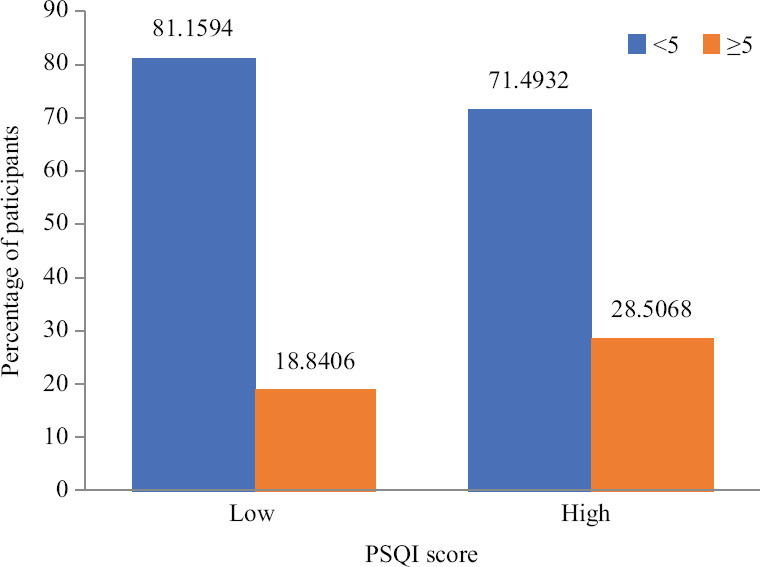
Of the 566 participants, 128 (22.61%) had PSQI ≥5, reflecting poor sleep quality. A higher use of mobile phone was significantly associated with a poor sleep quality as a component of PSQI questionnaire (P=0.01) and higher overall PSQI score (P=0.01). The latency from sleep onset to N2 and N3 sleep stages was significantly shorter in participants having a higher mobile phone usage as compared to those with a lower usage [Median (range): 13.5 min (1.5-109) vs. 6.5 min (0-89); P=0.02] and [Median (range): 49 min (8.5-220.5) vs. 28.75 min (0-141); P=0.03], respectively.
INTERPRETATION & CONCLUSIONS: This study focused on the maladaptive changes brought on by mobile phone usage on sleep. More studies with larger sample sizes need to be done that may serve to confirm the hypothesis generating findings of our study.
全球已有多项研究评估了手机使用对睡眠质量和时长以及日间嗜睡的影响。本研究旨在评估手机使用对印度人群睡眠质量和组成的影响。
本研究于 2014 年 7 月至 2019 年 9 月在印度北部的两家三级护理医院进行。从这两个中心共招募了 566 名参与者。使用匹兹堡睡眠质量指数(PSQI)问卷评估睡眠质量。随后,对 96 名参与者进行了活动记录仪检查,对 95 名参与者进行了多导睡眠图检查。
在 566 名参与者中,128 名(22.61%)的 PSQI≥5,表明睡眠质量较差。手机使用率较高与 PSQI 问卷中的睡眠质量较差(P=0.01)和总体 PSQI 评分较高(P=0.01)显著相关。与手机使用率较低的参与者相比,手机使用率较高的参与者从睡眠开始到 N2 和 N3 睡眠阶段的潜伏期明显更短[中位数(范围):13.5 分钟(1.5-109)与 6.5 分钟(0-89);P=0.02]和[N3 睡眠阶段:49 分钟(8.5-220.5)与 28.75 分钟(0-141);P=0.03]。
本研究重点关注手机使用对睡眠带来的不良适应性变化。需要进行更多具有更大样本量的研究,以证实我们研究结果产生的假设。