Department of Microbiology and Immunology, Louisiana State University Health Sciences Center- Shreveport, Shreveport, Louisiana, USA.
BIO5 Institute, University of Arizonagrid.134563.6, Tucson, Arizona, USA.
mBio. 2022 Aug 30;13(4):e0104222. doi: 10.1128/mbio.01042-22. Epub 2022 Aug 10.
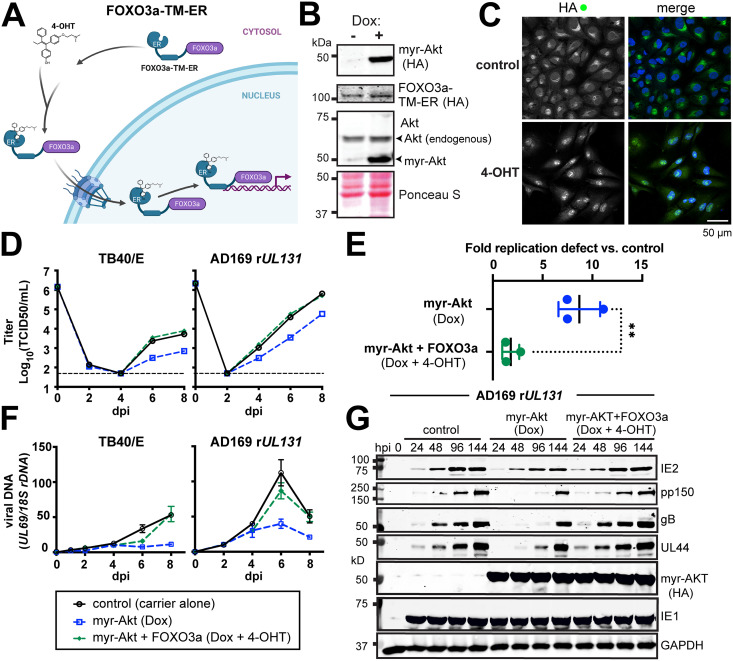
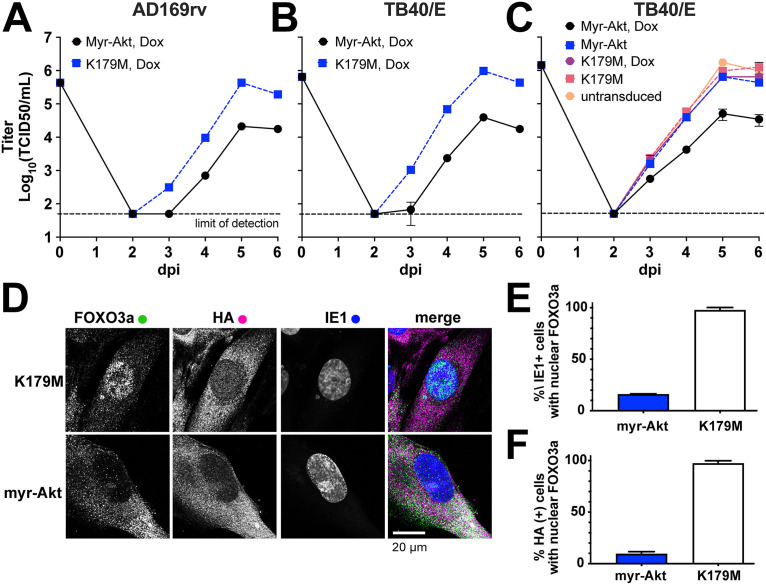
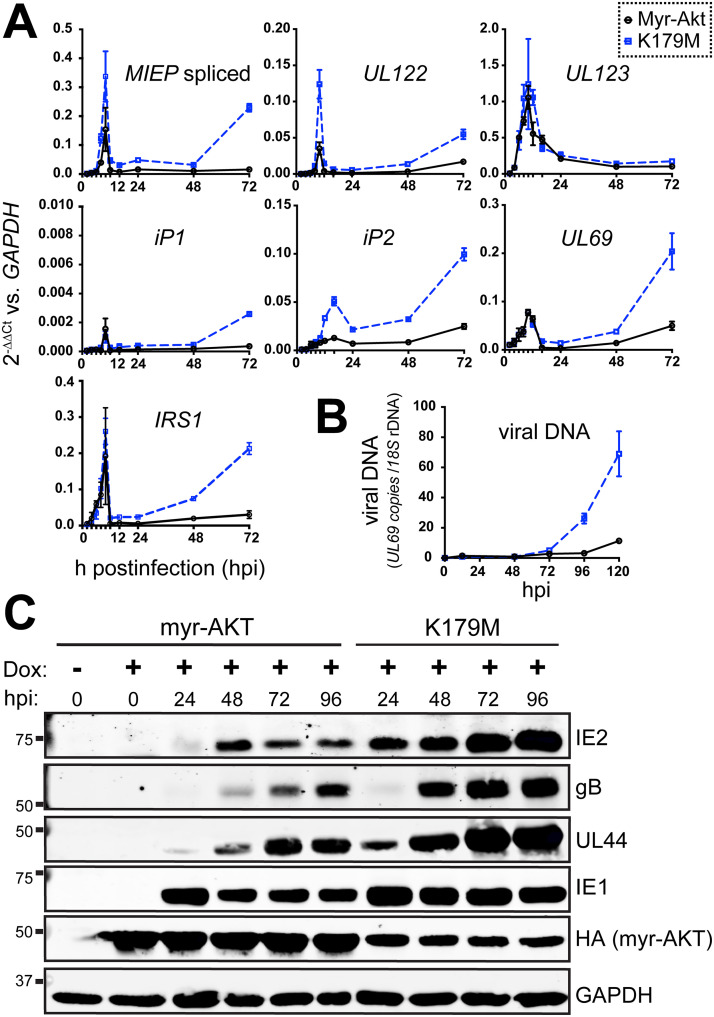
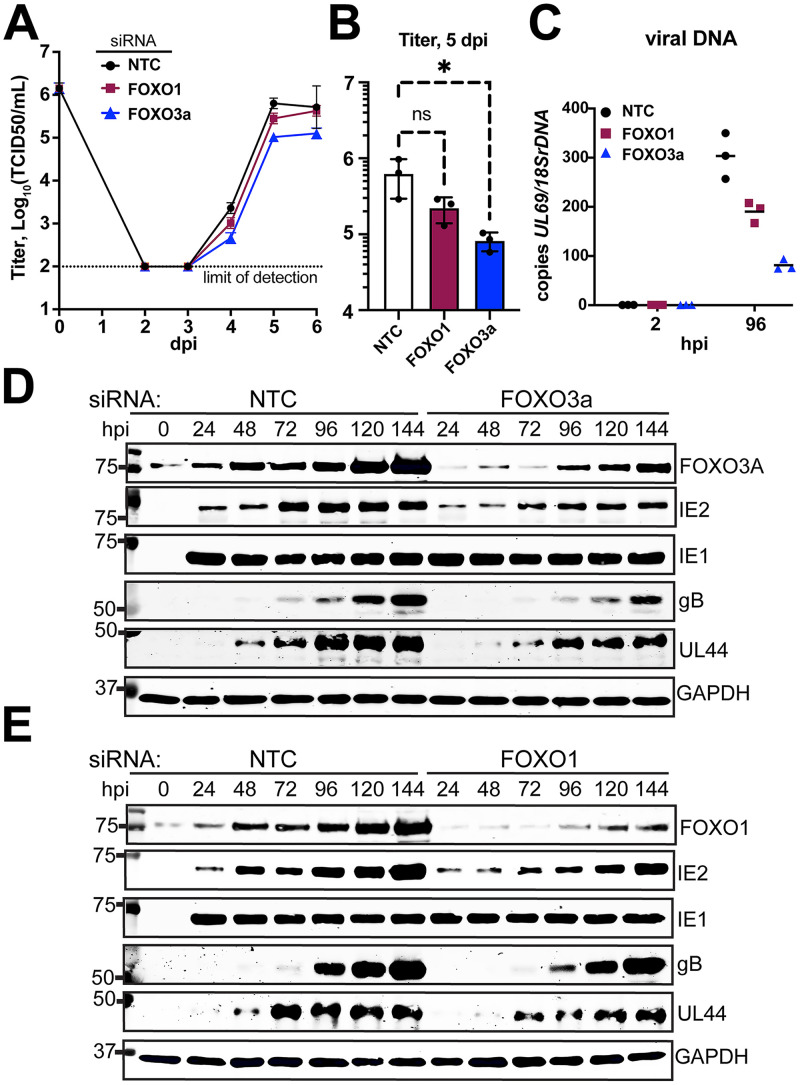
The protein kinase Akt broadly impacts many cellular processes, including mRNA translation, metabolism, apoptosis, and stress responses. Inhibition of phosphatidylinositol 3-kinase (PI3K), a lipid kinase pivotal to Akt activation, triggers various herpesviruses to reactivate from latency. Hence, decreased Akt activity may promote lytic replication. Here, we show that Akt accumulates in an inactive form during human cytomegalovirus (HCMV) infection of permissive fibroblasts, as indicated by hypophosphorylation of sites that activate Akt, decreased phosphorylation of PRAS40, and pronounced nuclear localization of FoxO3a, a substrate that remains cytoplasmic when Akt is active. HCMV strongly activates mTORC1 during lytic infection, suggesting a potential mechanism for Akt inactivation, since mTORC1 negatively regulates PI3K. However, we were surprised to observe that constitutive Akt activity, provided by expression of Akt fused to a myristoylation signal (myr-Akt), caused a 1-log decrease in viral replication, accompanied by defects in viral DNA synthesis and late gene expression. These results indicated that Akt inactivation is required for efficient viral replication, prompting us to address which Akt substrates underpin this requirement. Interestingly, we found that short interfering RNA knockdown of FoxO3a, but not FoxO1, phenocopied the defects caused by myr-Akt, corroborating a role for FoxO3a. Accordingly, a chimeric FoxO3a-estrogen receptor fusion protein, in which nuclear localization is regulated by 4-hydroxytamoxifen instead of Akt, reversed the replication defects caused by myr-Akt. Collectively, our results reveal a role for FoxO transcription factors in HCMV lytic replication and argue that this single class of Akt substrates underpins the requirement for Akt inactivation during productive infection. Evidence from diverse herpesvirus infection models suggests that the PI3K/Akt signaling pathway suppresses reactivation from latency and that inactivation of the pathway stimulates viral lytic replication. Here, we show that Akt accumulates in an inactive state during HCMV infection of lytically permissive cells while the presence of constitutive Akt activity causes substantial viral replication defects. Although Akt phosphorylates a diverse array of cellular substrates, we identify an important role for the Forkhead box class O transcription factors. Our findings show that when FoxO3a nuclear localization is decoupled from its negative regulation by Akt, the viral replication defects observed in the presence of constitutively active Akt are reversed. Collectively, our results reveal that HCMV inactivates Akt to promote the nuclear localization of FoxO transcription factors, which strongly implies that FoxOs play critical roles in transactivating cellular and/or viral genes during infection.
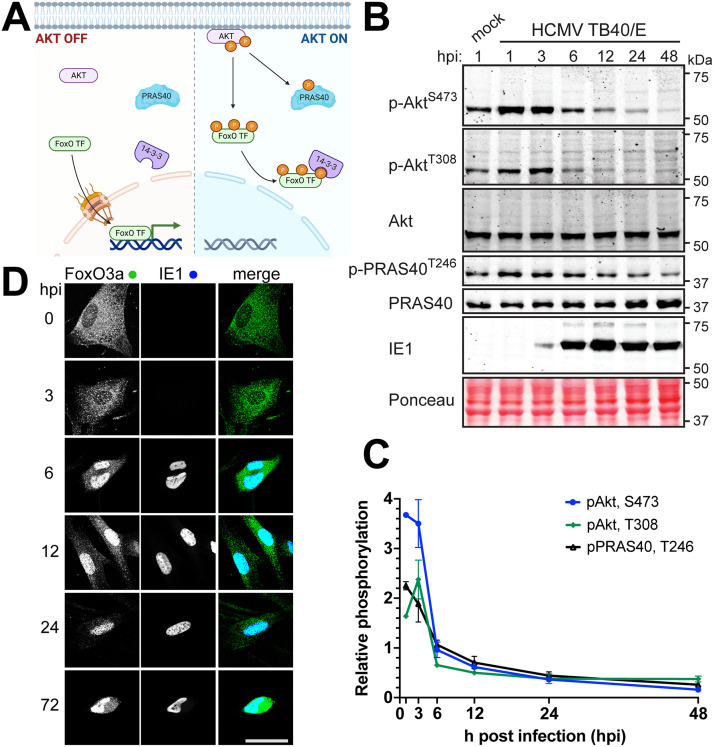
蛋白激酶 Akt 广泛影响多种细胞过程,包括 mRNA 翻译、代谢、细胞凋亡和应激反应。磷脂酰肌醇 3-激酶(PI3K)的抑制作用,这种脂质激酶对 Akt 的激活至关重要,会触发各种疱疹病毒从潜伏状态重新激活。因此,Akt 活性的降低可能会促进裂解复制。在这里,我们表明,在人巨细胞病毒(HCMV)感染允许的成纤维细胞时,Akt 以非磷酸化形式积累,表现为 Akt 激活部位的低磷酸化、PRAS40 磷酸化减少以及 FoxO3a 的明显核定位,FoxO3a 是一种在 Akt 活跃时仍留在细胞质中的底物。HCMV 在裂解感染过程中强烈激活 mTORC1,这表明 Akt 失活的潜在机制,因为 mTORC1 负调节 PI3K。然而,我们惊讶地观察到,由 Akt 与豆蔻酰化信号(myr-Akt)融合表达提供的组成型 Akt 活性导致病毒复制减少 1 个对数级,同时伴有病毒 DNA 合成和晚期基因表达缺陷。这些结果表明,Akt 失活是病毒复制所必需的,促使我们解决哪些 Akt 底物支持这一需求。有趣的是,我们发现 FoxO3a 的短发夹 RNA 敲低,但不是 FoxO1,可模拟 myr-Akt 引起的缺陷,这证实了 FoxO3a 的作用。相应地,FoxO3a-雌激素受体嵌合蛋白,其中核定位由 4-羟基他莫昔芬而不是 Akt 调节,逆转了 myr-Akt 引起的复制缺陷。总的来说,我们的结果揭示了 FoxO 转录因子在 HCMV 裂解复制中的作用,并认为这一类 Akt 底物是在产生活性感染期间 Akt 失活的基础。来自不同疱疹病毒感染模型的证据表明,PI3K/Akt 信号通路抑制潜伏状态的重新激活,而该通路的失活刺激病毒裂解复制。在这里,我们表明,在 HCMV 感染允许裂解的细胞时,Akt 积累为非活性状态,而组成型 Akt 活性的存在导致病毒复制缺陷。尽管 Akt 磷酸化多种细胞底物,但我们确定了叉头盒 O 转录因子的重要作用。我们的发现表明,当 FoxO3a 的核定位与其被 Akt 负调节脱钩时,在存在组成型活性 Akt 时观察到的病毒复制缺陷得到逆转。总的来说,我们的结果表明,HCMV 使 Akt 失活以促进 FoxO 转录因子的核定位,这强烈暗示 FoxO 在感染过程中对激活细胞和/或病毒基因起着关键作用。