Department of Medicine, Division of Hematology and Medical Oncology, Icahn School of Medicine at Mount Sinai/Tisch Cancer Institute, New York, New York, USA.
Frank H. Netter School of Medicine, Quinnipiac University, Hamden, Connecticut, USA.
Cancer. 2022 Oct;128(20):3602-3609. doi: 10.1002/cncr.34426. Epub 2022 Aug 10.
The relationship between Ki67 assessed by immunohistochemistry (IHC) and the Oncotype DX Recurrence Score (RS) is unclear. The objective of this study was to determine the correlation between the 21-gene RS and IHC-measured Ki67 with the prognostic classification groups recommended by the International Ki67 Working Group (IKWG).
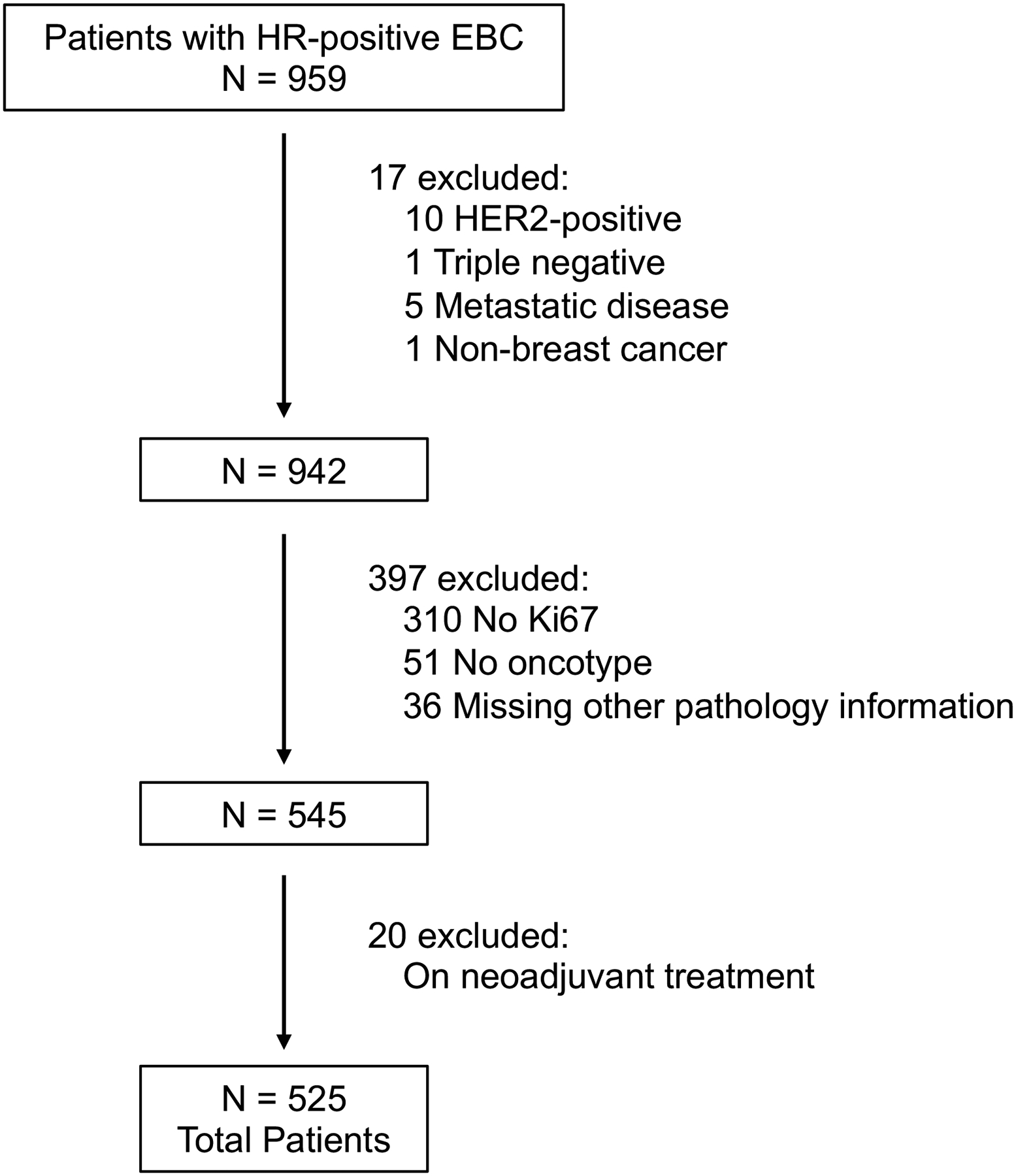
The authors performed a retrospective chart review of women who had hormone receptor (HR)-positive, human epidermal growth factor receptor 2-negative early breast cancer with zero to three positive lymph nodes and both Ki67 and the 21-gene RS performed at their institution from 2013 to 2021. Patients were categorized into low (≤5%), intermediate (6%-29%), and high Ki67 groups (≥30%) according to IKWG recommendations. Overall agreement and risk-stratified agreement between Ki67 and RS were assessed with the proportion of agreement and the κ statistic.
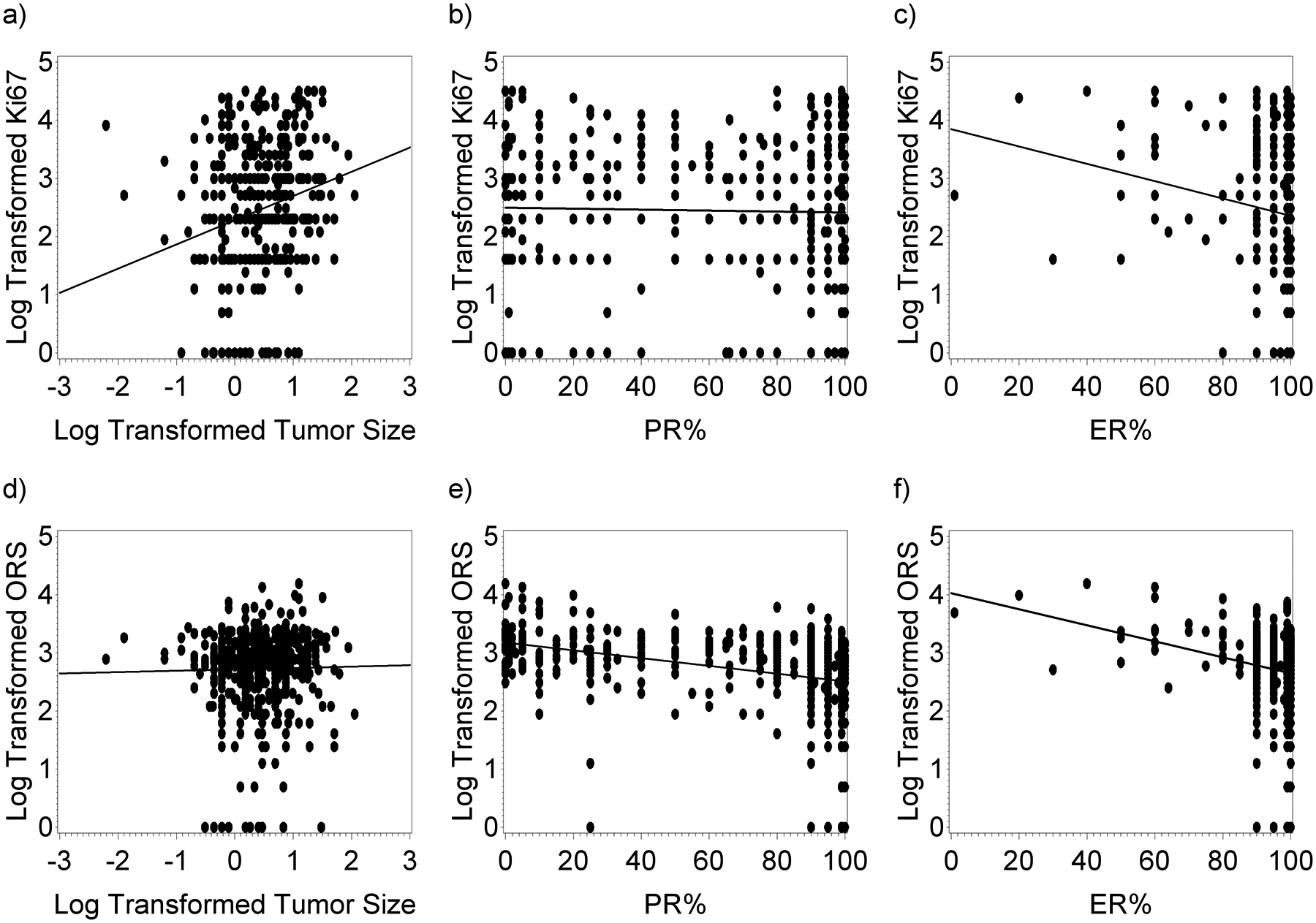
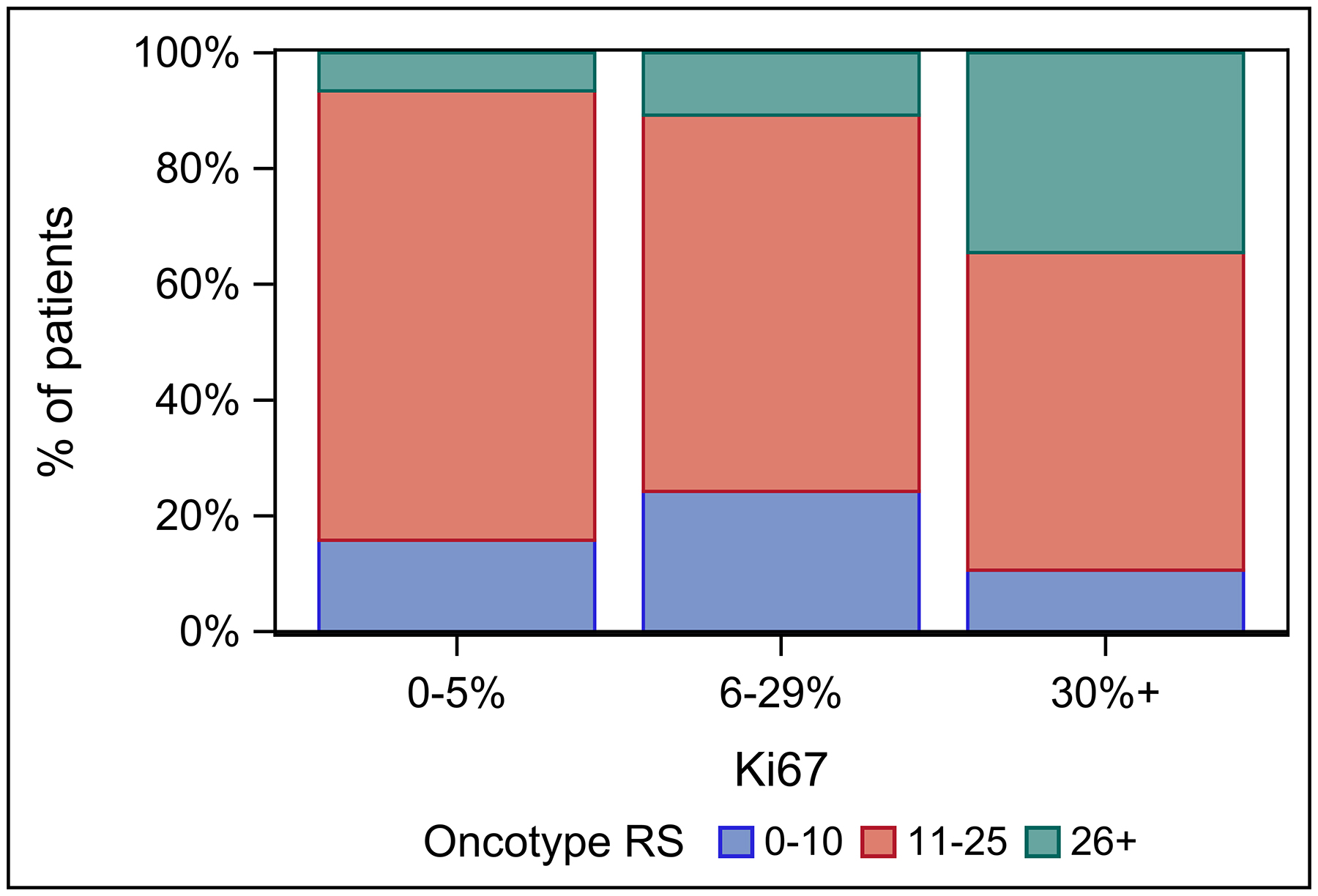
The study included 525 patients with HR-positive breast cancer. Among the 49% of patients with intermediate Ki67 values of 6%-29%, the distribution of low (0-10), intermediate (11-25), and high RS (26-100) was 19%, 66%, and 15%, respectively. There was slight agreement (κ = 0.01-0.20) between Ki67 and RS (κ = 0.027) in the overall population, although this was not significant (p = .1985). There was fair agreement (κ = 0.21-0.40) between high Ki67 and RS values (κ = 0.280; p < .0001). A higher progesterone receptor percentage was associated with lower RS values (p > .0001) but not lower Ki67 values. A positive nodal status and a larger tumor size were associated with higher Ki67 values (p = .0059 and p < .0001) but not with RS.
In this group of patients selected to have a 21-gene RS, there was no significant correlation between Ki67 and RS in the overall population, and there was fair agreement between high Ki67 and high RS values.
In patients with early-stage, hormone receptor-positive breast cancer, decisions on adjuvant chemotherapy are based on certain biological features of the cancer and genomic assays such as the Oncotype DX Recurrence Score (RS). The goal of this study was to determine the correlation between Ki67, a marker of proliferation, and the Oncotype DX RS, a 21-gene assay demonstrated to be predictive of an adjuvant chemotherapy benefit in patients with early-stage breast cancer. In 525 patients, the authors did not find a significant correlation between Ki67 and RS.
免疫组织化学(IHC)评估的 Ki67 与 Oncotype DX 复发评分(RS)之间的关系尚不清楚。本研究的目的是确定 21 基因 RS 与 IHC 测量的 Ki67 与国际 Ki67 工作组(IKWG)推荐的预后分类组之间的相关性。
作者对 2013 年至 2021 年间在其机构进行的激素受体(HR)阳性、人表皮生长因子受体 2 阴性、淋巴结转移 0-3 个阳性且均进行 Ki67 和 21 基因 RS 检测的 HR 阳性、HER2 阴性早期乳腺癌女性进行了回顾性图表审查。根据 IKWG 建议,患者被分为低(≤5%)、中(6%-29%)和高 Ki67 组(≥30%)。通过一致性比例和κ统计量评估 Ki67 和 RS 之间的总体一致性和风险分层一致性。
该研究纳入了 525 例 HR 阳性乳腺癌患者。在中间 Ki67 值为 6%-29%的 49%患者中,低(0-10)、中(11-25)和高 RS(26-100)的分布分别为 19%、66%和 15%。总体而言,Ki67 和 RS 之间存在轻微的一致性(κ=0.01-0.20;κ=0.027),但差异无统计学意义(p=0.1985)。高 Ki67 与 RS 值之间存在适度的一致性(κ=0.21-0.40;κ=0.280;p<0.0001)。较高的孕激素受体百分比与较低的 RS 值相关(p>0.0001),但与 Ki67 值无关。阳性淋巴结状态和较大的肿瘤大小与 Ki67 值较高相关(p=0.0059 和 p<0.0001),但与 RS 无关。
在本研究中,选择进行 21 基因 RS 检测的这组患者中,Ki67 和 RS 之间没有显著的相关性,而高 Ki67 和高 RS 值之间存在适度的一致性。
在患有早期激素受体阳性乳腺癌的患者中,辅助化疗的决策基于癌症的某些生物学特征和基因组检测,如 Oncotype DX 复发评分(RS)。本研究的目的是确定增殖标志物 Ki67 与 Oncotype DX RS 之间的相关性,该 RS 是一种已被证明可预测早期乳腺癌患者辅助化疗获益的 21 基因检测。在 525 例患者中,作者未发现 Ki67 和 RS 之间存在显著相关性。