Li Ka Shing Knowledge Institute, St Michael's Hospital, Unity Health Toronto, Toronto, Ontario, Canada.
David R. Cheriton School of Computer Science, University of Waterloo, Waterloo, Ontario, Canada.
BMJ Open. 2022 Jun 3;12(6):e045115. doi: 10.1136/bmjopen-2020-045115.
The COVID-19 pandemic has stimulated growing research on treatment options. We aim to provide an overview of the characteristics of studies evaluating COVID-19 treatment.
Rapid scoping review DATA SOURCES: Medline, Embase and biorxiv/medrxiv from inception to 15 May 2021.
Hospital and community care.
COVID-19 patients of all ages.
COVID-19 treatment.
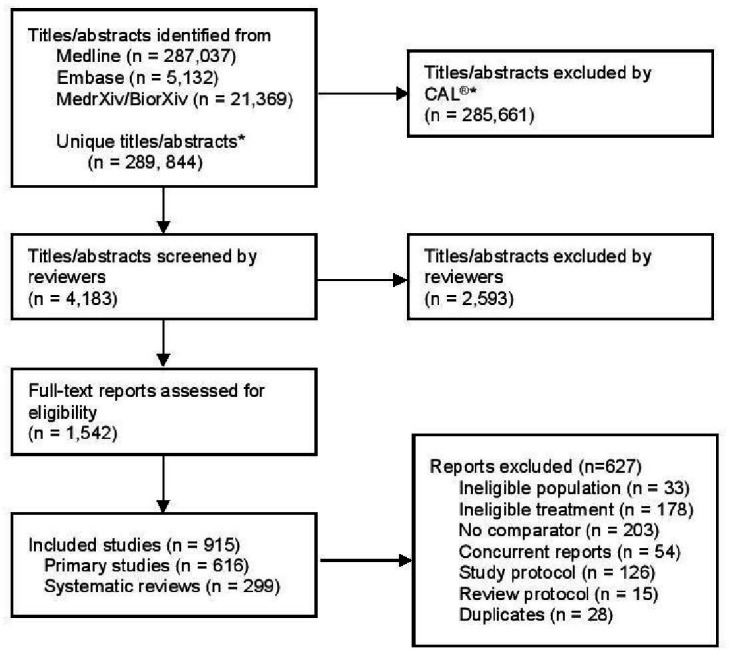
The literature search identified 616 relevant primary studies of which 188 were randomised controlled trials and 299 relevant evidence syntheses. The studies and evidence syntheses were conducted in 51 and 39 countries, respectively.Most studies enrolled patients admitted to acute care hospitals (84%), included on average 169 participants, with an average age of 60 years, study duration of 28 days, number of effect outcomes of four and number of harm outcomes of one. The most common primary outcome was death (32%).The included studies evaluated 214 treatment options. The most common treatments were tocilizumab (11%), hydroxychloroquine (9%) and convalescent plasma (7%). The most common therapeutic categories were non-steroidal immunosuppressants (18%), steroids (15%) and antivirals (14%). The most common therapeutic categories involving multiple drugs were antimalarials/antibiotics (16%), steroids/non-steroidal immunosuppressants (9%) and antimalarials/antivirals/antivirals (7%). The most common treatments evaluated in systematic reviews were hydroxychloroquine (11%), remdesivir (8%), tocilizumab (7%) and steroids (7%).The evaluated treatment was in favour 50% and 36% of the evaluations, according to the conclusion of the authors of primary studies and evidence syntheses, respectively.
This rapid scoping review characterised a growing body of comparative-effectiveness primary studies and evidence syntheses. The results suggest future studies should focus on children, elderly ≥65 years of age, patients with mild symptoms, outpatient treatment, multimechanism therapies, harms and active comparators. The results also suggest that future living evidence synthesis and network meta-analysis would provide additional information for decision-makers on managing COVID-19.
COVID-19 大流行刺激了对治疗选择的研究不断增加。我们旨在提供 COVID-19 治疗评估研究特征的概述。
快速范围界定审查。
从开始到 2021 年 5 月 15 日,在 Medline、Embase 和 biorxiv/medrxiv 上进行检索。
医院和社区护理。
所有年龄段的 COVID-19 患者。
COVID-19 治疗。
文献检索确定了 616 项相关的主要研究,其中 188 项为随机对照试验,299 项为相关证据综合。这些研究和证据综合分别在 51 个和 39 个国家进行。大多数研究纳入了急性护理医院收治的患者(84%),平均纳入 169 名参与者,平均年龄为 60 岁,研究持续时间为 28 天,有效结局数为 4 个,不良结局数为 1 个。最常见的主要结局是死亡(32%)。纳入的研究评估了 214 种治疗方法。最常见的治疗方法是托珠单抗(11%)、羟氯喹(9%)和恢复期血浆(7%)。最常见的治疗类别是非甾体类免疫抑制剂(18%)、类固醇(15%)和抗病毒药(14%)。最常见的涉及多种药物的治疗类别是抗疟药/抗生素(16%)、类固醇/非甾体类免疫抑制剂(9%)和抗疟药/抗病毒药/抗病毒药(7%)。在系统评价中评估最多的治疗方法是羟氯喹(11%)、瑞德西韦(8%)、托珠单抗(7%)和类固醇(7%)。
根据主要研究和证据综合作者的结论,评估的治疗方法分别有 50%和 36%的评估结果是有利的。
本快速范围界定审查描述了越来越多的比较疗效主要研究和证据综合。结果表明,未来的研究应侧重于儿童、≥65 岁的老年人、轻症患者、门诊治疗、多机制治疗、危害和活性对照。结果还表明,未来的实时证据综合和网络荟萃分析将为决策者管理 COVID-19 提供更多信息。