Department of Biochemical Engineering, University College London, Gower Street, London WC1E 6BT, United Kingdom.
Medicines & Healthcare Products Regulatory Agency, National Institute for Biological Standards and Control (NIBSC), Blanche Lane, South Mimms, Potters Bar, Hertfordshire EN6 3QG, United Kingdom.
Mol Pharm. 2022 Sep 5;19(9):3242-3255. doi: 10.1021/acs.molpharmaceut.2c00398. Epub 2022 Aug 10.
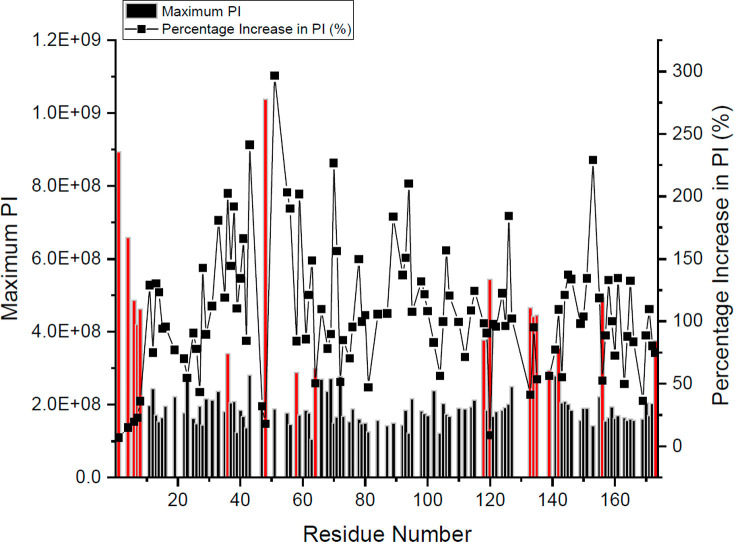
Structure-function relationships in proteins refer to a trade-off between stability and bioactivity, molded by evolution of the molecule. Identifying which protein amino acid residues jeopardize global or local stability for the benefit of bioactivity would reveal residues pivotal to this structure-function trade-off. Here, we use N-H heteronuclear single quantum coherence (HSQC) nuclear magnetic resonance (NMR) spectroscopy to probe the microenvironment and dynamics of residues in granulocyte colony-stimulating factor (G-CSF) through thermal perturbation. From this analysis, we identified four residues (G4, A6, T133, and Q134) that we classed as significant to global stability, given that they all experienced large environmental and dynamic changes and were closely correlated to each other in their NMR characteristics. Additionally, we observe that roughly four structural clusters are subject to localized conformational changes or partial unfolding prior to global unfolding at higher temperature. Combining NMR observables with structure relaxation methods reveals that these structural clusters concentrate around loop AB (binding site III inclusive). This loop has been previously implicated in conformational changes that result in an aggregation prone state of G-CSF. Residues H43, V48, and S63 appear to be pivotal to an opening motion of loop AB, a change that is possibly also important for function. Hence, we present here an approach to profiling residues in order to highlight their potential roles in the two vital characteristics of proteins: stability and bioactivity.
蛋白质的结构-功能关系是指分子进化过程中稳定性和生物活性之间的权衡。确定哪些蛋白质氨基酸残基会危及全局或局部稳定性,从而提高生物活性,这将揭示对这种结构-功能权衡至关重要的残基。在这里,我们使用 N-H 异核单量子相干(HSQC)核磁共振(NMR)光谱通过热扰动来探测粒细胞集落刺激因子(G-CSF)中残基的微环境和动态。通过这种分析,我们确定了四个残基(G4、A6、T133 和 Q134)对全局稳定性很重要,因为它们都经历了较大的环境和动态变化,并且在 NMR 特征上彼此密切相关。此外,我们观察到,在较高温度下发生全局展开之前,大约有四个结构簇会发生局部构象变化或部分展开。将 NMR 可观测性与结构弛豫方法相结合,表明这些结构簇集中在 AB 环(包含结合位点 III)周围。该环先前与导致 G-CSF 易于聚集的构象变化有关。残基 H43、V48 和 S63 似乎对 AB 环的开口运动至关重要,这种变化对于功能也可能很重要。因此,我们在这里提出了一种分析残基的方法,以突出它们在蛋白质的两个重要特性:稳定性和生物活性中的潜在作用。