School of Dentistry, Federal University of Amazonas, Av. Ministro Waldemar Pedrosa, 1539, Praça 14 de Janeiro, Manaus, AM, CEP 69025-050, Brazil.
Department of Health and Nursing Sciences, Faculty of Health and Sports Sciences, University of Agder, Campus Kristiansand, Universitetsveien 25, 4630, Kristiansand, Norway.
BMC Oral Health. 2022 Aug 10;22(1):340. doi: 10.1186/s12903-022-02372-2.
To examine the role of dental pain, sense of coherence (SOC) and social support on the relationship between dental caries and oral health-related quality of life (OHRQoL) in children aged 12 years.
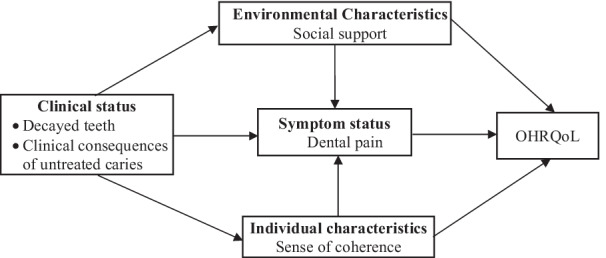
A cross-sectional study involving 400 schoolchildren selected from public schools in a socioeconomically disadvantaged region in the city of Manaus, Brazil was carried out. The predictors of OHRQoL were selected according to the Wilson and Cleary theoretical model, including number of decayed teeth and its clinical consequence (component D of the DMFT index and PUFA/pufa index), dental pain (symptom status), and SOC and social support (individual and environmental characteristics). Statistical analysis was conducted through structural equation modelling and multivariable negative binomial regression. The significance level established for all analyses was 5%.
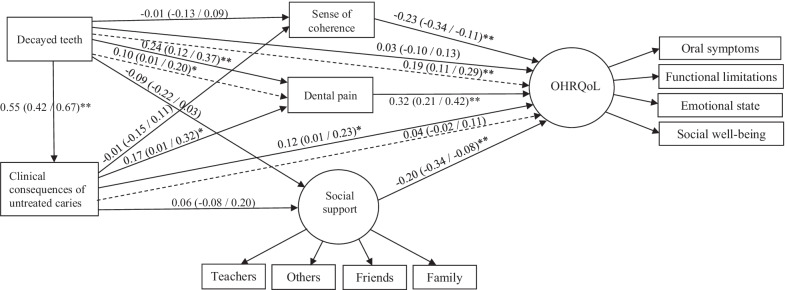
Number of dental caries was indirectly linked with OHRQoL (β = 0.19, 95% CI 0.11/0.29) through dental pain, SOC and social support. Clinical consequences of untreated caries directly predicted poor OHRQoL (β = 0.12, 95% CI 0.01/0.23). Dental pain, SOC and social support did not moderate the effect of dental caries measures on OHRQoL.
Our findings suggest the role of dental pain, SOC and social support as mediator factors on the link between dental caries and OHRQoL. Tackling dental caries along with psychosocial factors may attenuated the impact of oral health on OHRQoL in children.
本研究旨在探讨儿童十二岁时,龋齿和口腔健康相关生活质量(OHRQoL)之间的关系中,牙痛、心理一致感(SOC)和社会支持所起的作用。
本研究为横断面研究,共纳入了巴西马瑙斯市社会经济地位较低地区公立学校的 400 名学龄儿童。OHRQoL 的预测因子根据 Wilson 和 Cleary 理论模型选择,包括龋齿数量及其临床后果(DMFT 指数的 D 部分和 PUFA/pufa 指数)、牙痛(症状状况)、SOC 和社会支持(个体和环境特征)。采用结构方程模型和多变量负二项回归进行统计分析。所有分析的显著性水平设定为 5%。
龋齿数量通过牙痛、SOC 和社会支持间接与 OHRQoL 相关(β=0.19,95%CI 0.11/0.29)。未经治疗的龋齿的临床后果直接预测 OHRQoL 较差(β=0.12,95%CI 0.01/0.23)。牙痛、SOC 和社会支持并未调节龋齿措施对 OHRQoL 的影响。
我们的研究结果表明,牙痛、SOC 和社会支持在龋齿与 OHRQoL 之间的关系中起中介作用。解决龋齿和社会心理因素可能会减轻口腔健康对儿童 OHRQoL 的影响。