Orthodontics and Dentofacial Orthopedics, Department of Preventive Dental Sciences, College of Dentistry, Jazan University, Jazan, Saudi Arabia.
Department of Orthodontics, Pedodontics and Preventive Dentistry, Faculty of Dentistry, Sana'a University, Sana'a, Republic of Yemen.
BMC Oral Health. 2022 Aug 10;22(1):339. doi: 10.1186/s12903-022-02363-3.
The goal of this systematic review was to assess the available evidence regarding the skeletal and dentoalveolar effects of bi-maxillary skeletal anchorage devices (BMSADs) used in treating growing class II malocclusion patients.
A comprehensive search was conducted on PubMed, Scopus, Science Direct, Web of Science, Cochrane, and LILACS up to November 2021, which was augmented by a manual search. The studies included were clinical trials (RCTs) and/or follow-up observational studies (retrospective and prospective). The outcomes of interest were the skeletal, dentoalveolar, and occlusal treatment-induced changes obtained from pre- and post-cephalometric measurements. The risks of bias of the included studies were assessed using an assessment tool from previous publications.
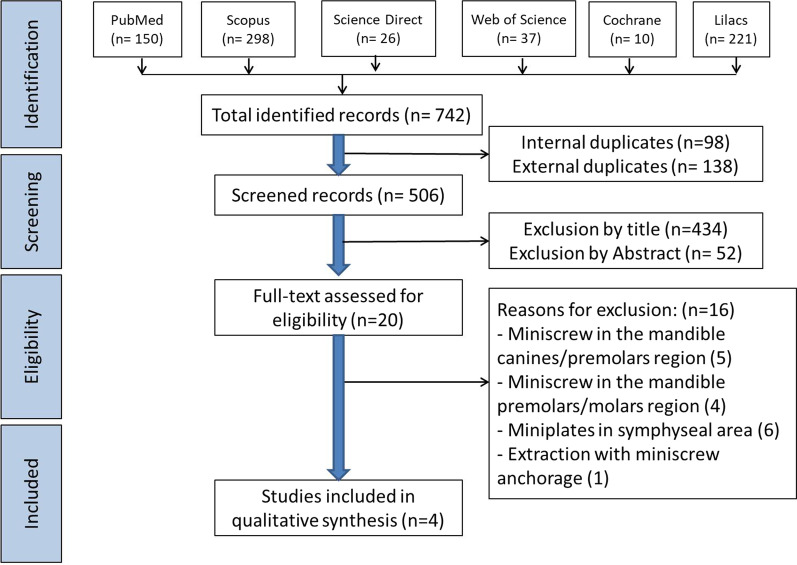
Out of 742 screened articles, only 4 were eligible and thus included in the qualitative synthesis. They showed a moderate overall risk of bias. The results are presented as mean changes in both the study and control groups. All studies reported retrusion of the maxillary base and advancement of the mandible (meaning reduced ANB angle). Three of the included studies reported an increase in the vertical jaw relation, which was contrary to what the fourth study reported. Three studies reported an increase in the maxillary incisors' inclination or position, while one study reported their retroclination. Proclination of the mandibular incisors happened in two studies, whereas the other two studies reported retroclination. The overjet was reduced in all included studies.
Apart from the protrusive effects on the mandible, retrusive effects on the maxilla, and the consequent reduction of the overjet, BMSADs results in inconsistent skeletal and dentoalveolar effects. However, the current evidence is limited due to the variability in the biomechanics of the intermaxillary components, type of anchorage, and comparable groups in the included studies. Further RCTs with more standardized methodologies are highly encouraged.
BMSADs (using miniscrews or miniplates on both jaws) induces more skeletal than dentoalveolar effects. However, this must be practiced with caution, based on the benefit to risk (surgical insertion) ratio, and the limited evidence available in hand so far. Registration The protocol for this systematic review was registered at the International Prospective Register of Systematic Reviews (PROSPERO, No.: CRD42020199601).
本系统评价的目的是评估用于治疗生长型 II 类错畸形患者的双颌骨骨锚定装置(BMSAD)在骨骼和牙牙槽方面的现有证据。
我们对 PubMed、Scopus、Science Direct、Web of Science、Cochrane 和 LILACS 进行了全面检索,检索时间截至 2021 年 11 月,并通过手动检索进行了补充。纳入的研究包括临床试验(RCT)和/或随访观察研究(回顾性和前瞻性)。我们感兴趣的结局是从头影测量的前后测量中获得的骨骼、牙牙槽和咬合治疗引起的变化。使用以前发表的评估工具评估纳入研究的偏倚风险。
在 742 篇筛选出的文章中,仅有 4 篇符合条件并纳入定性综合分析。它们显示出中度的总体偏倚风险。结果以研究组和对照组的平均变化呈现。所有研究均报告上颌基骨后缩和下颌前伸(即 ANB 角减小)。纳入的 3 项研究报告下颌骨垂直关系增加,而第 4 项研究报告则相反。3 项研究报告上颌切牙倾斜或位置增加,而 1 项研究报告其后退。2 项研究报告下颌切牙前倾,而另外 2 项研究报告后退。所有纳入的研究都减少了覆合。
除了对下颌骨的突出作用、对上颌骨的后缩作用以及由此导致的覆合减少外,BMSAD 还会导致骨骼和牙牙槽方面不一致的效果。然而,由于纳入研究中对颌间组件的生物力学、锚定类型和可比组的差异,目前的证据是有限的。非常鼓励开展更多采用标准化方法的 RCT。
BMSAD(在上颌和下颌使用微型螺钉或迷你板)引起的骨骼效应多于牙牙槽效应。然而,这必须基于获益与风险(手术插入)的比值,谨慎实施,而且到目前为止,手头的证据有限。注册本系统评价的方案已在国际前瞻性系统评价登记册(PROSPERO)注册(编号:CRD42020199601)。