MRC Centre for Reproductive Health, Queen's Medical Research Institute, University of Edinburgh, Edinburgh, UK.
Key Laboratory of SFGA on Conservation Biology of Rare Animals in The Giant Panda National Park, China Conservation and Research Centre for the Giant Panda (CCRCGP), DuJiangYan City, Sichuan Province, China.
Reprod Fertil. 2022 Jun 30;3(3):122-132. doi: 10.1530/RAF-22-0031. eCollection 2022 Jul 1.
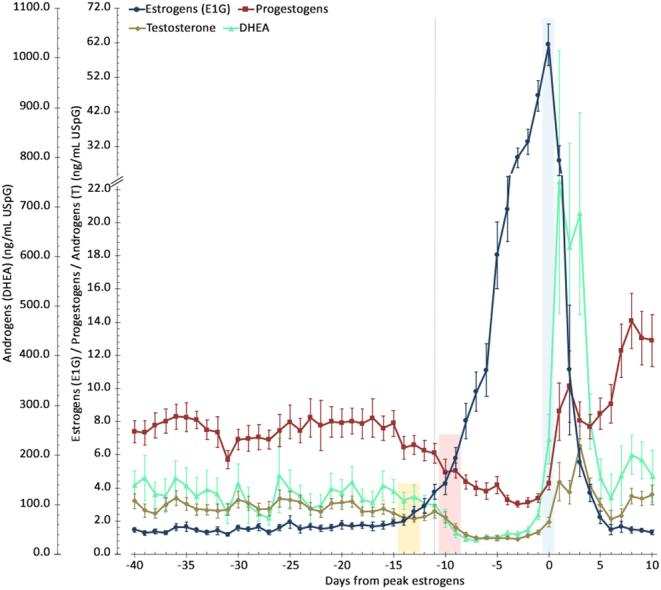
Giant pandas are mono-estrus seasonal breeders, with the breeding season typically occurring in the spring. Successful fertilization is followed by an embryonic diapause, of variable length, with birth in the late summer/autumn. There is a need for additional understanding of giant panda reproductive physiology, and the development of enhanced biomarkers for impending proestrus and peak fertility. We aimed to determine the utility of non-invasive androgen measurements in the detection of both proestrus and estrus. Urine from 20 cycles (-40 days to +10 days from peak estrus) from 5 female giant pandas was analyzed for estrogen, progestogens and androgens (via testosterone and DHEA assays), and hormone concentrations were corrected against urinary specific gravity. Across proestrus, estrogens increased while progestogens and androgens decreased - at the point of entry into proestrus, androgens (as detected by the testosterone assay) decreased prior to progestogens and gave 4 days advanced warning of proestrus. At the time of peak estrus, androgens (as detected by the DHEA assay) were significantly increased at the time of the decrease in estrogen metabolites from the peak, acting as an alternative confirmatory indicator of the fertile window. This novel finding allows for enlargement of the preparative window for captive breeding and facilitates panda management within breeding programmes. Androgens allow an enhanced monitoring of giant panda estrus, not only advancing the warning of impending proestrus, but also prospectively identifying peak fertility.
Giant pandas have one chance at pregnancy per year. The 2-day fertile window timing varies by year and panda. This is monitored by measuring the level of estrogens in the urine, which increase, indicating an upcoming fertile period. After 1-2 weeks of increase, estrogens peak and fall, marking the optimal fertile time. We tested other hormones to see if we can predict the fertile window in advance, and the specific fertile time with more accuracy. In 20 breeding seasons from 5 females, we found androgens, usually thought of as male hormones, had an important role. Testosterone gives 4 days advanced warning of estrogens increasing. DHEA identified peak estrogen and the fertile time before needing to see a confirmed decrease in estrogen itself. Therefore, androgens help improve monitoring of the giant panda breeding season, giving early warning of fertility, key in facilitating captive breeding and giant panda conservation.
大熊猫是单发情季节性繁殖者,繁殖季节通常在春季。受精后会经历一段可变长度的胚胎休眠期,然后在夏末/秋季分娩。需要进一步了解大熊猫的生殖生理学,并开发出用于预测发情前期和最佳生育力的增强生物标志物。我们旨在确定非侵入性雄激素测量在检测发情前期和发情期中的效用。分析了 5 只雌性大熊猫 20 个周期(从发情高峰期前-40 天至+10 天)的尿液中的雌激素、孕激素和雄激素(通过睾酮和 DHEA 测定),并根据尿液比重校正了激素浓度。在发情前期,雌激素增加,而孕激素和雄激素减少-在进入发情前期时,睾酮(通过睾酮测定检测到)的水平先于孕激素下降,并提前 4 天发出发情前期的预警。在发情高峰期,DHEA(通过 DHEA 测定检测到)的水平在雌激素代谢物从高峰期下降时显著增加,作为可育窗口的替代确认指标。这一新颖的发现扩大了圈养繁殖的准备窗口,并有利于繁殖计划中的熊猫管理。雄激素可以增强对大熊猫发情的监测,不仅提前预警即将到来的发情前期,还可以前瞻性地确定最佳生育力。
大熊猫每年只有一次怀孕的机会。为期两天的可育窗口的时间因年份和熊猫而异。这通过测量尿液中的雌激素水平来监测,雌激素水平升高表明即将进入可育期。在增加 1-2 周后,雌激素达到峰值并下降,标志着最佳可育期。我们测试了其他激素,以确定是否可以提前预测可育窗口,并更准确地预测具体的可育时间。在来自 5 只雌性的 20 个繁殖季节中,我们发现通常被认为是雄性激素的雄激素在其中起着重要作用。睾酮可提前 4 天发出雌激素增加的预警。DHEA 确定了雌激素峰值和可育时间,而无需等待雌激素本身的确认下降。因此,雄激素有助于改善大熊猫繁殖季节的监测,提前预警生育能力,这是促进圈养繁殖和大熊猫保护的关键。