Kohl Patrick L, Rutschmann Benjamin, Steffan-Dewenter Ingolf
Department of Animal Ecology and Tropical Biology, Biocenter, University of Würzburg, Würzburg, Germany.
R Soc Open Sci. 2022 Aug 3;9(8):220565. doi: 10.1098/rsos.220565. eCollection 2022 Aug.
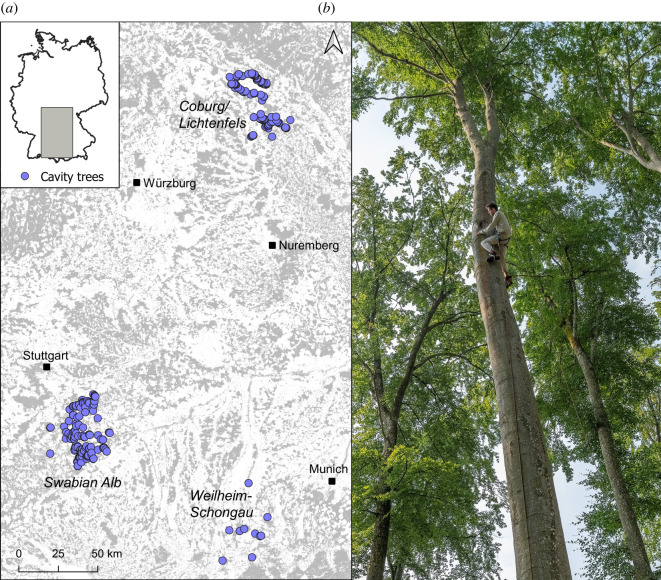
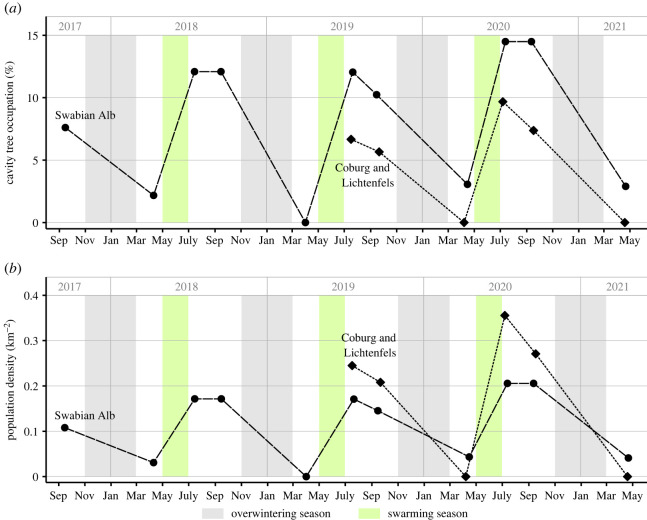
European honeybee populations are considered to consist only of managed colonies, but recent censuses have revealed that wild/feral colonies still occur in various countries. To gauge the ecological and evolutionary relevance of wild-living honeybees, information is needed on their population demography. We monitored feral honeybee colonies in German forests for up to 4 years through regular inspections of woodpecker cavity trees and microsatellite genotyping. Each summer, about 10% of the trees were occupied, corresponding to average densities of 0.23 feral colonies km (an estimated 5% of the regional honeybee populations). Populations decreased moderately until autumn but dropped massively during winter, so that their densities were only about 0.02 colonies km in early spring. During the reproductive (swarming) season, in May and June, populations recovered, with new swarms preferring nest sites that had been occupied in the previous year. The annual survival rate and the estimated lifespan of feral colonies ( = 112) were 10.6% and 0.6 years, respectively. We conclude that managed forests in Germany do not harbour self-sustaining feral honeybee populations, but they are recolonized every year by swarms escaping from apiaries.
欧洲蜜蜂种群通常被认为仅由人工管理的蜂群组成,但最近的普查显示,野生/半野生蜂群在各个国家仍然存在。为了评估野生蜜蜂的生态和进化相关性,需要了解它们的种群统计学信息。我们通过定期检查啄木鸟树洞和微卫星基因分型,对德国森林中的野生蜜蜂蜂群进行了长达4年的监测。每年夏天,约10%的树洞被占据,平均密度为每平方公里0.23个野生蜂群(估计占该地区蜜蜂种群的5%)。种群数量在秋季前适度下降,但在冬季大幅减少,以至于在早春时其密度仅约为每平方公里0.02个蜂群。在繁殖(分蜂)季节,即5月和6月,种群数量恢复,新分蜂群更喜欢占据前一年已被占据的巢穴地点。野生蜂群的年生存率和估计寿命(=112)分别为10.6%和0.6年。我们得出结论,德国的人工管理森林中不存在自我维持的野生蜜蜂种群,但每年都有来自养蜂场的分蜂群重新在这些森林中定居。