Department of Anesthesiology, Mayo Clinic, Rochester, Minnesota.
Department of Nutrition and Exercise Physiology, University of Missouri, Columbia, Missouri.
J Appl Physiol (1985). 2022 Oct 1;133(4):867-875. doi: 10.1152/japplphysiol.00837.2021. Epub 2022 Aug 11.
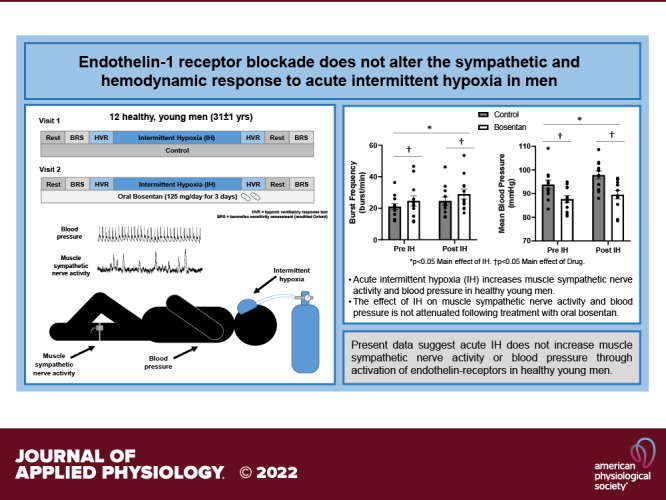
Repeat exposures to low oxygen (intermittent hypoxia, IH), like that observed in sleep apnea, elicit increases in muscle sympathetic nerve activity (MSNA) and blood pressure (BP) in men. Endothelin (ET) receptor antagonists can attenuate the sympathetic and BP response to IH in rodents; whether these data translate to humans are unclear. We hypothesized that ET-receptor antagonism would ameliorate any rise in MSNA and BP following acute IH in humans. Twelve healthy men (31 ± 1 yr) completed two visits (control, bosentan) separated by at least 1 wk. MSNA, BP, and baroreflex sensitivity (modified Oxford) were assessed during normoxic rest before and following 30 min of IH. The midpoint (T50) for each individual's baroreflex curve was calculated. Acute IH increased plasma ET-1 ( < 0.01), MSNA burst frequency ( = 0.03), and mean BP ( < 0.01). There was no effect of IH on baroreflex sensitivity ( = 0.46), although an increase in T50 was observed ( < 0.01). MSNA burst frequency was higher ( = 0.04) and mean BP ( < 0.01) was lower following bosentan treatment compared with control. There was no effect of bosentan on baroreflex sensitivity ( = 0.53), although a lower T50 was observed on the bosentan visit ( < 0.01). There was no effect of bosentan on increases in MSNA ( = 0.81) or mean BP ( = 0.12) following acute IH. Acute IH results in an increase in ET-1, MSNA, and BP in healthy young men. The effect of IH on MSNA and BP is not attenuated following ET-receptor inhibition. Present data suggest that acute IH does not increase MSNA or BP through activation of ET-receptors in healthy young men. Repeat exposures to low oxygen (intermittent hypoxia, IH) elicit increases in muscle sympathetic nerve activity (MSNA) and blood pressure (BP) in men. Endothelin (ET) receptor antagonists can attenuate the sympathetic and BP response to IH in rodents; whether these data translate to humans were unclear. We show acute IH results in an increase in ET-1, MSNA, and BP in healthy young men; however, the effect of IH on MSNA and BP does not occur through activation of ET-receptors in healthy young men.
重复的低氧暴露(间歇性低氧,IH),如在睡眠呼吸暂停中观察到的那样,会导致男性肌肉交感神经活动(MSNA)和血压(BP)增加。内皮素(ET)受体拮抗剂可减轻啮齿动物对 IH 的交感神经和 BP 反应;这些数据是否适用于人类尚不清楚。我们假设 ET 受体拮抗作用会改善人类急性 IH 后 MSNA 和 BP 的任何升高。12 名健康男性(31 ± 1 岁)在至少 1 周的间隔内完成了两次访问(对照,波生坦)。在 30 分钟 IH 之前和之后,在正常氧休息期间评估 MSNA、BP 和压力反射敏感性(改良牛津)。计算每个人的压力反射曲线的中点(T50)。急性 IH 增加了血浆 ET-1(<0.01)、MSNA 爆发频率(=0.03)和平均 BP(<0.01)。IH 对压力反射敏感性没有影响(=0.46),尽管观察到 T50 增加(<0.01)。与对照相比,波生坦治疗后 MSNA 爆发频率更高(=0.04),平均 BP 更低(<0.01)。波生坦对压力反射敏感性没有影响(=0.53),但在波生坦就诊时观察到 T50 较低(<0.01)。波生坦对急性 IH 后 MSNA(=0.81)或平均 BP(=0.12)的增加没有影响。急性 IH 导致健康年轻男性 ET-1、MSNA 和 BP 增加。在 ET 受体抑制后,IH 对 MSNA 和 BP 的影响没有减弱。目前的数据表明,在健康的年轻男性中,急性 IH 不会通过激活 ET 受体来增加 MSNA 或 BP。