Department of Prevention and Sports Medicine, University Hospital Klinikum Rechts der Isar, 27190Technical University of Munich, Munich, Germany.
DZHK (German Centre for Cardiovascular Research), Partner Site Munich Heart Alliance, Munich, Germany.
Diab Vasc Dis Res. 2022 Jul-Aug;19(4):14791641221113781. doi: 10.1177/14791641221113781.
Lifestyle interventions are a cornerstone in the treatment of chronic ischaemic heart disease (CIHD) and type 2 diabetes mellitus (T2DM). This study aimed at identifying differences in clinical characteristics between categories of the common lifestyle intervention targets BMI, exercise capacity (peak V̇O) and health literacy (HL).
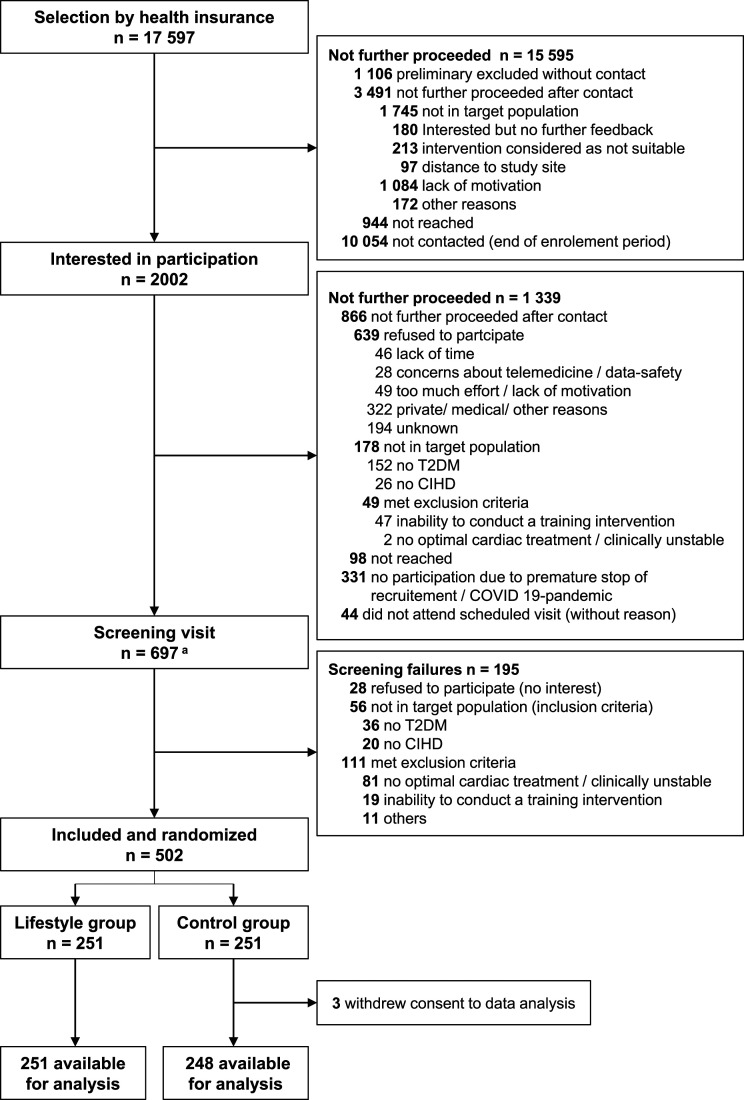
Cross-sectional baseline characteristics of patients enrolled in the LeIKD trial (Clinicaltrials.gov NCT03835923) are presented in total, grouped by BMI, %-predicted peak V̇O and HL (HLS-EU-Q16), and compared to other clinical trials with similar populations.
Among 499 patients (68.3±7.7 years; 16.2% female; HbA1c, 6.9±0.9%), baseline characteristics were similar to other trials and revealed insufficient treatment of several risk factors (LDL-C 92±34 mg/dl; BMI, 30.1±4.8 kg/m; 69.6% with peak V̇O<90% predicted). Patients with lower peak V̇O showed significantly higher ( < 0.05) CIHD and T2DM disease severity (HbA1c, CIHD symptoms, coronary artery bypass graft). Obese patients had a significantly higher prevalence of hypertension and higher triglyceride levels, whereas in patients with low HL both quality of life components (physical, mental) were significantly reduced.
In patients with CIHD and T2DM, peak V̇O2, BMI and HL are important indicators of disease severity, risk factor burden and quality of life, which reinforces the relevance of lifestyle interventions.
生活方式干预是治疗慢性缺血性心脏病(CIHD)和 2 型糖尿病(T2DM)的基石。本研究旨在确定常见生活方式干预目标 BMI、运动能力(峰值 VO)和健康素养(HL)的类别之间的临床特征差异。
总共有 LeIKD 试验(Clinicaltrials.gov NCT03835923)入组患者的横断面基线特征,按 BMI、%预测峰值 VO 和 HL(HLS-EU-Q16)分组,并与具有类似人群的其他临床试验进行比较。
在 499 名患者(68.3±7.7 岁;16.2%为女性;HbA1c,6.9±0.9%)中,基线特征与其他试验相似,并显示出对多种危险因素的治疗不足(LDL-C 92±34 mg/dl;BMI,30.1±4.8 kg/m;69.6%的峰值 VO<90%预测)。峰值 VO 较低的患者的 CIHD 和 T2DM 疾病严重程度显著较高(<0.05;HbA1c、CIHD 症状、冠状动脉旁路移植术)。肥胖患者的高血压和甘油三酯水平明显较高,而 HL 较低的患者的生活质量(身体、精神)两个方面都明显降低。
在 CIHD 和 T2DM 患者中,峰值 VO2、BMI 和 HL 是疾病严重程度、危险因素负担和生活质量的重要指标,这加强了生活方式干预的相关性。