State Key Laboratory of Oncology in South China, Collaborative Innovation Center for Cancer Medicine, Guangdong Key Laboratory of Nasopharyngeal Carcinoma Diagnosis and Therapy, Sun Yat-Sen University Cancer Center, Guangzhou, China.
Department of Nasopharyngeal Carcinoma, Sun Yat-Sen University Cancer Center, Guangzhou, China.
BMC Cancer. 2022 Aug 11;22(1):880. doi: 10.1186/s12885-022-09924-3.
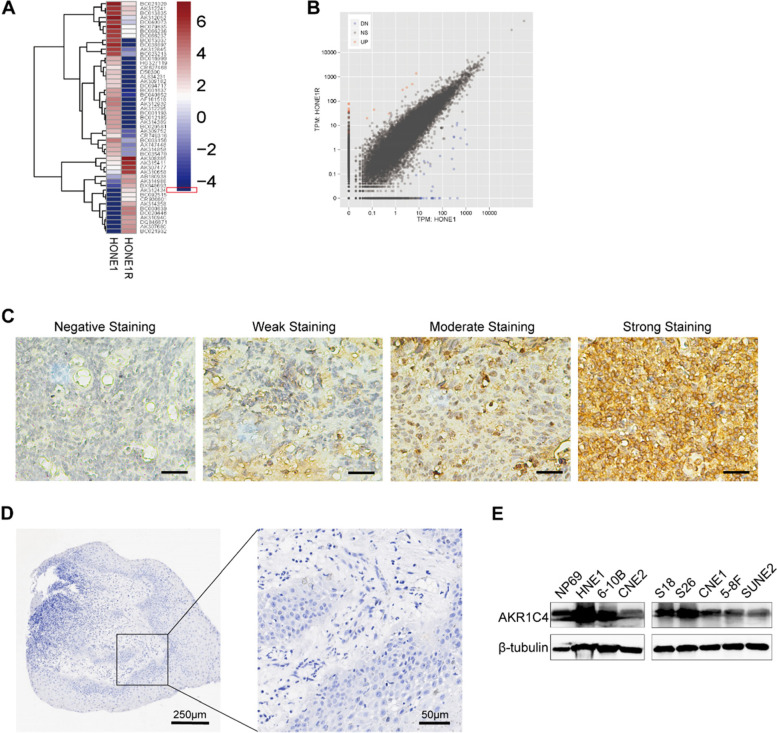
Distinguishing patients at a greater risk of recurrence is essential for treating locoregional advanced nasopharyngeal carcinoma (NPC). This study aimed to explore the potential of aldo-keto reductase 1C4 (AKR1C4) in stratifying patients at high risk of locoregional relapse.
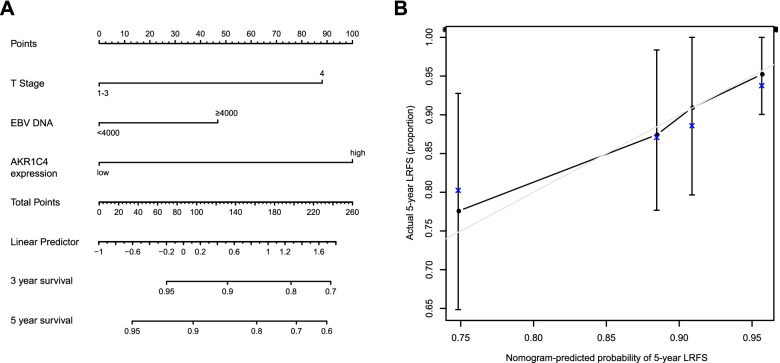
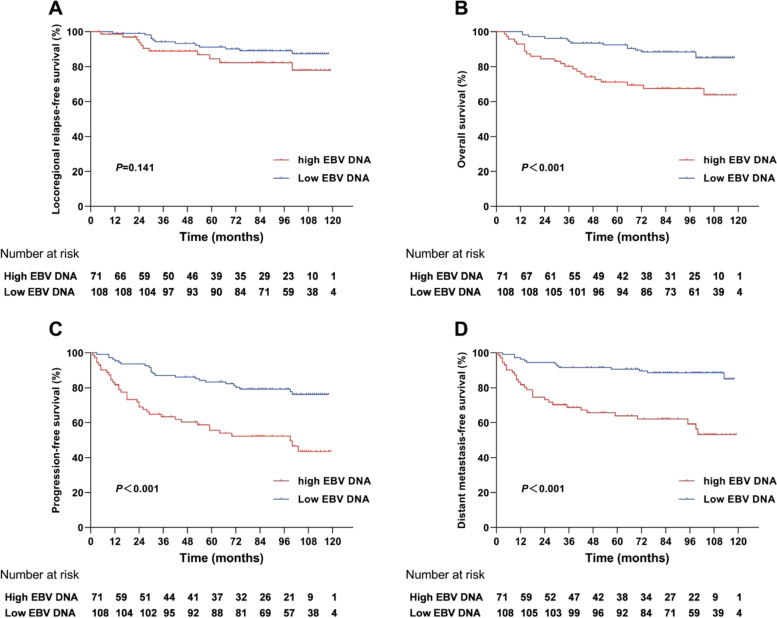
A total of 179 patients with locoregionally advanced NPC were grouped by different strategies; they were: (a) divided into two groups according to AKR1C4 expression level, and (b) classified into three clusters by integrating AKR1C4 and Epstein-Barr virus (EBV) DNA. The Kaplan-Meier method was used to calculate locoregional relapse-free survival (LRFS), overall survival (OS), progression-free survival (PFS), and distant metastasis-free survival (DMFS). The Cox proportional hazards model was used to determine potential prognostic factors, and a nomogram was generated to predict 3-year and 5-year LRFS.
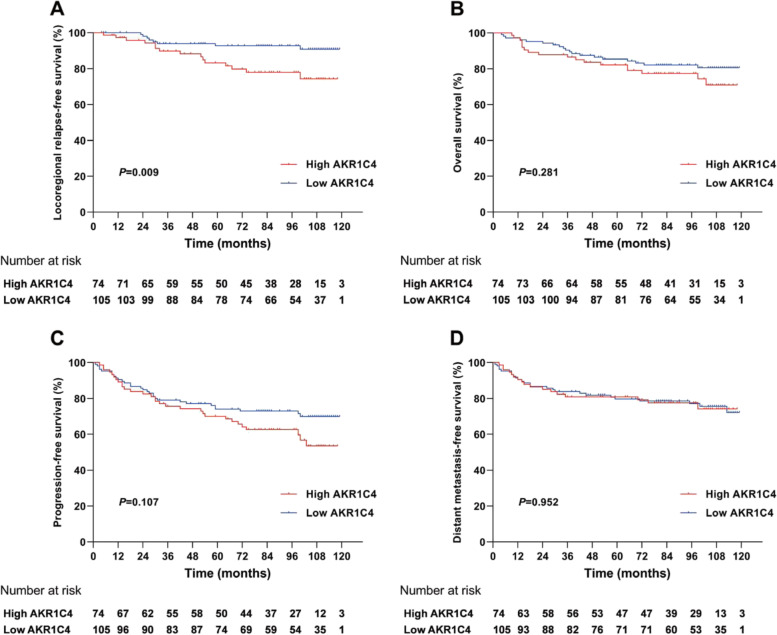
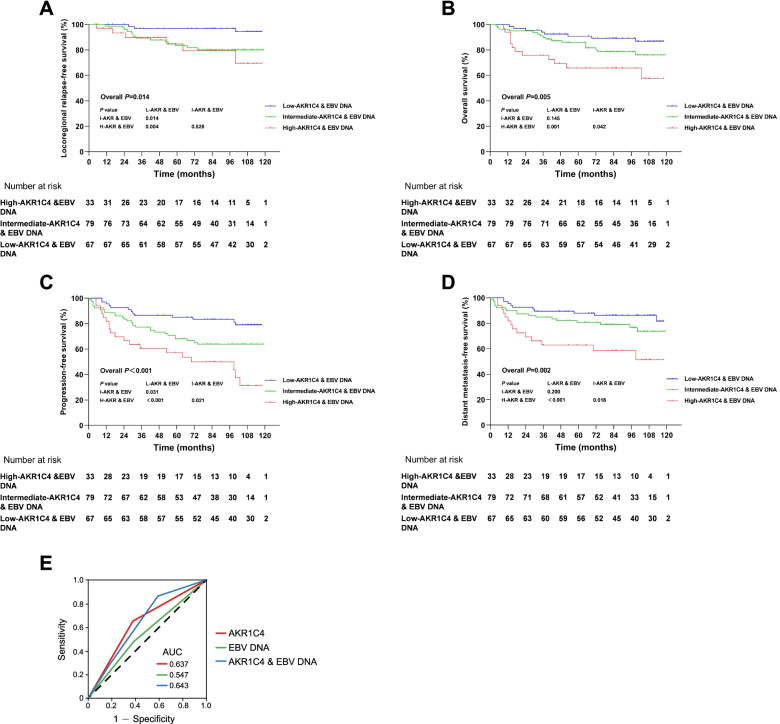
A significant difference in the 5-year LRFS was observed between the high and low AKR1C4 expression groups (83.3% vs. 92.7%, respectively; p = 0.009). After integrating AKR1C4 expression and EBV DNA, the LRFS (84.7%, 84.5%, 96.9%, p = 0.014) of high-, intermediate-, and low- AKR1C4 and EBV DNA was also significant. Multivariate analysis indicated that AKR1C4 expression (p = 0.006) was an independent prognostic factor for LRFS. The prognostic factors incorporated into the nomogram were AKR1C4 expression, T stage, and EBV DNA, and the concordance index of the nomogram for locoregional relapse was 0.718.
In conclusion, high AKR1C4 expression was associated with a high possibility of relapse in NPC patients, and integrating EBV DNA and AKR1C4 can stratify high-risk patients with locoregional recurrence.
鉴别复发风险较高的患者对于治疗局部晚期鼻咽癌(NPC)至关重要。本研究旨在探索醛酮还原酶 1C4(AKR1C4)在分层局部区域复发高危患者中的潜在作用。
共 179 例局部晚期 NPC 患者根据不同策略分组:(a)根据 AKR1C4 表达水平分为两组;(b)通过整合 AKR1C4 和 Epstein-Barr 病毒(EBV)DNA 将其分为三个聚类。采用 Kaplan-Meier 法计算局部区域无复发生存率(LRFS)、总生存率(OS)、无进展生存率(PFS)和无远处转移生存率(DMFS)。采用 Cox 比例风险模型确定潜在的预后因素,并生成预测 3 年和 5 年 LRFS 的列线图。
高低 AKR1C4 表达组的 5 年 LRFS 差异有统计学意义(分别为 83.3%和 92.7%,p=0.009)。整合 AKR1C4 表达和 EBV DNA 后,高低 AKR1C4 和 EBV DNA 的 LRFS(84.7%、84.5%、96.9%,p=0.014)也具有显著差异。多因素分析表明,AKR1C4 表达(p=0.006)是 LRFS 的独立预后因素。纳入列线图的预后因素包括 AKR1C4 表达、T 分期和 EBV DNA,列线图局部区域复发的一致性指数为 0.718。
高 AKR1C4 表达与 NPC 患者复发的可能性较高相关,整合 EBV DNA 和 AKR1C4 可分层局部区域复发的高危患者。