Zhang Lu-Lu, Huang Meng-Yao, Wang Ke-Xin, Song Di, Wang Ting, Sun Li-Yue, Shao Jian-Yong
Department of Molecular Diagnostics, Sun Yat-sen University Cancer Center, State Key Laboratory of Oncology in South China, Guangdong Key Laboratory of Nasopharyngeal Carcinoma Diagnosis and Therapy, Collaborative Innovation Center for Cancer Medicine, Guangzhou, People's Republic of China.
School of Mathematics, Sun Yat-Sen University, Guangzhou, People's Republic of China.
Ther Adv Med Oncol. 2020 Jun 12;12:1758835920932052. doi: 10.1177/1758835920932052. eCollection 2020.
The present study aimed to evaluate the combined value of locoregional extension patterns (LEPs) and circulating cell-free Epstein-Barr virus (cf EBV) DNA for risk stratification of locoregionally advanced nasopharyngeal carcinoma (LA-NPC) to better guide therapeutic strategies.
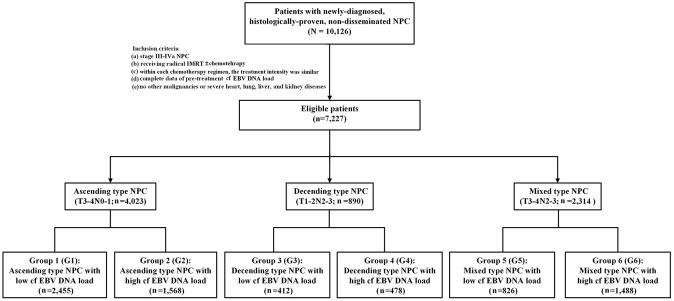
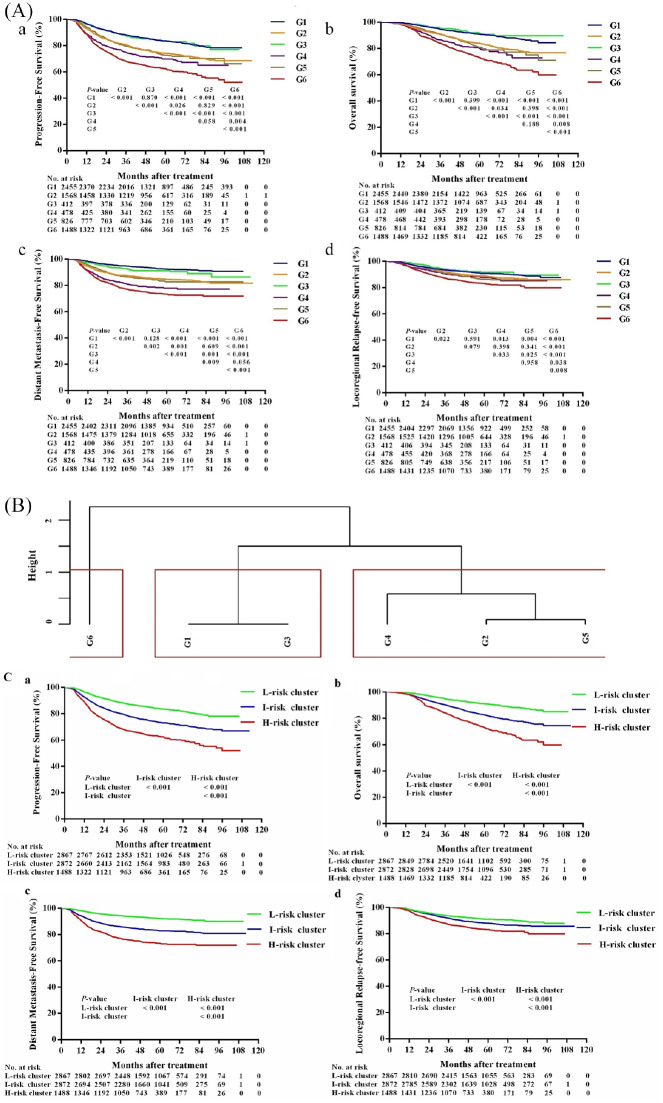
A total of 7227 cases of LA-NPC were reviewed retrospectively and classified into six groups according to their LEP (ascending, descending, or mixed type) and pre-treatment cf EBV-DNA load (⩾ <4000 copy/ml). Using a supervised statistical clustering approach, patients in the six groups were clustered into low, intermediate, and high-risk clusters. Progression-free survival (PFS), overall survival (OS), distant metastasis-free survival (DMFS), and locoregional relapse-free survival (LRRFS) were calculated using the Kaplan-Meier method and differences were compared using the log-rank test.
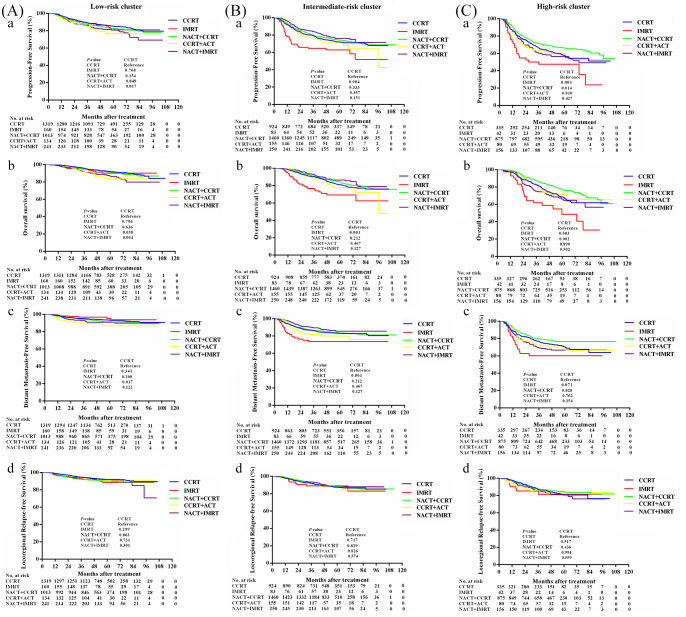
Survival curves for the low, intermediate, and high-risk clusters were significantly different for all endpoints. The 5-year survival rate for the low, intermediate, and high-risk clusters, respectively, were: PFS (83.5%, 73.2%, 62.6%, < 0.001), OS (91.0%, 82.7%, 73.2%, < 0.001), DMFS (92.3%, 83.0%, 73.4%, < 0.001), and LRRFS (91.0%, 88.0%, 83.3%, < 0.001). The risk clusters acted as independent prognostic factors for all endpoints. Among the patients in the high-risk cluster, neoadjuvant chemotherapy combined with concurrent chemoradiotherapy (CCRT) significantly improved the patients 5-year PFS (66.4% 57.9%, = 0.014), OS (77.6% 68.6%; < 0.002), and DMFS (76.6% 70.6%; = 0.028) compared with those treated with CCRT.
Our results could facilitate the development of risk-stratification and risk-adapted therapeutic strategies for patients with LA-NPC.
本研究旨在评估局部区域扩展模式(LEP)和循环游离爱泼斯坦-巴尔病毒(cf EBV)DNA对局部区域晚期鼻咽癌(LA-NPC)风险分层的综合价值,以更好地指导治疗策略。
回顾性分析7227例LA-NPC病例,根据其LEP(上升型、下降型或混合型)和治疗前cf EBV-DNA载量(⩾ <4000拷贝/毫升)分为六组。采用监督统计聚类方法,将六组患者聚类为低、中、高风险组。采用Kaplan-Meier法计算无进展生存期(PFS)、总生存期(OS)、无远处转移生存期(DMFS)和无局部区域复发生存期(LRRFS),并采用对数秩检验比较差异。
低、中、高风险组的所有终点生存曲线均有显著差异。低、中、高风险组的5年生存率分别为:PFS(83.5%、73.2%、62.6%,<0.001),OS(91.0%、82.7%、73.2%,<0.001),DMFS(92.3%、83.0%、73.4%,<0.001),LRRFS(91.0%、88.0%、83.3%,<0.001)。风险组是所有终点的独立预后因素。在高风险组患者中,与接受同步放化疗(CCRT)的患者相比,新辅助化疗联合CCRT显著提高了患者的5年PFS(66.4%对57.9%,=0.014)、OS(77.6%对68.6%;<0.002)和DMFS(76.6%对70.6%;=0.028)。
我们的结果有助于为LA-NPC患者制定风险分层和风险适应性治疗策略。