
治疗前CALLY评分联合EBV-DNA水平对非转移性鼻咽癌患者预后的意义:临床视角
Significance of Pre-Treatment CALLY Score Combined with EBV-DNA Levels for Prognostication in Non-Metastatic Nasopharyngeal Cancer Patients: A Clinical Perspective.
作者信息
Jiang Tongchao, Sun Haishuang, Xu Tiankai, Xue Shuyu, Xia Wen, Xiao Xiang, Wang Ying, Guo Ling, Lin Huanxin
机构信息
Department of Radiation Oncology, State Key Laboratory of Oncology in South China, Guangdong Key Laboratory of Nasopharyngeal Carcinoma Diagnosis and Therapy, Guangdong Provincial Clinical Research Center for Cancer, Sun Yat-Sen University Cancer Center, Guangzhou, 510060, People's Republic of China.
Department of Medical Oncology, State Key Laboratory of Oncology in South China, Guangdong Key Laboratory of Nasopharyngeal Carcinoma Diagnosis and Therapy, Guangdong Provincial Clinical Research Center for Cancer, Sun Yat-Sen University Cancer Center, Guangzhou, 510060, People's Republic of China.
出版信息
J Inflamm Res. 2024 May 23;17:3353-3369. doi: 10.2147/JIR.S460109. eCollection 2024.
BACKGROUND
The C-reactive protein-albumin-lymphocyte (CALLY) score is a novel indicator associated with inflammation, immunity, and nutrition, utilized for cancer prognostic stratification. This study aimed to evaluate the integrated prognostic significance of the pre-treatment CALLY score and Epstein-Barr virus (EBV) DNA levels in nasopharyngeal carcinoma (NPC) patients and to develop prognostic models.
PATIENTS AND METHODS
A total of 1707 NPC patients from September 2015 to December 2017 were retrospectively enrolled. The cut-off point for the CALLY score, determined by maximum selected rank statistics, integrates with the published cut-off point for pre-EBV DNA to develop a comprehensive index. Subsequently, patients were randomly allocated in a 1:1 ratio into training and validation cohorts. Survival analysis was conducted using the Kaplan-Meier method with Log rank tests, and the Cox proportional hazards model was applied to identify independent prognostic factors for constructing predictive nomograms. The predictive ability of the nomograms were assessed through the concordance index (C-index), calibration curves, and decision curve analysis.
RESULTS
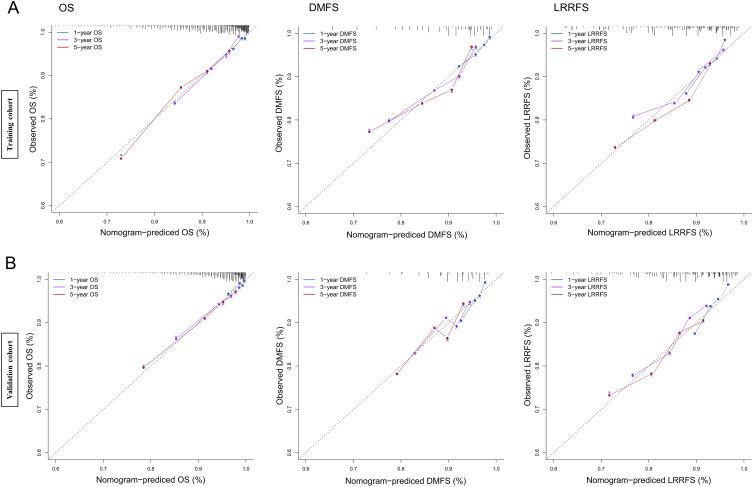
By integrating CALLY scores and EBV-DNA levels, patients were categorized into three risk clusters. Kaplan-Meier curves reveal significant differences in overall survival (OS), distant metastasis-free survival (DMFS), and locoregional relapse-free survival (LRRFS) outcomes among different risk groups (all values < 0.05). Multivariate analysis revealed that CALLY-EBV DNA index serves as an independent prognostic factor for the OS, DMFS, and LRRFS. The prognostic nomograms based on the CALLY-EBV DNA index provided accurate predictions for 1-year, 3-year, and 5-year OS, DMFS, and LRRFS. Additionally, compared to the traditional TNM staging system, the nomograms exhibited enhanced discriminatory power, calibration capability, and clinical applicability. All results were in agreement with the validation cohort.
CONCLUSION
The CALLY-EBV DNA index is an independent prognostic biomarker. The nomogram prediction models, constructed based on the CALLY-EBV DNA index, demonstrates superior predictive performance compared to the traditional TNM staging.
背景
C反应蛋白-白蛋白-淋巴细胞(CALLY)评分是一种与炎症、免疫和营养相关的新型指标,用于癌症预后分层。本研究旨在评估鼻咽癌(NPC)患者治疗前CALLY评分和爱泼斯坦-巴尔病毒(EBV)DNA水平的综合预后意义,并建立预后模型。
患者与方法
回顾性纳入2015年9月至2017年12月期间的1707例NPC患者。通过最大选择秩统计确定CALLY评分的截断点,并与已发表的EBV DNA预处理截断点相结合,形成一个综合指标。随后,患者按1:1的比例随机分为训练队列和验证队列。采用Kaplan-Meier法和Log秩检验进行生存分析,并应用Cox比例风险模型识别独立预后因素,以构建预测列线图。通过一致性指数(C指数)、校准曲线和决策曲线分析评估列线图的预测能力。
结果
通过整合CALLY评分和EBV-DNA水平,患者被分为三个风险组。Kaplan-Meier曲线显示,不同风险组之间的总生存期(OS)、无远处转移生存期(DMFS)和无局部区域复发生存期(LRRFS)结果存在显著差异(所有P值<0.05)。多变量分析显示,CALLY-EBV DNA指数是OS、DMFS和LRRFS的独立预后因素。基于CALLY-EBV DNA指数的预后列线图对1年、3年和5年的OS、DMFS和LRRFS提供了准确的预测。此外,与传统的TNM分期系统相比,列线图具有更强的鉴别能力、校准能力和临床适用性。所有结果与验证队列一致。
结论
CALLY-EBV DNA指数是一种独立的预后生物标志物。基于CALLY-EBV DNA指数构建的列线图预测模型与传统TNM分期相比,具有更好的预测性能。


 Zotero 插件