Adamu Endale, Asfaw Zemede, Demissew Sebsebe, Baye Kaleab
Department of Plant Biology and Biodiversity Management, College of Natural Sciences, Addis Ababa University, Addis Ababa P.O. Box 3434, Ethiopia.
Department of Biology, College of Natural & Computational Sciences, Debre Tabor University, Debre Tabor P.O. Box 272, Ethiopia.
Foods. 2022 Aug 1;11(15):2291. doi: 10.3390/foods11152291.
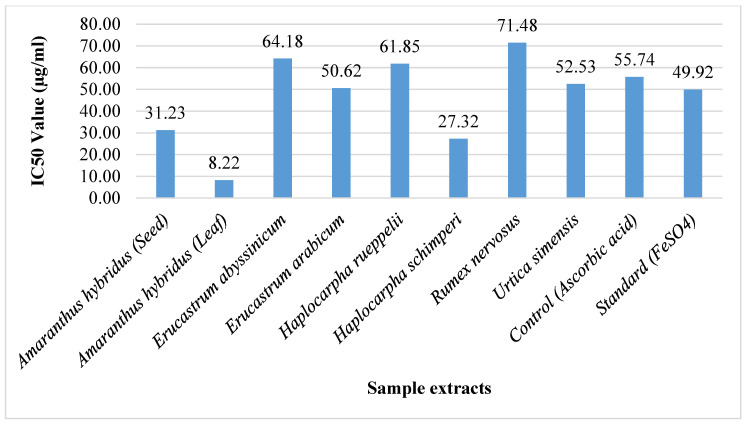
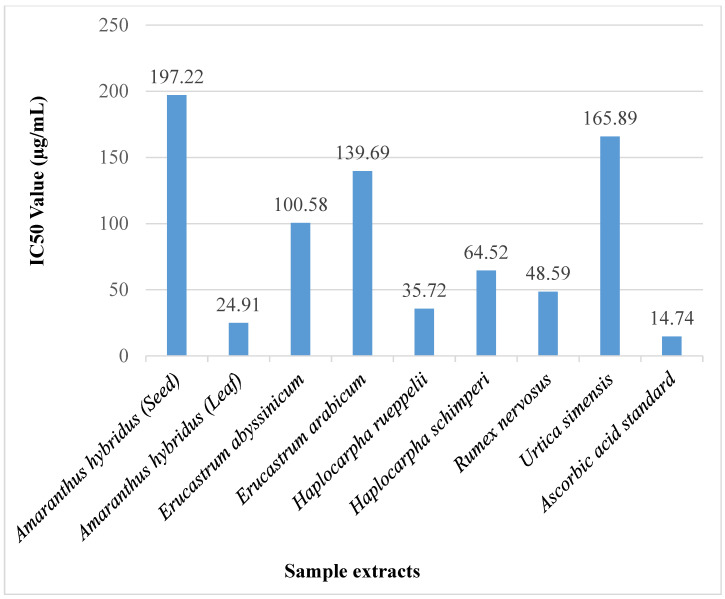
In Ethiopia, wild edible plants (WEPs) offer a natural food supply for humans to alleviate food insecurity and hunger. Despite the extensive usage of WEPs in Ethiopia, there have been few investigations on their nutritional composition. Our study aimed to evaluate the antioxidant activity and anti-nutritional factors of the most commonly consumed WEPs in Northeastern Ethiopia. The antioxidant parameters including total phenol, total flavonoid, 2,2-diphenyl-1-picrylhydrazyl (DPPH) and Ferric Antioxidant Power (FRAP) assay contents and the anti-nutritional parameters including oxalate, phytate and tannin contents of the selected seven WEPs were evaluated using standard food analysis techniques. The total phenol (mg GAE/100 g) and total flavonoid (mg QE/100 g) content of WEPs resulted in ranges of 0.79-17.02 and 2.27-7.12, respectively. The antioxidant activity revealed that leaves of and have the highest DPPH and FRAP value, scavenging 50% of free radicals under 50 µg/mL. Non-food values resulted in the respective ranges of 3.37-11.73 mg/100 g oxalate, 16.31-165 µg/100 g phytate and 1.38-5.49 mg/100 g tannin. The investigation indicates that the antioxidant activity of WEPs under research was higher than common crops, and the non-food values were laid in the safe limit, indicating that these might be used for making more healthy and nutritious foods.
在埃塞俄比亚,野生可食用植物为人类提供了一种天然食物来源,以缓解粮食不安全和饥饿问题。尽管埃塞俄比亚广泛使用野生可食用植物,但对其营养成分的研究却很少。我们的研究旨在评估埃塞俄比亚东北部最常食用的野生可食用植物的抗氧化活性和抗营养因子。使用标准食品分析技术评估了所选七种野生可食用植物的抗氧化参数,包括总酚、总黄酮、2,2-二苯基-1-苦基肼(DPPH)和铁抗氧化能力(FRAP)测定含量,以及抗营养参数,包括草酸盐、植酸盐和单宁含量。野生可食用植物的总酚(mg GAE/100 g)和总黄酮(mg QE/100 g)含量分别在0.79 - 17.02和2.27 - 7.12范围内。抗氧化活性表明,[植物名称1]和[植物名称2]的叶子具有最高的DPPH和FRAP值,在50 µg/mL浓度下能清除50%的自由基。非食用价值方面,草酸盐含量在3.37 - 11.73 mg/100 g范围内,植酸盐含量在16.31 - 165 µg/100 g范围内,单宁含量在1.38 - 5.49 mg/100 g范围内。调查表明,所研究的野生可食用植物的抗氧化活性高于常见作物,且非食用价值处于安全范围内,这表明这些植物可用于制作更健康、更营养的食品。