Unité d'Hygiène, Epidémiologie et Prévention, Hôpital Edouard Herriot, Groupement Hospitalier Centre, Hospices Civils de Lyon, 69003 Lyon, France.
Public Health, Epidemiology and Evolutionary Ecology of Infectious Diseases (PHE3ID), Centre International de Recherche en Infectiologie (CIRI), Inserm, U1111,Université Claude Bernard Lyon 1, CNRS, UMR5308, ENS de Lyon, 69007 Lyon, France.
Int J Environ Res Public Health. 2022 Jul 31;19(15):9401. doi: 10.3390/ijerph19159401.
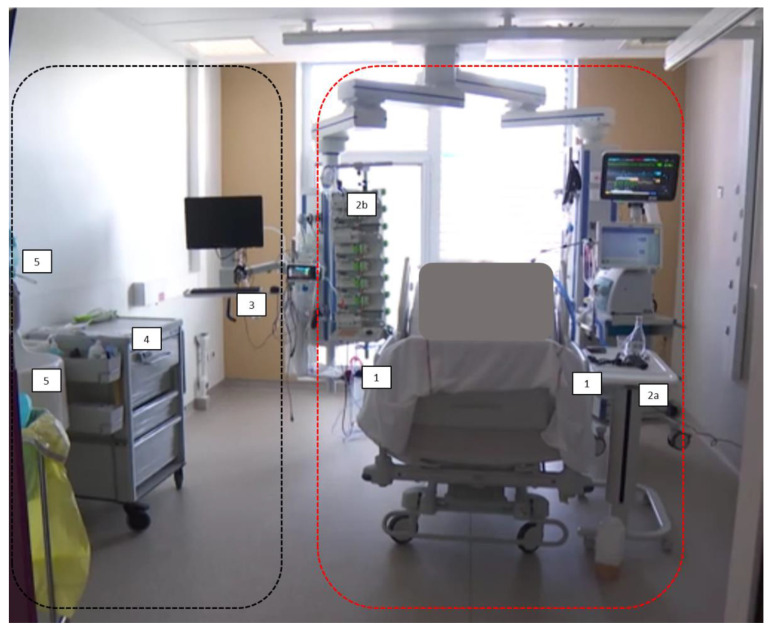
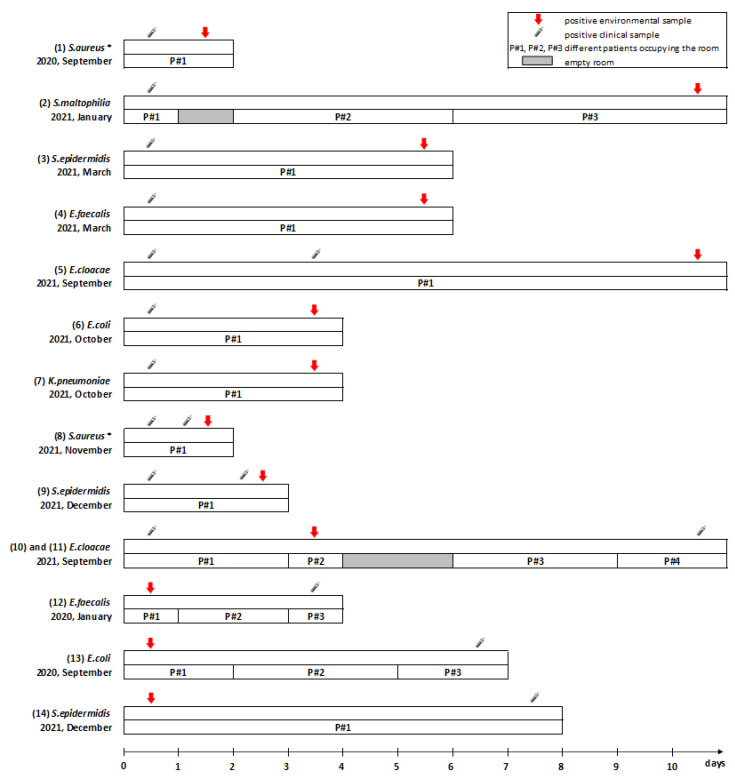
: Contaminated surfaces play an important role in the nosocomial infection of patients in intensive care units (ICUs). This study, conducted in two ICUs at Edouard Herriot Hospital (Lyon, France), aimed to describe rooms' microbial ecology and explore the potential link between environmental contamination and patients' colonization and/or infection. Environmental samples were realized once monthly from January 2020 to December 2021 on surfaces close to the patient (bedrails, bedside table, and dedicated stethoscope) and healthcare workers' high-touch surfaces, which were distant from the patient (computer, worktop/nurse cart, washbasin, and hydro-alcoholic solution/soap dispenser). Environmental bacteria were compared to the cultures of the patients hospitalized in the sampled room over a period of ± 10 days from the environmental sampling. Overall, 137 samples were collected: 90.7% of the samples close to patients, and 87.9% of the distant ones were positives. Overall, 223 bacteria were isolated, mainly: (15.7%), (8.1%), (6.3%), and other spp (6.3%), (5.8%), (5.4%), and (4.9%). Throughout the study, 142 patients were included, of which, = 67 (47.2%) were infected or colonized by at least one bacterium. In fourteen cases, the same bacterial species were found both in environment and patient samples, with the suspicion of a cross-contamination between the patient-environment ( = 10) and environment-patient ( = 4). In this work, we found a high level of bacterial contamination on ICU rooms' surfaces and described several cases of potential cross-contamination between environment and patients in real-world conditions.
污染表面在重症监护病房(ICU)患者的医院感染中起着重要作用。本研究在法国里昂的爱德华·赫里奥特医院的两个 ICU 进行,旨在描述房间的微生物生态学,并探讨环境污染与患者定植和/或感染之间的潜在联系。从 2020 年 1 月至 2021 年 12 月,每月对靠近患者的表面(床栏、床头柜和专用听诊器)和远离患者的医护人员高接触表面(计算机、工作台/护士推车、洗手盆和酒精溶液/肥皂分配器)进行一次环境样本采集。将环境细菌与在环境采样后±10 天内住院的患者培养物进行比较。 共采集了 137 个样本:靠近患者的样本中 90.7%为阳性,远离患者的样本中 87.9%为阳性。总体上共分离出 223 株细菌,主要为: (15.7%)、 (8.1%)、 (6.3%)和其他 spp(6.3%)、 (5.8%)、 (5.4%)和 (4.9%)。整个研究期间,共纳入 142 名患者,其中 = 67 名(47.2%)至少被一种细菌感染或定植。在 14 例中,环境和患者样本中均发现相同的细菌种类,怀疑患者-环境( = 10)和环境-患者( = 4)之间存在交叉污染。 在这项工作中,我们发现 ICU 病房表面存在高水平的细菌污染,并描述了在实际条件下环境与患者之间潜在交叉污染的几个案例。