Department of Imaging and Pathology, Katholieke Universiteit Leuven, 3000 Leuven, Belgium.
Int J Mol Sci. 2022 Aug 3;23(15):8637. doi: 10.3390/ijms23158637.
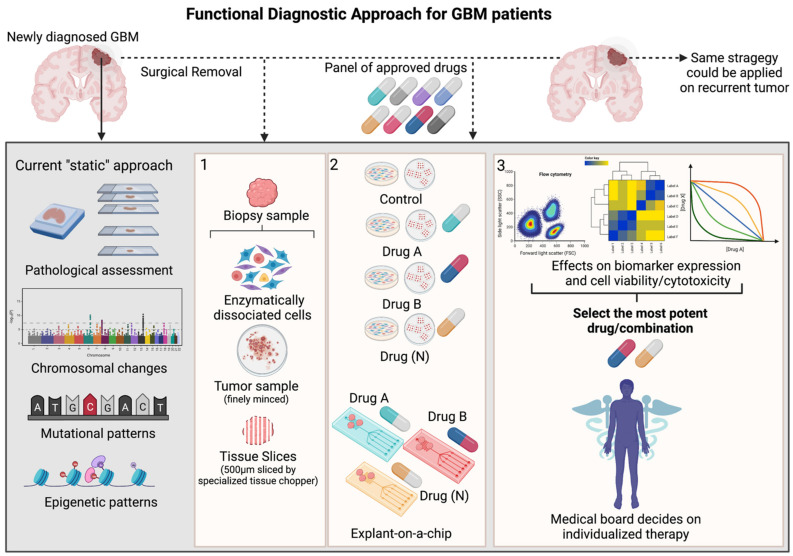
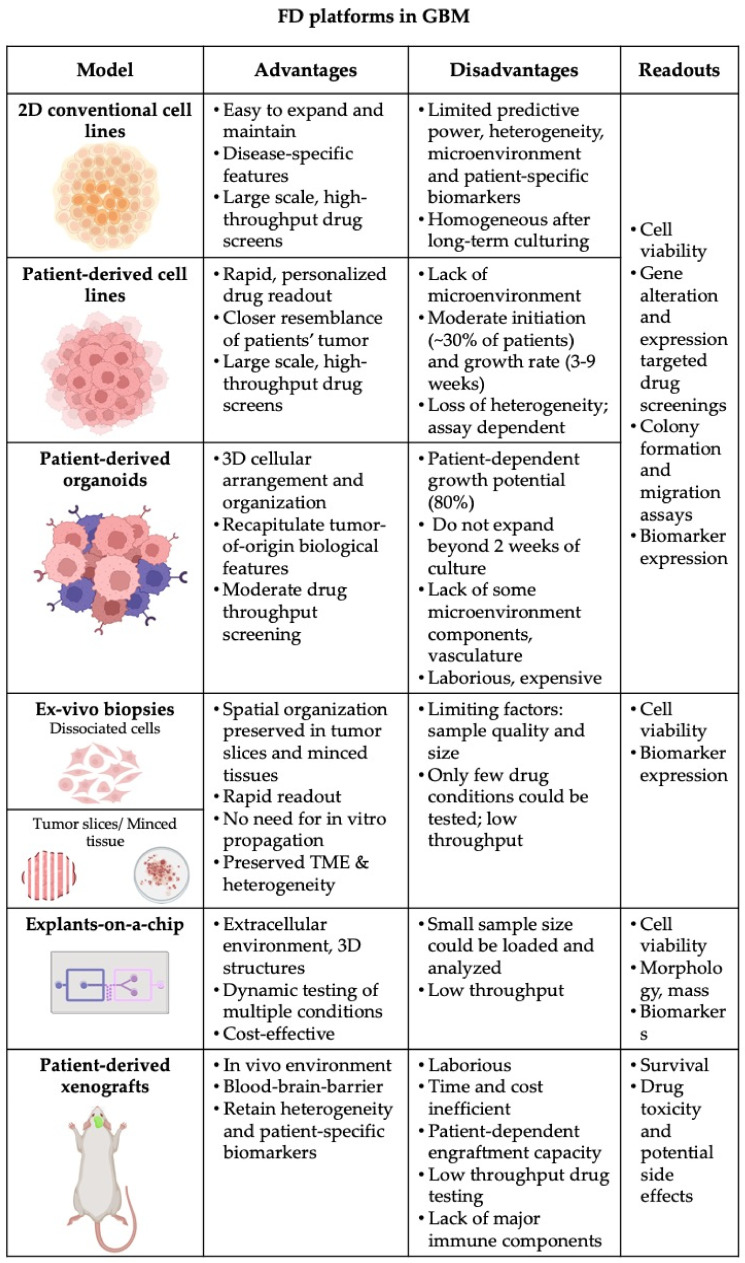
Glioblastoma remains the most malignant and intrinsically resistant brain tumour in adults. Despite intensive research over the past few decades, through which numerous potentially druggable targets have been identified, virtually all clinical trials of the past 20 years have failed to improve the outcome for the vast majority of GBM patients. The observation that small subgroups of patients displayed a therapeutic response across several unsuccessful clinical trials suggests that the GBM patient population probably consists of multiple subgroups that probably all require a distinct therapeutic approach. Due to extensive inter- and intratumoral heterogeneity, assigning the right therapy to each patient remains a major challenge. Classically, bulk genetic profiling would be used to identify suitable therapies, although the success of this approach remains limited due to tumor heterogeneity and the absence of direct relationships between mutations and therapy responses in GBM. An attractive novel strategy aims at implementing methods for functional precision oncology, which refers to the evaluation of treatment efficacies and vulnerabilities of (ex vivo) living tumor cells in a highly personalized way. Such approaches are currently being implemented for other cancer types by providing rapid, translatable information to guide patient-tailored therapeutic selections. In this review, we discuss the current state of the art of transforming technologies, tools and challenges for functional precision oncology and how these could improve therapy selection for GBM patients.
胶质母细胞瘤仍然是成年人中最恶性和内在耐药的脑肿瘤。尽管在过去几十年中进行了密集的研究,确定了许多潜在的可药物治疗的靶点,但过去 20 年的几乎所有临床试验都未能改善绝大多数 GBM 患者的预后。观察到一小部分患者在几次失败的临床试验中显示出治疗反应,这表明 GBM 患者群体可能由多个亚组组成,可能都需要独特的治疗方法。由于广泛的肿瘤内和肿瘤间异质性,为每个患者分配正确的治疗方法仍然是一个主要挑战。经典地,大量基因分析将用于识别合适的治疗方法,尽管由于肿瘤异质性和 GBM 中突变与治疗反应之间缺乏直接关系,这种方法的成功仍然有限。一种有吸引力的新策略旨在实施功能精准肿瘤学的方法,这是指以高度个性化的方式评估(体外)活肿瘤细胞的治疗效果和脆弱性。这些方法目前正在通过提供快速、可转化的信息来指导针对患者的治疗选择,应用于其他癌症类型。在这篇综述中,我们讨论了功能精准肿瘤学的转化技术、工具和挑战的最新进展,以及这些进展如何改善 GBM 患者的治疗选择。