Yang Min, Gou Ze-Hui, Wang Jun, Liu Ju-Xian, Xiang Bo
Department of Pediatric Surgery, West China Hospital of Sichuan University, Chengdu 610041, China.
Department of Ultrasound Medicine, West China Hospital of Sichuan University, Chengdu 610041, China.
J Clin Med. 2022 Jul 31;11(15):4473. doi: 10.3390/jcm11154473.
The pandemic of COVID-19 has significantly influenced the epidemiology of intussusception. Nevertheless, the effects of the COVID-19 pandemic on the operation of ultrasound-guided hydrostatic enema reduction (USGHER) for intussusception have been largely unknown.
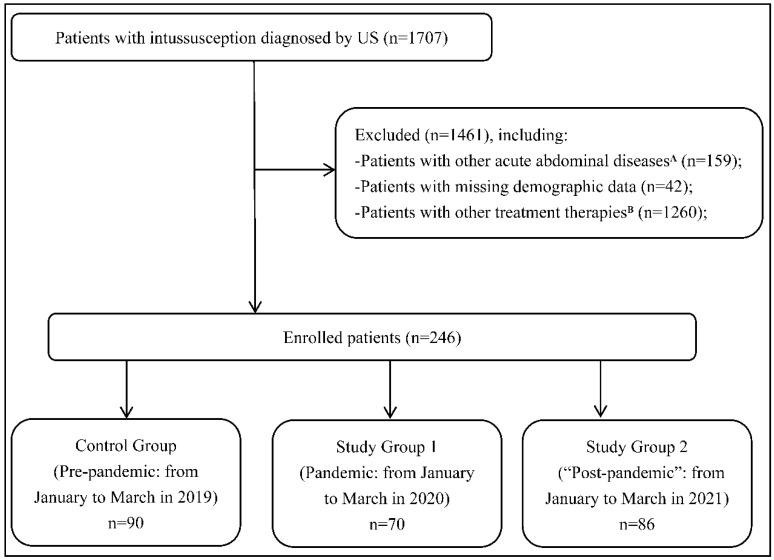
The data of pediatric patients with intussusception who were treated by USGHER from January to March of 2019 (Control Group), 2020 (Study Group 1), and 2021 (Study Group 2) in a large Chinese medical institution were retrospectively collected and analyzed.
We enrolled 246 patients, including 90 cases in Control Group, 70 in Study Group 1, and 86 in Study Group 2 ( = 0.042). The time from the onset of symptoms to the hospital visit and the time from the hospital visit to performing the ultrasound in Study Group 1 was significantly longer than that in Control Group and Study Group 2 ( = 0.036, = 0.031, respectively). The number of patients with bloody stool and the longest invaginated length of intussusception in Study Group 1 increased significantly compared with patients in the other two groups ( = 0.007, = 0.042, respectively). Comparisons of neither the pressure of enema nor the time of duration when performing USGHER present statistical significance among the three groups ( = 0.091, = 0.085, respectively). For all enrolled pediatric patients, there was no perforation case involved, and recurrence of intussusception occurred in few cases.
Besides the negative impacts on the incidence of intussusception, the COVID-19 pandemic might have led to the diagnostic delay of intussusception and the deterioration of patients' clinical manifestations, but it did not significantly affect the operation of USGHER and patients' clinical outcome.
新型冠状病毒肺炎(COVID-19)大流行对肠套叠的流行病学产生了重大影响。然而,COVID-19大流行对肠套叠超声引导下水压灌肠复位术(USGHER)操作的影响在很大程度上尚不清楚。
回顾性收集并分析了一家大型中国医疗机构2019年1月至3月(对照组)、2020年(研究组1)和2021年(研究组2)接受USGHER治疗的小儿肠套叠患者的数据。
我们纳入了246例患者,其中对照组90例,研究组1 70例,研究组2 86例(P = 0.042)。研究组1从症状出现到就诊的时间以及从就诊到进行超声检查的时间明显长于对照组和研究组2(分别为P = 0.036,P = 0.031)。与其他两组患者相比,研究组1血便患者数量和肠套叠最长套入长度显著增加(分别为P = 0.007,P = 0.042)。三组间灌肠压力和进行USGHER时的持续时间比较均无统计学意义(分别为P = 0.091,P = 0.085)。所有纳入的小儿患者均未发生穿孔病例,肠套叠复发病例很少。
除了对肠套叠发病率有负面影响外,COVID-19大流行可能导致肠套叠诊断延迟和患者临床表现恶化,但对USGHER操作和患者临床结局无显著影响。