Department of Neurology, Christian-Albrechts-University, Arnold-Heller-Str. 3, 24105 Kiel, Germany.
Institute for Human Nutrition and Food Science, Christian-Albrechts-University, 24105 Kiel, Germany.
Nutrients. 2022 Aug 8;14(15):3240. doi: 10.3390/nu14153240.
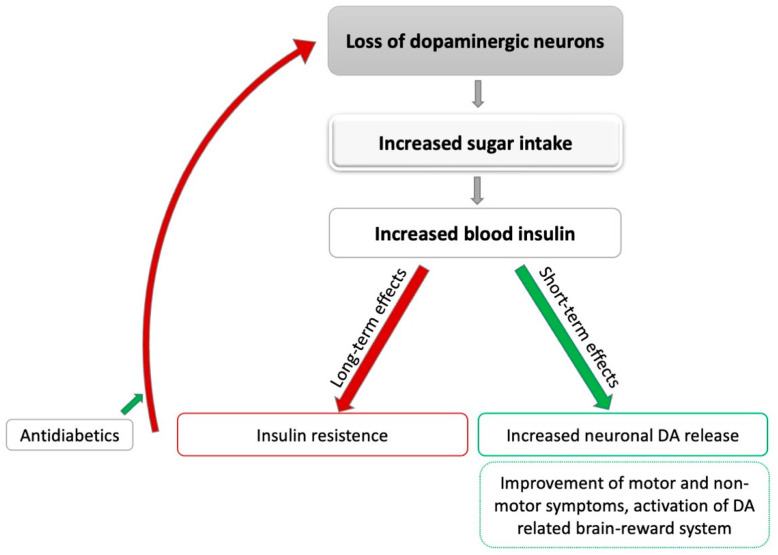
Lately, studies have shown that patients with Parkinson's disease (PD) report a strong craving for sweets and consume significantly more fast-acting carbohydrates than healthy controls. Consuming food with a high-sugar content is assumed to lead to an increase in insulin concentration, which could positively influence dopamine concentration in the brain and unconsciously be used by patients as kind of "self-medication" to compensate for a lack of dopamine in PD. On the other hand, high-sugar intake could also lead to insulin resistance and diabetes, which is discussed as a causative factor for progressive neurodegeneration in PD. In this critical appraisal, we discuss the role of sugar intake and insulin on dopamine metabolism in patients with PD and how this could influence the potential neurodegeneration mediated by insulin resistance.
最近的研究表明,帕金森病(PD)患者强烈渴望甜食,并且比健康对照组消耗更多的快速作用碳水化合物。人们认为,食用高糖含量的食物会导致胰岛素浓度升高,这可能会对大脑中的多巴胺浓度产生积极影响,并且患者会不自觉地将其用作“自我治疗”来弥补 PD 中多巴胺的缺乏。另一方面,高糖摄入也可能导致胰岛素抵抗和糖尿病,这被认为是 PD 中进行性神经退行性变的一个致病因素。在这篇批判性评价中,我们讨论了糖摄入和胰岛素对 PD 患者多巴胺代谢的作用,以及这如何影响胰岛素抵抗介导的潜在神经退行性变。