
壳聚糖引发种子可改善白三叶在水分胁迫下与抗氧化防御和脱水响应途径变化相关的萌发特性。
Seed Priming with Chitosan Improves Germination Characteristics Associated with Alterations in Antioxidant Defense and Dehydration-Responsive Pathway in White Clover under Water Stress.
作者信息
Ling Yao, Zhao Yue, Cheng Bizhen, Tan Meng, Zhang Yan, Li Zhou
机构信息
Department of Turf Science and Engineering, College of Grassland Science and Technology, Sichuan Agricultural University, Chengdu 611130, China.
出版信息
Plants (Basel). 2022 Aug 2;11(15):2015. doi: 10.3390/plants11152015.
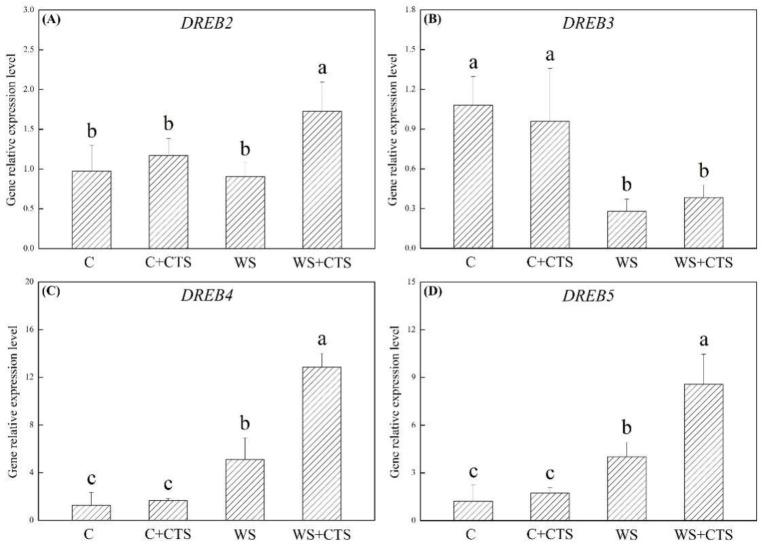
Water stress decreases seed-germination characteristics and also hinders subsequent seedling establishment. Seed priming with bioactive compounds has been proven as an effective way to improve seed germination under normal and stressful conditions. However, effect and mechanism of seed priming with chitosan (CTS) on improving seed germination and seedling establishment were not well-understood under water-deficit conditions. White clover () seeds were pretreated with or without 5 mg/L CTS before being subjected to water stress induced by 18% (/) polyethylene glycol 6000 for 7 days of germination in a controlled growth chamber. Results showed that water stress significantly decreased germination percentage, germination vigor, germination index, seed vigor index, and seedling dry weight and also increased mean germination time and accumulation of reactive oxygen species, leading to membrane lipid peroxidation during seed germination. These symptoms could be significantly alleviated by the CTS priming through activating superoxide dismutase, catalase, and peroxidase activities. In addition, seeds pretreated with CTS exhibited significantly higher expression levels of genes encoding dehydration-responsive transcription factors (, , and ) and dehydrins (, , and ) than those seeds without the CTS priming. Current findings indicated that the CTS-induced tolerance to water stress could be associated with the enhancement in dehydration-responsive pathway during seed germination.
水分胁迫会降低种子萌发特性,还会阻碍后续幼苗的形成。用生物活性化合物引发种子已被证明是在正常和胁迫条件下提高种子萌发率的有效方法。然而,在水分亏缺条件下,壳聚糖(CTS)引发种子对提高种子萌发率和幼苗形成的效果及机制尚不清楚。在可控生长室中,白三叶草()种子在18%(/)聚乙二醇6000诱导的水分胁迫下萌发7天之前,用或不用5 mg/L CTS进行预处理。结果表明,水分胁迫显著降低了发芽率、发芽活力、发芽指数、种子活力指数和幼苗干重,还延长了平均发芽时间并增加了活性氧的积累,导致种子萌发期间膜脂过氧化。通过激活超氧化物歧化酶、过氧化氢酶和过氧化物酶活性,CTS引发可显著缓解这些症状。此外,与未用CTS引发的种子相比,用CTS预处理的种子中编码脱水响应转录因子(、和)和脱水素(、和)的基因表达水平显著更高。目前的研究结果表明,CTS诱导的对水分胁迫的耐受性可能与种子萌发期间脱水响应途径的增强有关。


 Zotero 插件