• 文献检索
  • 文档翻译
  • 深度研究
  • 学术资讯
  • Suppr Zotero 插件Zotero 插件
  • 邀请有礼
  • 套餐&价格
  • 历史记录
应用&插件
Suppr Zotero 插件Zotero 插件浏览器插件Mac 客户端Windows 客户端微信小程序
定价
高级版会员购买积分包购买API积分包
服务
文献检索文档翻译深度研究API 文档MCP 服务
关于我们
关于 Suppr公司介绍联系我们用户协议隐私条款
关注我们

Suppr 超能文献

核心技术专利:CN118964589B侵权必究
粤ICP备2023148730 号-1Suppr @ 2026

文献检索

告别复杂PubMed语法,用中文像聊天一样搜索,搜遍4000万医学文献。AI智能推荐,让科研检索更轻松。

立即免费搜索

文件翻译

保留排版,准确专业,支持PDF/Word/PPT等文件格式,支持 12+语言互译。

免费翻译文档

深度研究

AI帮你快速写综述,25分钟生成高质量综述,智能提取关键信息,辅助科研写作。

立即免费体验

基于迁移学习的物联网网络入侵检测框架。

Transfer-Learning-Based Intrusion Detection Framework in IoT Networks.

机构信息

Department of Computer Architecture, Universitat Politècnica de Catalunya, 08034 Barcelona, Spain.

出版信息

Sensors (Basel). 2022 Jul 27;22(15):5621. doi: 10.3390/s22155621.

DOI:10.3390/s22155621
PMID:35957178
原文链接:https://pmc.ncbi.nlm.nih.gov/articles/PMC9371036/
Abstract

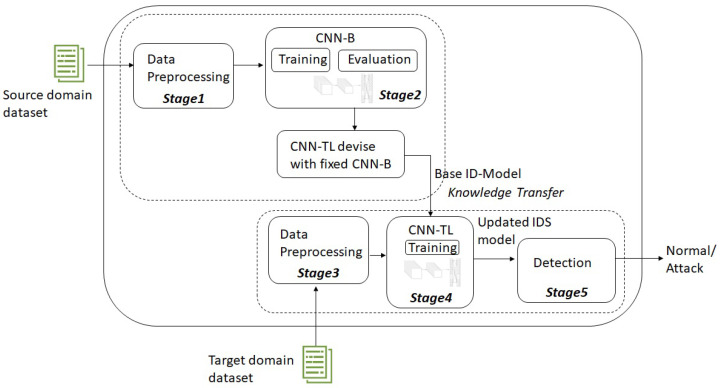
Cyberattacks in the Internet of Things (IoT) are growing exponentially, especially zero-day attacks mostly driven by security weaknesses on IoT networks. Traditional intrusion detection systems (IDSs) adopted machine learning (ML), especially deep Learning (DL), to improve the detection of cyberattacks. DL-based IDSs require balanced datasets with large amounts of labeled data; however, there is a lack of such large collections in IoT networks. This paper proposes an efficient intrusion detection framework based on transfer learning (TL), knowledge transfer, and model refinement, for the effective detection of zero-day attacks. The framework is tailored to 5G IoT scenarios with unbalanced and scarce labeled datasets. The TL model is based on convolutional neural networks (CNNs). The framework was evaluated to detect a wide range of zero-day attacks. To this end, three specialized datasets were created. Experimental results show that the proposed TL-based framework achieves high accuracy and low false prediction rate (). The proposed solution has better detection rates for the different families of known and zero-day attacks than any previous DL-based IDS. These results demonstrate that TL is effective in the detection of cyberattacks in IoT environments.

摘要

物联网 (IoT) 中的网络攻击呈指数级增长,尤其是由 IoT 网络安全漏洞引发的零日攻击。传统的入侵检测系统 (IDS) 采用机器学习 (ML),尤其是深度学习 (DL),来提高对网络攻击的检测能力。基于 DL 的 IDS 需要具有大量标记数据的平衡数据集;然而,IoT 网络中缺乏这样的大型数据集。本文提出了一种基于迁移学习 (TL)、知识迁移和模型细化的高效入侵检测框架,用于有效检测零日攻击。该框架针对具有不平衡和稀缺标记数据集的 5G IoT 场景进行了定制。TL 模型基于卷积神经网络 (CNNs)。该框架用于检测广泛的零日攻击。为此,创建了三个专门的数据集。实验结果表明,基于 TL 的框架实现了高准确率和低误报率()。与任何以前基于 DL 的 IDS 相比,所提出的解决方案对不同类型的已知和零日攻击具有更好的检测率。这些结果表明,TL 在检测 IoT 环境中的网络攻击方面非常有效。

https://cdn.ncbi.nlm.nih.gov/pmc/blobs/4b89/9371036/f124c59c644e/sensors-22-05621-g004.jpg
https://cdn.ncbi.nlm.nih.gov/pmc/blobs/4b89/9371036/b8231027f72e/sensors-22-05621-g001.jpg
https://cdn.ncbi.nlm.nih.gov/pmc/blobs/4b89/9371036/01879efd970f/sensors-22-05621-g002.jpg
https://cdn.ncbi.nlm.nih.gov/pmc/blobs/4b89/9371036/661479a6ee0a/sensors-22-05621-g003.jpg
https://cdn.ncbi.nlm.nih.gov/pmc/blobs/4b89/9371036/f124c59c644e/sensors-22-05621-g004.jpg
https://cdn.ncbi.nlm.nih.gov/pmc/blobs/4b89/9371036/b8231027f72e/sensors-22-05621-g001.jpg
https://cdn.ncbi.nlm.nih.gov/pmc/blobs/4b89/9371036/01879efd970f/sensors-22-05621-g002.jpg
https://cdn.ncbi.nlm.nih.gov/pmc/blobs/4b89/9371036/661479a6ee0a/sensors-22-05621-g003.jpg
https://cdn.ncbi.nlm.nih.gov/pmc/blobs/4b89/9371036/f124c59c644e/sensors-22-05621-g004.jpg

相似文献

1
Transfer-Learning-Based Intrusion Detection Framework in IoT Networks.基于迁移学习的物联网网络入侵检测框架。
Sensors (Basel). 2022 Jul 27;22(15):5621. doi: 10.3390/s22155621.
2
IoT Intrusion Detection Taxonomy, Reference Architecture, and Analyses.物联网入侵检测分类法、参考架构和分析。
Sensors (Basel). 2021 Sep 26;21(19):6432. doi: 10.3390/s21196432.
3
A New Intrusion Detection System for the Internet of Things via Deep Convolutional Neural Network and Feature Engineering.基于深度卷积神经网络和特征工程的物联网新型入侵检测系统。
Sensors (Basel). 2022 May 10;22(10):3607. doi: 10.3390/s22103607.
4
Customised Intrusion Detection for an Industrial IoT Heterogeneous Network Based on Machine Learning Algorithms Called FTL-CID.基于机器学习算法的工业物联网异构网络的定制入侵检测,称为 FTL-CID。
Sensors (Basel). 2022 Dec 28;23(1):321. doi: 10.3390/s23010321.
5
A hybrid deep learning-based intrusion detection system for IoT networks.一种用于物联网网络的基于深度学习的混合入侵检测系统。
Math Biosci Eng. 2023 Jun 13;20(8):13491-13520. doi: 10.3934/mbe.2023602.
6
Using Embedded Feature Selection and CNN for Classification on CCD-INID-V1-A New IoT Dataset.利用嵌入式特征选择和卷积神经网络对 CCD-INID-V1-新物联网数据集进行分类。
Sensors (Basel). 2021 Jul 15;21(14):4834. doi: 10.3390/s21144834.
7
ROAST-IoT: A Novel Range-Optimized Attention Convolutional Scattered Technique for Intrusion Detection in IoT Networks.ROAST-IoT:一种用于物联网网络入侵检测的新型距离优化注意力卷积散射技术。
Sensors (Basel). 2023 Sep 23;23(19):8044. doi: 10.3390/s23198044.
8
BoostedEnML: Efficient Technique for Detecting Cyberattacks in IoT Systems Using Boosted Ensemble Machine Learning.增强集成机器学习的物联网系统网络攻击检测高效技术:BoostedEnML
Sensors (Basel). 2022 Sep 29;22(19):7409. doi: 10.3390/s22197409.
9
Towards Deep-Learning-Driven Intrusion Detection for the Internet of Things.迈向基于深度学习驱动的物联网入侵检测
Sensors (Basel). 2019 Apr 27;19(9):1977. doi: 10.3390/s19091977.
10
HDL-IDS: A Hybrid Deep Learning Architecture for Intrusion Detection in the Internet of Vehicles.HDL-IDS:一种用于车联网入侵检测的混合深度学习架构。
Sensors (Basel). 2022 Feb 10;22(4):1340. doi: 10.3390/s22041340.

引用本文的文献

1
Signature-based intrusion detection using machine learning and deep learning approaches empowered with fuzzy clustering.基于签名的入侵检测,采用机器学习和深度学习方法,并结合模糊聚类技术。
Sci Rep. 2025 Jan 11;15(1):1726. doi: 10.1038/s41598-025-85866-7.
2
A Scalable Approach to Internet of Things and Industrial Internet of Things Security: Evaluating Adaptive Self-Adjusting Memory K-Nearest Neighbor for Zero-Day Attack Detection.一种适用于物联网和工业物联网安全的可扩展方法:评估用于零日攻击检测的自适应自调整内存K近邻算法
Sensors (Basel). 2025 Jan 2;25(1):216. doi: 10.3390/s25010216.
3
A lightweight model design approach for few-shot malicious traffic classification.

本文引用的文献

1
Deep Transfer Learning Based Intrusion Detection System for Electric Vehicular Networks.基于深度迁移学习的车联网入侵检测系统。
Sensors (Basel). 2021 Jul 11;21(14):4736. doi: 10.3390/s21144736.
2
Towards Deep-Learning-Driven Intrusion Detection for the Internet of Things.迈向基于深度学习驱动的物联网入侵检测
Sensors (Basel). 2019 Apr 27;19(9):1977. doi: 10.3390/s19091977.
一种用于少样本恶意流量分类的轻量级模型设计方法。
Sci Rep. 2024 Oct 21;14(1):24710. doi: 10.1038/s41598-024-73342-7.
4
Logistic Regression Ensemble Classifier for Intrusion Detection System in Internet of Things.物联网入侵检测系统的逻辑回归集成分类器
Sensors (Basel). 2023 Dec 3;23(23):9583. doi: 10.3390/s23239583.