Garcia Rodrigue, Rajan Deepthi, Warming Peder Emil, Svane Jesper, Vissing Christoffer, Weeke Peter, Barcella Carlo Alberto, Jabbari Reza, Gislason Gunnar Hilmar, Torp-Pedersen Christian, Petersen Jørgen Holm, Folke Fredrik, Tfelt-Hansen Jacob
Department of Cardiology, The Heart Centre, Copenhagen University Hospital, Rigshospitalet, Blegdamsvej 9, 2100 Copenhagen, Denmark.
Cardiology Department, University Hospital of Poitiers, 2 rue de la Milétrie, 86000 Poitiers, France.
Lancet Reg Health Eur. 2022 Aug 5;22:100477. doi: 10.1016/j.lanepe.2022.100477. eCollection 2022 Nov.
Ethnicity might impact out-of-hospital cardiac arrest (OHCA) risk, but it has scarcely been studied in Europe. We aimed to assess whether ethnicity influenced the risk of OHCA of cardiac cause in Danish immigrants and its interplay with risk factors for OHCA and socioeconomic status.
This nationwide study included all immigrants between 18 and 80 years present in Denmark at some point between 2001 and 2020. Regions of origin were defined as Africa, Arabic countries, Asia, Eastern Europe, Latin America, and Western countries. OHCAs with presumed cardiac cause were identified from the Danish Cardiac Arrest Registry.
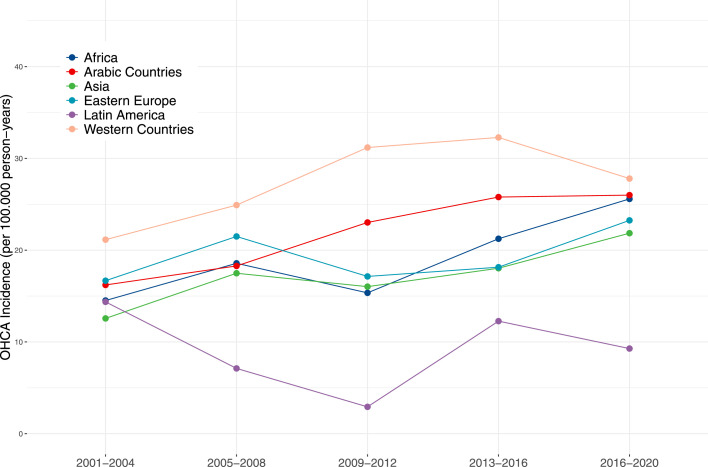
Overall, among 1,011,565 immigrants, a total of 1,801 (0.2%) OHCAs (median age 64 (Q1-Q3 53-72) years, 72% males) occurred. The age- and sex- standardized (reference: Western countries) incidence of OHCA (/1,00,000 person-years) was 34.6 (27.8-43.4) in African, 34.1 (30.4-38.4) in Arabic, 33.5 (29.3-38.2) in Asian, 35.6 (31.9-39.6) in Eastern European, and 16.2 (9.0-27.2) in Latin American immigrants. When selecting Western origin as a reference, and after adjusting on OHCA risk factors, Arabic (HR 1.18, 95%CI 1.04-1.35; =0.01), Eastern European (HR 1.28, 95%CI 1.13-1.46; <0.001), and African origin (HR 1.34, 95%CI 1.10-1.63; <0.01) were associated with higher risk of OHCA, whereas Latin American origin (HR 0.58, 95%CI 0.35-0.0.96; =0.03) was associated with lower risk of OHCA. Comparable results were observed when adjusting on education level and economic status.
This study emphasizes that ethnicity is associated with OHCA risk, even when considering traditional cardiac arrest risk factors.
R Garcia received a grant from the for his post-doctoral fellowship and this work was supported by the (grant# 31364).
种族可能会影响院外心脏骤停(OHCA)的风险,但在欧洲对此研究甚少。我们旨在评估种族是否会影响丹麦移民中心脏原因导致的OHCA风险,以及它与OHCA风险因素和社会经济地位之间的相互作用。
这项全国性研究纳入了2001年至2020年期间在丹麦的所有18至80岁的移民。原籍地区分为非洲、阿拉伯国家、亚洲、东欧、拉丁美洲和西方国家。从丹麦心脏骤停登记处识别出推测为心脏原因的OHCA病例。
总体而言,在1,011,565名移民中,共发生了1,801例(0.2%)OHCA(中位年龄64岁(四分位间距53 - 72岁),72%为男性)。按年龄和性别标准化(参照:西方国家)的OHCA发病率(每100,000人年)在非洲移民中为34.6(27.8 - 43.4),在阿拉伯移民中为34.1(30.4 - 38.4),在亚洲移民中为33.5(29.3 - 38.2),在东欧移民中为35.6(31.9 - 39.6),在拉丁美洲移民中为16.2(9.0 - 27.2)。以西方原籍为参照,在对OHCA风险因素进行调整后,阿拉伯裔(风险比1.18,95%置信区间1.04 - 1.35;P = 0.01)、东欧裔(风险比1.28,95%置信区间1.13 - 1.46;P < 0.001)和非洲裔(风险比1.34,95%置信区间1.10 - 1.63;P < 0.01)与较高的OHCA风险相关,而拉丁美洲裔(风险比0.58,95%置信区间0.35 - 0.96;P = 0.03)与较低的OHCA风险相关。在对教育水平和经济状况进行调整时也观察到了类似结果。
本研究强调,即使考虑传统的心脏骤停风险因素,种族也与OHCA风险相关。
R·加西亚获得了[具体资助机构]的博士后奖学金,本研究得到了[具体资助机构](资助编号31364)的支持。