
土壤pH值决定华北平原麦田微型真核生物群落的空间分布、组装过程及共存网络。
Soil pH Determines the Spatial Distribution, Assembly Processes, and Co-existence Networks of Microeukaryotic Community in Wheat Fields of the North China Plain.
作者信息
Shi Yu, Xu Mengwei, Zhao Yige, Cheng Liang, Chu Haiyan
机构信息
State Key Laboratory of Crop Stress Adaptation and Improvement, School of Life Sciences, Henan University, Kaifeng, China.
State Key Laboratory of Soil and Sustainable Agriculture, Institute of Soil Science, Chinese Academy of Sciences, Nanjing, China.
出版信息
Front Microbiol. 2022 Jul 25;13:911116. doi: 10.3389/fmicb.2022.911116. eCollection 2022.
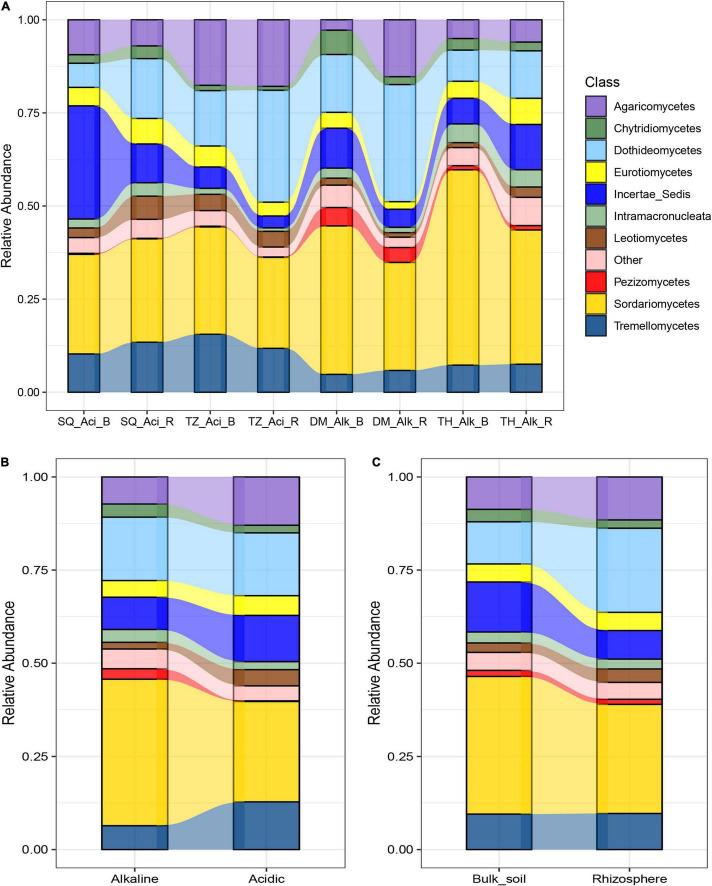
Soil microeukaryotes play a pivotal role in soil nutrient cycling and crop growth in agroecosystems. However, knowledge of microeukaryotic community distribution patterns, assembly processes, and co-existence networks is greatly limited. Here, microbial eukaryotes in bulk and rhizosphere soils of the North China Plain were investigated. The results showed that soil pH was the driving factor for the microeukaryotic community composition in the bulk and rhizosphere soils. The soil microeukaryotic community could significantly differ between alkaline and acidic soils. The results indicated that the soil pH had a stronger effect than niche differences on community composition. Partial Mantel tests showed that soil pH and spatial distance had similar effects on the microeukaryotic community composition in the bulk soil. However, in the rhizosphere soil, spatial distance had a stronger effect than soil pH. Infer Community Assembly Mechanisms by Phylogenetic bin-based null model (iCAMP) analysis revealed that drift was the most important process driving microeukaryotic community assembly, with an average relative importance of 37.4-71.1%. Dispersal limitation displayed slightly greater importance in alkaline rhizosphere than in alkaline bulk soils. Meanwhile, the opposite trend was observed in acidic soils. In addition, the contribution of each assembly process to each iCAMP lineage "bin" varied according to the acidic or alkaline conditions of the soil and the niche environment. High proportions of positive links were found within the four ecological networks. Alkaline soil networks, especially the alkaline bulk soil network, showed greater complexity than the acidic soil networks. Natural connectivity analysis revealed that the rhizosphere community had a greater stability than the bulk soil community in alkaline soil. This study provides a foundation for understanding the potential roles of microbial eukaryotes in agricultural soil ecosystem functioning.
土壤微型真核生物在农业生态系统的土壤养分循环和作物生长中起着关键作用。然而,关于微型真核生物群落分布模式、组装过程和共存网络的知识非常有限。在此,对华北平原大田土壤和根际土壤中的微型真核生物进行了研究。结果表明,土壤pH是大田土壤和根际土壤中微型真核生物群落组成的驱动因素。碱性土壤和酸性土壤中的土壤微型真核生物群落可能存在显著差异。结果表明,土壤pH对群落组成的影响比生态位差异更强。偏 Mantel 检验表明,土壤pH和空间距离对大田土壤中微型真核生物群落组成的影响相似。然而,在根际土壤中,空间距离的影响比土壤pH更强。通过基于系统发育分类单元的空模型(iCAMP)分析推断群落组装机制表明,随机漂变是驱动微型真核生物群落组装的最重要过程,平均相对重要性为37.4 - 71.1%。扩散限制在碱性根际土壤中的重要性略高于碱性大田土壤。同时,在酸性土壤中观察到相反的趋势。此外,根据土壤的酸性或碱性条件以及生态位环境,每个组装过程对每个iCAMP谱系“分类单元”的贡献各不相同。在四个生态网络中发现了高比例的正连接。碱性土壤网络,尤其是碱性大田土壤网络,比酸性土壤网络表现出更高的复杂性。自然连通性分析表明,在碱性土壤中,根际群落比大田土壤群落具有更高的稳定性。本研究为理解微型真核生物在农业土壤生态系统功能中的潜在作用提供了基础。


 Zotero 插件