Rui Junpeng, Zhao Yuwei, Cong Nan, Wang Fuxin, Li Chao, Liu Xiang, Hu Jingjing, Ling Ning, Jing Xin
State Key Laboratory of Herbage Improvement and Grassland Agro-ecosystems, College of Ecology, Lanzhou University, Lanzhou, China.
Center for Grassland Microbiome, College of Pastoral Agriculture Science and Technology, Lanzhou University, Lanzhou, China.
Front Microbiol. 2023 Sep 22;14:1280011. doi: 10.3389/fmicb.2023.1280011. eCollection 2023.
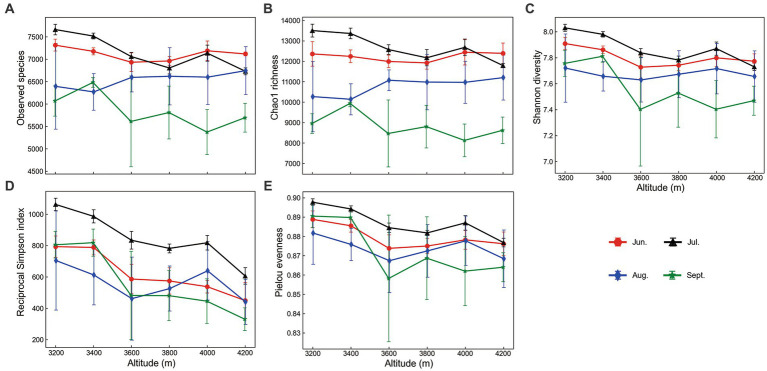
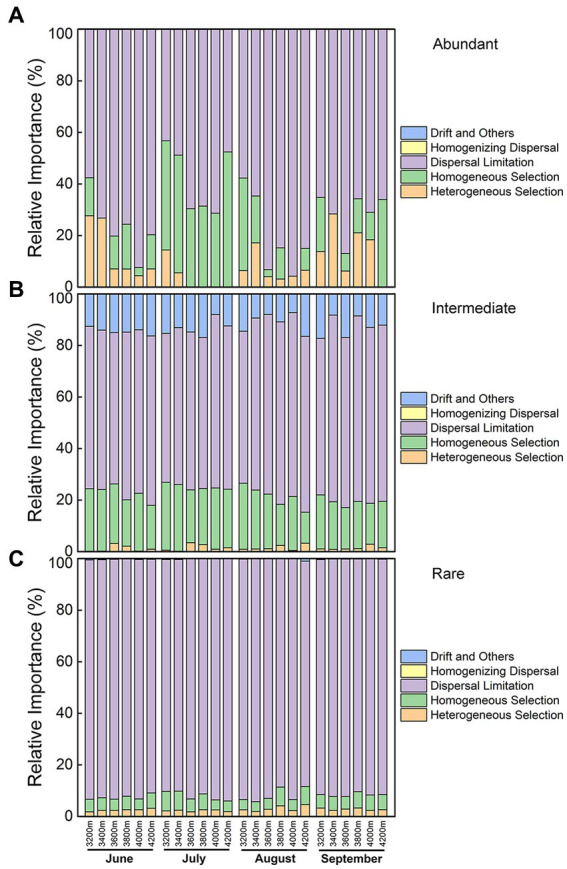
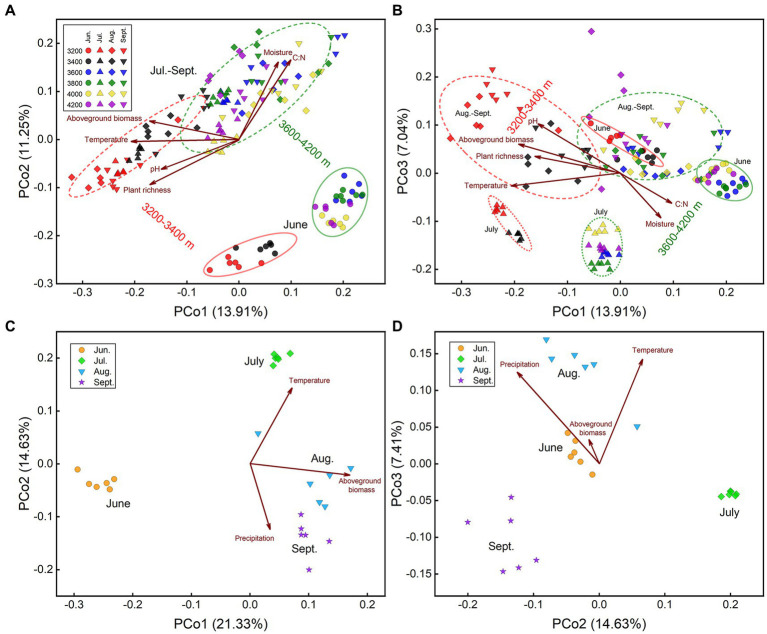
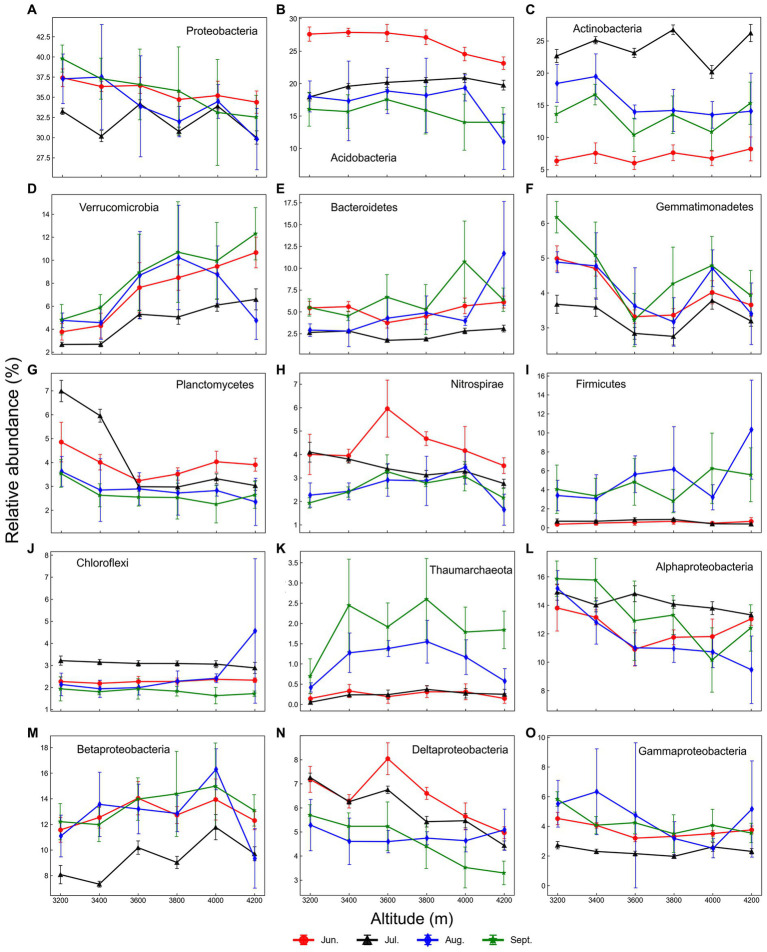
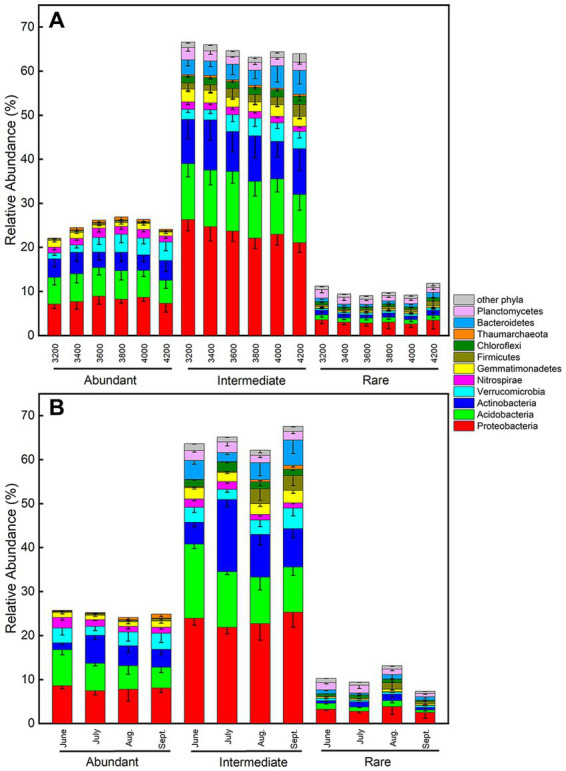
The alpine grassland ecosystem is a biodiversity hotspot of plants on the Qinghai-Tibetan Plateau, where rapid climate change is altering the patterns of plant biodiversity along elevational and seasonal gradients of environments. However, how belowground microbial biodiversity changes along elevational gradient during the growing season is not well understood yet. Here, we investigated the elevational distribution of soil prokaryotic communities by using 16S rRNA amplicon sequencing along an elevational gradient between 3,200 and 4,200 m, and a seasonal gradient between June and September in the Qinghai-Tibetan alpine grasslands. First, we found soil prokaryotic diversity and community composition significantly shifted along the elevational gradient, mainly driven by soil temperature and moisture. Species richness did not show consistent elevational trends, while those of evenness declined with elevation. Copiotrophs and symbiotic diazotrophs declined with elevation, while oligotrophs and AOB increased, affected by temperature. Anaerobic or facultatively anaerobic bacteria and AOA were hump-shaped, mainly influenced by moisture. Second, seasonal patterns of community composition were mainly driven by aboveground biomass, precipitation, and soil temperature. The seasonal dynamics of community composition indicated that soil prokaryotic community, particularly Actinobacteria, was sensitive to short-term climate change, such as the monthly precipitation variation. At last, dispersal limitation consistently dominated the assembly process of soil prokaryotic communities along both elevational and seasonal gradients, especially for those of rare species, while the deterministic process of abundant species was relatively higher at drier sites and in drier July. The balance between deterministic and stochastic processes in abundant subcommunities might be strongly influenced by water conditions (precipitation/moisture). Our findings suggest that both elevation and season can alter the patterns of soil prokaryotic biodiversity in alpine grassland ecosystem of Qinghai-Tibetan Plateau, which is a biodiversity hotspot and is experiencing rapid climate change. This work provides new insights into the response of soil prokaryotic communities to changes in elevation and season, and helps us understand the temporal and spatial variations in such climate change-sensitive regions.
高寒草原生态系统是青藏高原植物的生物多样性热点地区,在这里,快速的气候变化正在改变植物生物多样性沿海拔和季节环境梯度的格局。然而,生长季节期间地下微生物多样性如何沿海拔梯度变化,目前仍知之甚少。在此,我们通过16S rRNA扩增子测序,研究了青藏高原高寒草原海拔3200米至4200米之间的海拔梯度以及6月至9月之间的季节梯度上土壤原核生物群落的海拔分布。首先,我们发现土壤原核生物多样性和群落组成沿海拔梯度显著变化,主要受土壤温度和湿度驱动。物种丰富度未呈现一致的海拔趋势,而均匀度随海拔下降。富营养菌和共生固氮菌随海拔下降,而贫营养菌和氨氧化细菌受温度影响随海拔升高。厌氧或兼性厌氧细菌和氨氧化古菌呈驼峰状,主要受湿度影响。其次,群落组成的季节模式主要受地上生物量、降水量和土壤温度驱动。群落组成的季节动态表明,土壤原核生物群落,尤其是放线菌,对短期气候变化敏感,如月度降水量变化。最后,扩散限制在土壤原核生物群落沿海拔和季节梯度的组装过程中始终占主导地位,尤其是对于稀有物种,而优势物种的确定性过程在较干燥的地点和7月较干燥时相对较高。优势亚群落中确定性和随机过程之间的平衡可能受水分条件(降水量/湿度)强烈影响。我们的研究结果表明,海拔和季节均可改变青藏高原高寒草原生态系统中土壤原核生物多样性的格局,该地区是生物多样性热点地区且正在经历快速气候变化。这项工作为土壤原核生物群落对海拔和季节变化的响应提供了新见解,并有助于我们理解此类气候变化敏感地区的时空变化。