Traditional Chinese Medicine Integrated Department of Nephrology, the First Affiliated Hospital of Zhengzhou University, Research Institute of Nephrology, Zhengzhou University, Henan Province Research Center For Kidney Disease, Key Laboratory of Precision Diagnosis and Treatment for Chronic Kidney Disease in Henan Province, Zhengzhou, China.
Department of Orthopedics, First People's Hospital of Shangqiu, Shangqiu, China.
Front Immunol. 2022 Jul 26;13:956090. doi: 10.3389/fimmu.2022.956090. eCollection 2022.
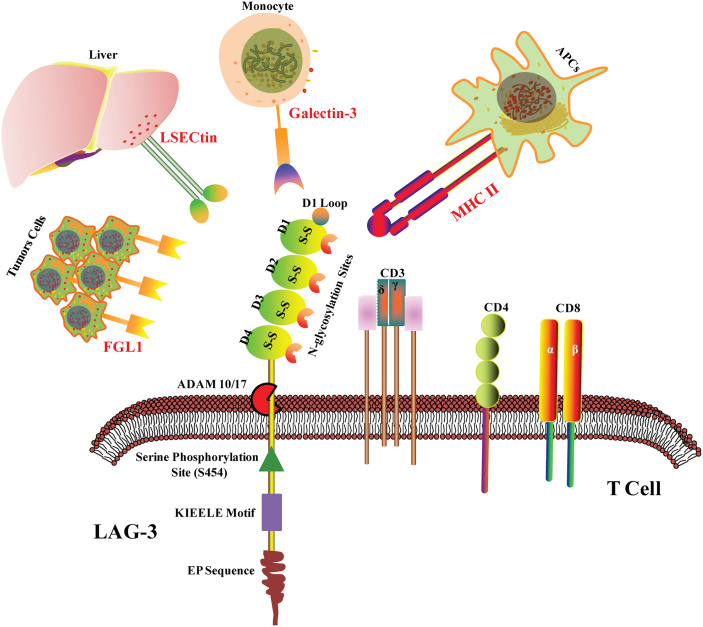
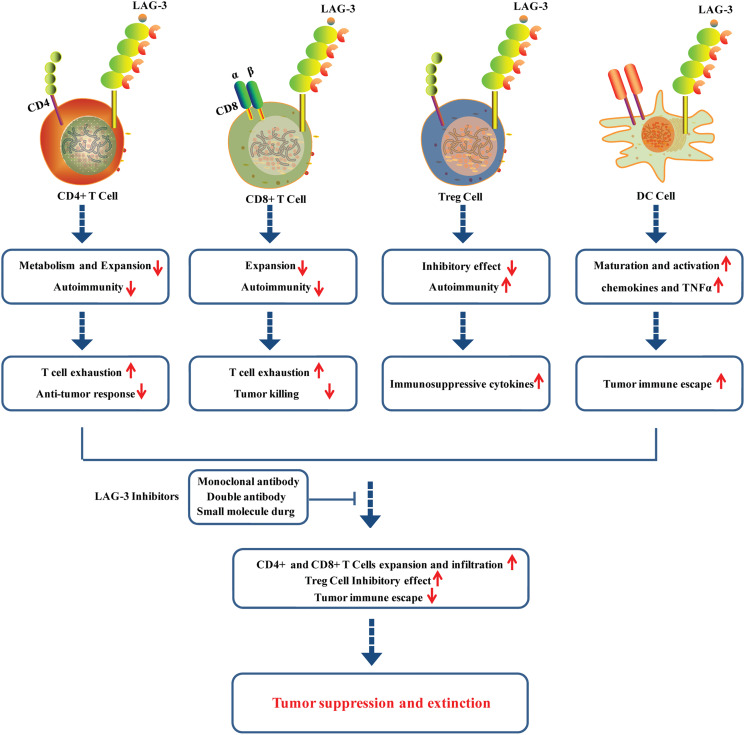
LAG-3, a type of immune checkpoint receptor protein belonging to the immunoglobulin superfamily, is confirmed to be expressed on activated immune cells, mainly including activated T cells. LAG-3 can negatively regulate the function of T cells, exerting important effects on maintaining the homeostasis of the immune system under normal physiological conditions and promoting tumor cells immune escape in the tumor microenvironment. Given its important biological roles, LAG-3 has been regarded as a promising target for cancer immunotherapy. To date, many LAG-3 inhibitors have been reported, which can be divided into monoclonal antibody, double antibody, and small molecule drug, some of which have entered the clinical research stage. LAG-3 inhibitors can negatively regulate and suppress T cell proliferation and activation through combination with MHC II ligand. Besides, LAG-3 inhibitors can also affect T cell function binding to Galectin-3 and LSECtin. In addition, LAG-3 inhibitors can prevent the FGL1-LAG-3 interaction, thereby enhancing the human body's antitumor immune effect. In this review, we will describe the function of LAG-3 and summarize the latest LAG-3 inhibitors in the clinic for cancer therapy.
LAG-3,一种免疫检查点受体蛋白,属于免疫球蛋白超家族,被证实表达于激活的免疫细胞上,主要包括激活的 T 细胞。LAG-3 可负向调节 T 细胞的功能,在正常生理条件下对维持免疫系统的稳态和促进肿瘤微环境中的肿瘤细胞免疫逃逸发挥重要作用。鉴于其重要的生物学作用,LAG-3 已被视为癌症免疫治疗的有前途的靶点。迄今为止,已经报道了许多 LAG-3 抑制剂,可分为单克隆抗体、双抗体和小分子药物,其中一些已进入临床研究阶段。LAG-3 抑制剂可通过与 MHC II 配体结合负向调节和抑制 T 细胞增殖和活化。此外,LAG-3 抑制剂还可通过与 Galectin-3 和 LSECtin 结合影响 T 细胞功能。此外,LAG-3 抑制剂可防止 FGL1-LAG-3 相互作用,从而增强人体的抗肿瘤免疫效应。在本文中,我们将描述 LAG-3 的功能,并总结用于癌症治疗的最新 LAG-3 抑制剂。