Department of Dermatology, Medical Center University of Freiburg, Faculty of Medicine, University of Freiburg, Freiburg, Germany.
Department of Dermatology, University of Cologne, Cologne, Germany.
Front Immunol. 2022 Jul 25;13:945176. doi: 10.3389/fimmu.2022.945176. eCollection 2022.
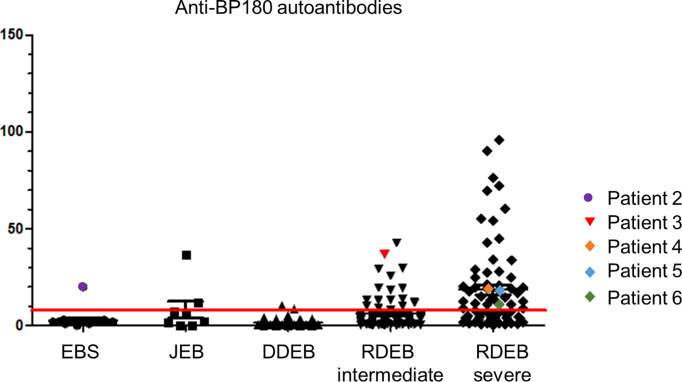
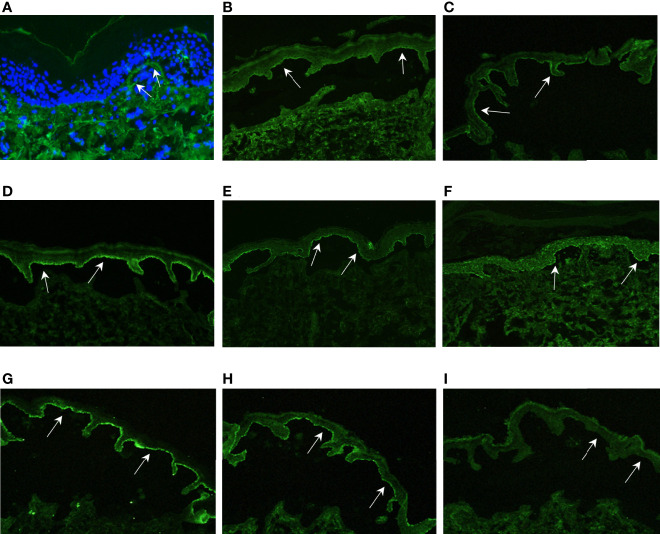
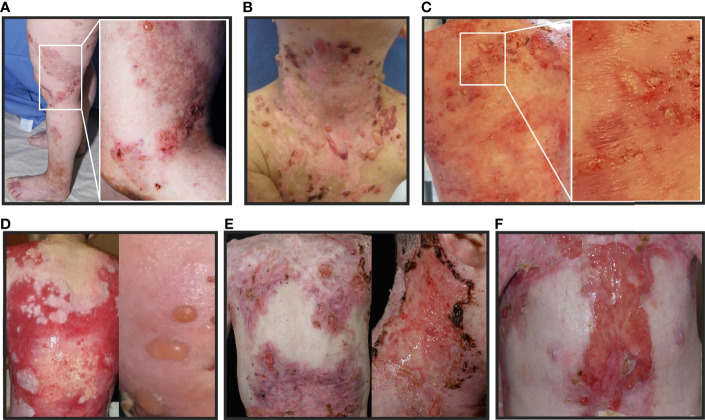
Skin blistering disorders are associated with inherited defects in proteins involved in the dermal-epidermal adhesion or autoantibodies targeting those proteins. Although blistering in hereditary epidermolysis bullosa (EB) is pathogenetically linked to genetic deficiency of distinct proteins of the epidermis or the dermal-epidermal junction, circulating autoantibodies against these proteins have also been identified in EB patients. So far, autoantibodies have been considered bystanders in EB and active pathogenicity of them in EB has not been disclosed. In sera of a cohort of 258 EB patients, we found by ELISA in 22% of the patients autoantibodies against the bullous pemphigoid antigen BP180. The titers correlated negatively with collagen VII skin expression and positively with disease severity. Among those patients, we identified six (2.33%) with clinical features of an autoimmune bullous disorder (AIBD) and positive indirect immunofluorescence (IIF) staining. In literature, we found four more cases of EB patients developing disease-aggravating AIBD. Co-existence of these two rare skin disorders suggests that EB patients have a predisposition for the development of AIBD. Our work highlights that EB patients with increased itch or blister formation should be evaluated for additional AIBD and repeated screening for changes in autoantibody titers and skin-binding specificities is advised.
皮肤水疱病与涉及真皮-表皮黏附的蛋白遗传缺陷或针对这些蛋白的自身抗体有关。虽然遗传性大疱性表皮松解症(EB)的水疱病与表皮或真皮-表皮连接处的特定蛋白的遗传缺乏有关,但EB 患者的循环自身抗体也已被识别。到目前为止,自身抗体被认为是 EB 的旁观者,它们在 EB 中的致病活性尚未被揭示。在 258 名 EB 患者的队列中,我们通过 ELISA 在 22%的患者中发现了针对大疱性类天疱疮抗原 BP180 的自身抗体。滴度与胶原 VII 皮肤表达呈负相关,与疾病严重程度呈正相关。在这些患者中,我们确定了 6 名(2.33%)具有自身免疫性大疱性疾病(AIBD)和间接免疫荧光(IIF)染色阳性的临床特征。在文献中,我们发现了另外 4 例 EB 患者发展为病情加重的 AIBD。这两种罕见皮肤病的共存表明,EB 患者有发展为 AIBD 的倾向。我们的工作强调,出现瘙痒或水疱形成增加的 EB 患者应评估是否存在其他 AIBD,并建议重复检测自身抗体滴度和皮肤结合特异性的变化。