Global Value Chain Research Center, Zhejiang Gongshang University, Hangzhou, China.
Institute of International Business and Economics Innovation and Governance, Shanghai University of International Business and Economics, Shanghai, China.
Front Public Health. 2022 Jul 26;10:949482. doi: 10.3389/fpubh.2022.949482. eCollection 2022.
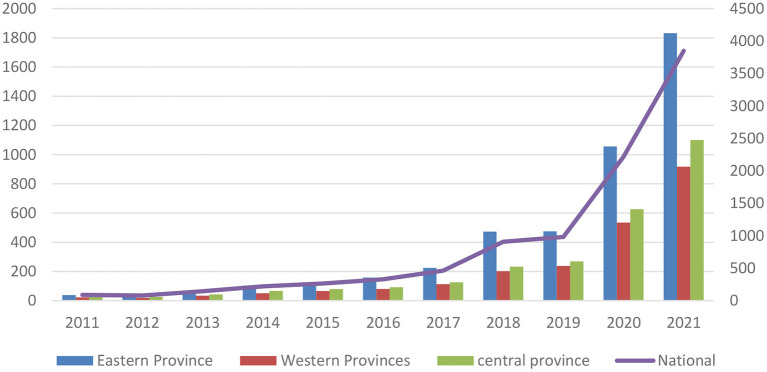
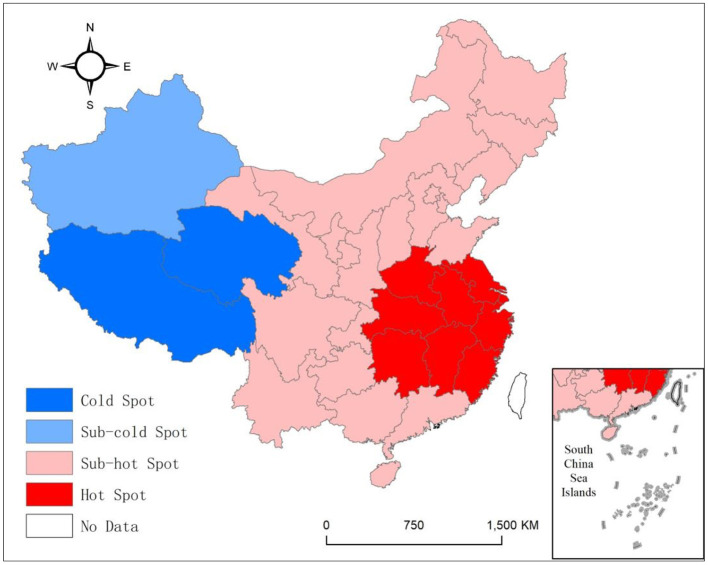
Since the outbreak of Coronavirus Disease 2019 (COVID-19), the Chinese government has taken a number of measures to effectively control the pandemic. By the end of 2021, China achieved a full vaccination rate higher than 85%. The Chinese Plan provides an important model for the global fight against COVID-19. Internet search reflects the public's attention toward and potential demand for a particular thing. Research on the spatiotemporal characteristics of online attention to vaccines can determine the spatiotemporal distribution of vaccine demand in China and provides a basis for global public health policy making. This study analyzes the spatiotemporal characteristics of online attention to vaccines and their influencing factors in 31 provinces/municipalities in mainland China with Baidu Index as the data source by using geographic concentration index, coefficient of variation, GeoDetector, and other methods. The following findings are presented. First, online attention to vaccines showed an overall upward trend in China since 2011, especially after 2016. Significant seasonal differences and an unbalanced monthly distribution were observed. Second, there was an obvious geographical imbalance in online attention to vaccines among the provinces/municipalities, generally exhibiting a spatial pattern of "high in the east and low in the west." Low aggregation and obvious spatial dispersion among the provinces/municipalities were also observed. The geographic distribution of hot and cold spots of online attention to vaccines has clear boundaries. The hot spots are mainly distributed in the central-eastern provinces and the cold spots are in the western provinces. Third, the spatiotemporal differences in online attention to vaccines are the combined result of socioeconomic level, socio-demographic characteristics, and disease control level.
自 2019 年冠状病毒病(COVID-19)爆发以来,中国政府采取了多项措施来有效控制疫情。到 2021 年底,中国实现了高于 85%的完全疫苗接种率。中国方案为全球抗击 COVID-19 提供了重要模式。互联网搜索反映了公众对特定事物的关注和潜在需求。对疫苗在线关注度的时空特征的研究可以确定中国疫苗需求的时空分布,并为全球公共卫生政策制定提供依据。本研究以百度指数为数据来源,采用地理集中指数、变异系数、GeoDetector 等方法,分析了中国大陆 31 个省(市、自治区)疫苗在线关注度的时空特征及其影响因素。结果表明:(1)自 2011 年以来,中国的疫苗在线关注度总体呈上升趋势,尤其是 2016 年以后。呈现出明显的季节性差异和不平衡的月度分布。(2)疫苗在线关注度在省际间存在明显的地理不平衡,总体呈“东高西低”的空间格局。同时还存在聚集度低、分布离散度大的特点,疫苗在线关注度的热点和冷点地域分布具有明显的边界。热点主要分布在中东部省份,冷点主要分布在西部省份。(3)疫苗在线关注度的时空差异是社会经济水平、社会人口特征和疾病防控水平综合作用的结果。