Deng Yu-Qin, Zhang Binn, Zheng Xinyan, Liu Ying, Wang Xiaochun, Zhou Chenglin
Institute of Sports Science, Nantong University, Nantong, China.
School of Psychology, Shanghai University of Sport, Shanghai, China.
Front Psychol. 2022 Jul 25;13:674501. doi: 10.3389/fpsyg.2022.674501. eCollection 2022.
Individuals with mind-wandering experience their attention decoupling from their main task at hand while others with flow experience fully engage in their task with the optimum experience. There seems to be a negative relationship between mind-wandering and flow. However, it remains unclear to what extent mind-wandering exerts an impact on flow. And it is also elusive whether physical activity and mindfulness, which are as important factors that affected individuals' attentional control and psychological health, are beneficial in explaining the association between mind-wandering and flow. The current study investigated the relationship between mind-wandering and flow, and the potential mediation effects of physical activity and mindfulness in this association.
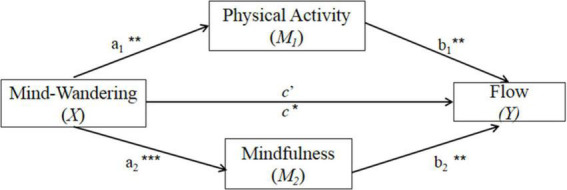
A cross-sectional exploratory study design, including multiple scales such as the Mind-Wandering Questionnaire (MWQ), the International Physical Activity Questionnaire Short Form (IPAQ), Mindfulness Attention and Awareness Scale (MAAS), and the Short Dispositional Flow Scale (S-DFS) was applied. Descriptive statistics and bivariate correlation coefficients were applied in the analysis of these data. A multiple mediation model was used to examine the relationships between mind-wandering, flow, physical activity, and mindfulness.
Mind-wandering was inversely associated with physical activity, mindfulness and flow, respectively; and flow was positively related to physical activity and mindfulness, respectively. Moreover, multiple mediation results demonstrated that physical activity and mindfulness, respectively, mediated the relationship between mind-wandering and flow.
These findings are helpful to understand how our minds attend to the present moment, and the crucial roles of physical activity and mindfulness in the association between mind-wandering and flow. An implication of these is the possibility that the effective strategies aimed at enhancing both the levels of physical activity and mindfulness are needed to reduce the negative impact of mind-wandering on flow.
思绪游走的个体在经历注意力从手头主要任务上脱耦,而处于心流体验的个体则以最佳体验全身心投入任务。思绪游走与心流之间似乎存在负相关关系。然而,思绪游走在多大程度上对心流产生影响仍不清楚。此外,体育活动和正念作为影响个体注意力控制和心理健康的重要因素,是否有助于解释思绪游走与心流之间的关联也尚不明确。本研究调查了思绪游走与心流之间的关系,以及体育活动和正念在此关联中的潜在中介作用。
采用横断面探索性研究设计,应用了多个量表,如思绪游移问卷(MWQ)、国际体力活动问卷简表(IPAQ)、正念注意觉知量表(MAAS)和简短特质性心流量表(S-DFS)。对这些数据进行描述性统计和双变量相关系数分析。使用多重中介模型来检验思绪游走、心流、体育活动和正念之间的关系。
思绪游走分别与体育活动、正念和心流呈负相关;心流分别与体育活动和正念呈正相关。此外,多重中介结果表明,体育活动和正念分别中介了思绪游走与心流之间的关系。
这些发现有助于理解我们的思维如何关注当下,以及体育活动和正念在思绪游走与心流关联中的关键作用。这些发现的一个启示是,可能需要旨在提高体育活动水平和正念水平的有效策略来减少思绪游走对心流的负面影响。