Anijs Midas, Devanna Paolo, Vernes Sonja C
Neurogenetics of Vocal Communication Group, Max Planck Institute for Psycholinguistics, Nijmegen, Netherlands.
School of Biology, The University of St Andrews, St Andrews, United Kingdom.
Front Mol Neurosci. 2022 Jul 25;15:941494. doi: 10.3389/fnmol.2022.941494. eCollection 2022.
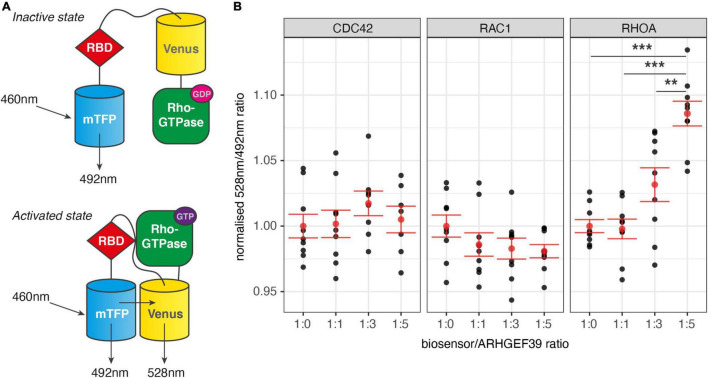
was previously implicated in developmental language disorder (DLD) a functional polymorphism that can disrupt post-transcriptional regulation by microRNAs. ARHGEF39 is part of the family of Rho guanine nucleotide exchange factors (RhoGEFs) that activate small Rho GTPases to regulate a wide variety of cellular processes. However, little is known about the function of , or how its function might contribute to neurodevelopment or related disorders. Here, we explore the molecular function of ARHGEF39 and show that it activates the Rho GTPase RHOA and that high ARHGEF39 expression in cell cultures leads to an increase of detached cells. To explore its role in neurodevelopment, we analyse published single cell RNA-sequencing data and demonstrate that is a marker gene for proliferating neural progenitor cells and that it is co-expressed with genes involved in cell division. This suggests a role for in neurogenesis in the developing brain. The co-expression of with other RHOA-regulating genes supports RHOA as substrate of ARHGEF39 in neural cells, and the involvement of RHOA in neuropsychiatric disorders highlights a potential link between ARHGEF39 and neurodevelopment and disorder. Understanding the GTPase substrate, co-expression network, and processes downstream of provide new avenues for exploring the mechanisms by which altered expression levels of ARHGEF39 may contribute to neurodevelopment and associated disorders.
以前被认为与发育性语言障碍(DLD)有关,这是一种功能性多态性,可破坏微小RNA的转录后调控。ARHGEF39是Rho鸟嘌呤核苷酸交换因子(RhoGEFs)家族的一部分,该家族激活小Rho GTP酶以调节多种细胞过程。然而,人们对ARHGEF39的功能,或其功能如何可能导致神经发育或相关疾病知之甚少。在这里,我们探索了ARHGEF39的分子功能,表明它激活Rho GTP酶RHOA,并且在细胞培养物中高表达ARHGEF39会导致脱离细胞的增加。为了探索其在神经发育中的作用,我们分析了已发表的单细胞RNA测序数据,并证明ARHGEF39是增殖神经祖细胞的标记基因,并且它与参与细胞分裂的基因共表达。这表明ARHGEF39在发育中的大脑神经发生中起作用。ARHGEF39与其他RHOA调节基因的共表达支持RHOA作为神经细胞中ARHGEF39的底物,并且RHOA参与神经精神疾病突出了ARHGEF39与神经发育和疾病之间的潜在联系。了解GTP酶底物、共表达网络以及ARHGEF39下游的过程为探索ARHGEF39表达水平改变可能导致神经发育和相关疾病的机制提供了新途径。