Department of Hematology and Immunohematology, School of Biomedical and Laboratory Sciences, College of Medicine and Health Sciences, University of Gondar, Gondar, Ethiopia.
Vasc Health Risk Manag. 2022 Aug 5;18:617-627. doi: 10.2147/VHRM.S371912. eCollection 2022.
Heart disease is a leading cause of hospitalization, death, and poor physical function due to comorbid conditions such as atrial fibrillation and stroke. It affects the blood hemostatic system, vasculature, and flow dynamics, causing both arterial and venous thrombosis. Thus, this study aimed to determine the magnitude of coagulation abnormalities among patients with heart disease attending the University of Gondar Comprehensive Specialized hospital.
A cross-sectional study was conducted on a total of 98 patients with heart disease. Pretested structured questionnaires were used to collect data on socio-demographic and clinical variables. About 6 mL of venous blood was collected with the vacutainer method and analyzed using Huma cue-due plus and Sysmex KX-21N hematology analyzers for assessing coagulation abnormalities. Stool samples were processed via a direct wet mount. Thin and thick blood films were examined to assess malaria parasites. Data was entered into EPI-Info version 3.5.3 and then transported to SPSS version 20 for analysis. Descriptive statistics were summarized using frequency and percentage. Univariate and multivariate logistic regression models were fitted to identify factors associated with coagulopathy. P-value <0.05 was considered to be statistically significant.
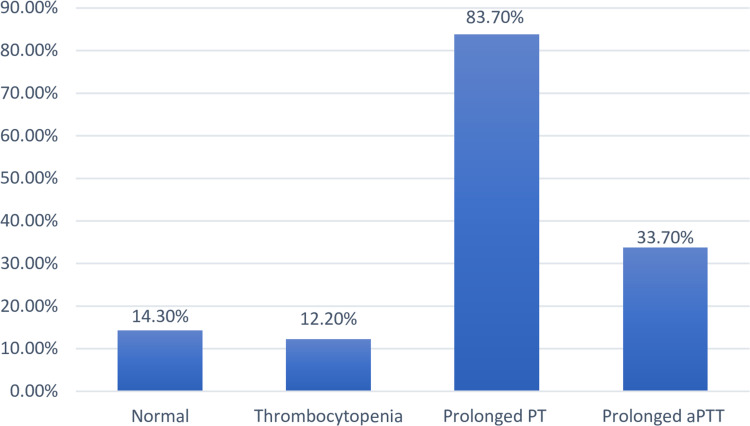
The overall magnitude of coagulation abnormalities (thrombocytopenia, prolonged prothrombin time, and activated partial thromboplastin time) in patients with heart diseases was 85.7% (95% CI: 81.96, 89.45). Besides, prolonged prothrombin time, prolonged activated partial thromboplastin time, and thrombocytopenia were detected in 83.7%, 33.7%, and 12.2% of the study participants, respectively. Participants who are taking medications for chronic disease (AOR = 0.17; 95% CI: 0.04, 0.69), participants with stroke (AOR = 20; 95% CI: 14.7, 35), and participants taking antibiotics (AOR = 8.17; 95% CI: 1.66, 40.27) were significantly associated with prolonged coagulation time.
This study showed that patients with heart disease had prolonged prothrombin time, activated partial thromboplastin time, and thrombocytopenia. Therefore, coagulation parameters are required to be checked regularly to monitor coagulation disorders and their complications in heart disease patients.
心脏病是导致住院、死亡和身体功能下降的主要原因,其病因包括房颤和中风等合并症。心脏病会影响血液止血系统、血管和血流动力学,导致动脉和静脉血栓形成。因此,本研究旨在确定在贡德尔大学综合专科医院就诊的心脏病患者凝血异常的程度。
这是一项横断面研究,共纳入了 98 例心脏病患者。使用经过预测试的结构化问卷收集社会人口学和临床变量数据。采用 vacutainer 法采集 6 毫升静脉血,使用 Huma cue-due plus 和 Sysmex KX-21N 血液分析仪评估凝血异常。处理粪便样本采用直接湿载片法。检查薄血和厚血涂片以评估疟原虫。数据输入 EPI-Info 版本 3.5.3 并传输至 SPSS 版本 20 进行分析。使用频率和百分比对描述性统计数据进行总结。采用单变量和多变量逻辑回归模型来确定与凝血障碍相关的因素。P 值<0.05 被认为具有统计学意义。
患有心脏病的患者中凝血异常(血小板减少、凝血酶原时间延长和活化部分凝血活酶时间延长)的总体发生率为 85.7%(95%CI:81.96,89.45)。此外,研究参与者中分别有 83.7%、33.7%和 12.2%存在凝血酶原时间延长、活化部分凝血活酶时间延长和血小板减少。正在服用慢性病药物的患者(AOR = 0.17;95%CI:0.04,0.69)、患有中风的患者(AOR = 20;95%CI:14.7,35)和正在服用抗生素的患者(AOR = 8.17;95%CI:1.66,40.27)与凝血时间延长显著相关。
本研究表明,心脏病患者存在凝血酶原时间延长、活化部分凝血活酶时间延长和血小板减少。因此,需要定期检查凝血参数,以监测心脏病患者的凝血障碍及其并发症。