Ju Yanmin, Liu Ting, Zhang Kexin, Lin Xiaoye, Zheng Enlai, Leng Jiyan
Department of Cadre Ward, The First Hospital of Jilin University, Changchun, China.
Front Aging Neurosci. 2022 Jul 26;14:936024. doi: 10.3389/fnagi.2022.936024. eCollection 2022.
Depression is common and serious among elderly patients. The treatment of elderly depression is often delayed owing to insufficient diagnosis, which eventually leads to adverse consequences.
To explore the association between the parameters of the Comprehensive Geriatric Assessment and depression in elderly patients.
A cross-sectional study of 211 outpatients and inpatients aged ≥ 65 years from the Comprehensive Geriatric Assessment database was conducted. A Comprehensive Geriatric Assessment inventory was prepared by compiling and screening general characteristics, chronic diseases (cardiovascular disease, diabetes, and peptic ulcer disease), nutritional status, daily living ability, anthropometric measurements (body mass index (BMI), upper arm circumference, and calf circumference), and blood biochemical indicators (hemoglobin, albumin, prealbumin, triglycerides, and low-density lipoprotein cholesterol). The Geriatric Depression Scale was also conducted for each elderly patient to screen for depression. A multivariable logistic regression analysis was used to determine the association between the parameters of the Comprehensive Geriatric Assessment and geriatric depression.
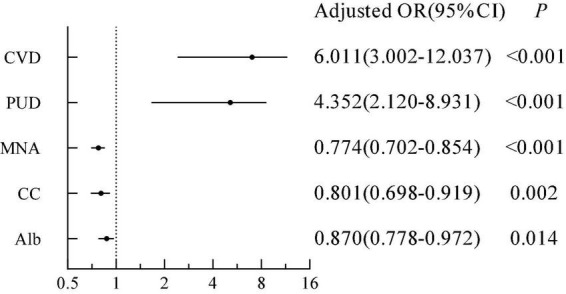
There were 63 patients in the depression group with a median age of 84.00 years, and 148 patients in the non-depression group with a median age of 78.50 years. After controlling for confounders, the risk of depression in elderly patients with cardiovascular diseases was 6.011 times higher than that in those without cardiovascular diseases ( < 0.001); and the risk of depression in elderly patients with peptic ulcer diseases was 4.352 times higher than that in those without peptic ulcer diseases ( < 0.001); the risk of depression in elderly patients decreased by 22.6% for each 1-point increase in the Mini Nutritional Assessment ( < 0.001). The risk of depression in elderly patients decreased by 19.9% for each 1-point increase in calf circumference ( = 0.002), and by 13.0% for each 1-point increase in albumin ( = 0.014).
Our findings suggest that Comprehensive Geriatric Assessment parameters, such as cardiovascular disease, peptic ulcer disease, Mini Nutritional Assessment score, calf circumference, and albumin, were associated with depression. The Comprehensive Geriatric Assessment can assist in the early identification of depression in the elderly population.
抑郁症在老年患者中常见且严重。由于诊断不足,老年抑郁症的治疗常常延迟,最终导致不良后果。
探讨老年综合评估参数与老年患者抑郁症之间的关联。
对老年综合评估数据库中211名年龄≥65岁的门诊和住院患者进行横断面研究。通过汇编和筛选一般特征、慢性疾病(心血管疾病、糖尿病和消化性溃疡疾病)、营养状况、日常生活能力、人体测量指标(体重指数(BMI)、上臂围和小腿围)以及血液生化指标(血红蛋白、白蛋白、前白蛋白、甘油三酯和低密度脂蛋白胆固醇),编制了一份老年综合评估清单。还对每位老年患者进行老年抑郁量表测试以筛查抑郁症。采用多变量逻辑回归分析来确定老年综合评估参数与老年抑郁症之间的关联。
抑郁症组有63例患者,中位年龄为84.00岁;非抑郁症组有148例患者,中位年龄为78.50岁。在控制混杂因素后,患有心血管疾病的老年患者患抑郁症的风险比未患心血管疾病的患者高6.011倍(<0.001);患有消化性溃疡疾病的老年患者患抑郁症的风险比未患消化性溃疡疾病的患者高4.352倍(<0.001);老年患者的简易营养评估每增加1分,患抑郁症的风险降低22.6%(<0.001)。老年患者的小腿围每增加1分,患抑郁症的风险降低19.9%(=0.002),白蛋白每增加1分,患抑郁症的风险降低13.0%(=0.014)。
我们的研究结果表明,心血管疾病、消化性溃疡疾病、简易营养评估得分、小腿围和白蛋白等老年综合评估参数与抑郁症有关。老年综合评估有助于早期识别老年人群中的抑郁症。