Nahacka Zuzana, Novak Jaromir, Zobalova Renata, Neuzil Jiri
Laboratory of Molecular Therapy, Institute of Biotechnology, Czech Academy of Sciences, Prague, Czechia.
Faculty of Science, Charles University, Prague, Czechia.
Front Cell Dev Biol. 2022 Jul 25;10:937753. doi: 10.3389/fcell.2022.937753. eCollection 2022.
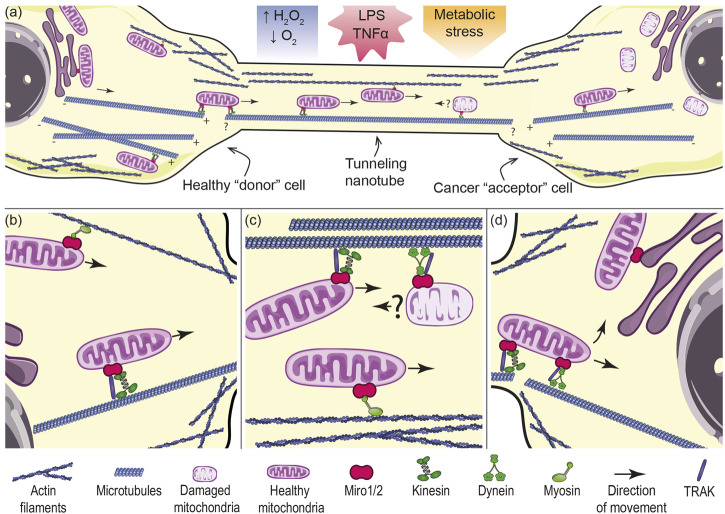
Mitochondria are organelles essential for tumor cell proliferation and metastasis. Although their main cellular function, generation of energy in the form of ATP is dispensable for cancer cells, their capability to drive their adaptation to stress originating from tumor microenvironment makes them a plausible therapeutic target. Recent research has revealed that cancer cells with damaged oxidative phosphorylation import healthy (functional) mitochondria from surrounding stromal cells to drive pyrimidine synthesis and cell proliferation. Furthermore, it has been shown that energetically competent mitochondria are fundamental for tumor cell migration, invasion and metastasis. The spatial positioning and transport of mitochondria involves Miro proteins from a subfamily of small GTPases, localized in outer mitochondrial membrane. Miro proteins are involved in the structure of the MICOS complex, connecting outer and inner-mitochondrial membrane; in mitochondria-ER communication; Ca metabolism; and in the recycling of damaged organelles mitophagy. The most important role of Miro is regulation of mitochondrial movement and distribution within (and between) cells, acting as an adaptor linking organelles to cytoskeleton-associated motor proteins. In this review, we discuss the function of Miro proteins in various modes of intercellular mitochondrial transfer, emphasizing the structure and dynamics of tunneling nanotubes, the most common transfer modality. We summarize the evidence for and propose possible roles of Miro proteins in nanotube-mediated transfer as well as in cancer cell migration and metastasis, both processes being tightly connected to cytoskeleton-driven mitochondrial movement and positioning.
线粒体是肿瘤细胞增殖和转移所必需的细胞器。尽管其主要细胞功能(以ATP形式产生能量)对癌细胞并非不可或缺,但其驱动癌细胞适应源自肿瘤微环境的应激的能力使其成为一个合理的治疗靶点。最近的研究表明,氧化磷酸化受损的癌细胞会从周围基质细胞中导入健康(有功能)的线粒体,以驱动嘧啶合成和细胞增殖。此外,研究表明,能量代谢正常的线粒体对肿瘤细胞的迁移、侵袭和转移至关重要。线粒体的空间定位和运输涉及小GTP酶亚家族的Miro蛋白,其定位于线粒体外膜。Miro蛋白参与MICOS复合体的结构,连接线粒体外膜和内膜;参与线粒体与内质网的通讯;参与钙代谢;以及参与受损细胞器的自噬回收。Miro最重要的作用是调节线粒体在细胞内(以及细胞间)的移动和分布,作为一种衔接蛋白将细胞器与细胞骨架相关的运动蛋白相连。在这篇综述中,我们讨论了Miro蛋白在细胞间线粒体转移的各种模式中的功能,重点强调了隧道纳米管(最常见的转移方式)的结构和动态变化。我们总结了Miro蛋白在纳米管介导的转移以及癌细胞迁移和转移中作用的证据,并提出了可能的作用,这两个过程都与细胞骨架驱动的线粒体移动和定位紧密相关。