Department of Speech-Language Pathology and Audiology, University of Pretoria, Pretoria, South Africa.
Virtual Hearing Lab, Collaborative initiative between University of Colorado and the University of Pretoria, Aurora, CO, USA.
Glob Health Action. 2022 Dec 31;15(1):2095784. doi: 10.1080/16549716.2022.2095784.
The rising prevalence of hearing loss is a global health concern. Professional hearing services are largely absent within low- and middle-income countries where appropriate skills are lacking. Task-shifting to community healthcare workers (CHWs) supported by mHealth technologies is an important strategy to address the problem.
To evaluate the feasibility of a community-based rehabilitation model providing hearing aids to adults in low-income communities using CHWs supported by mHealth technologies.
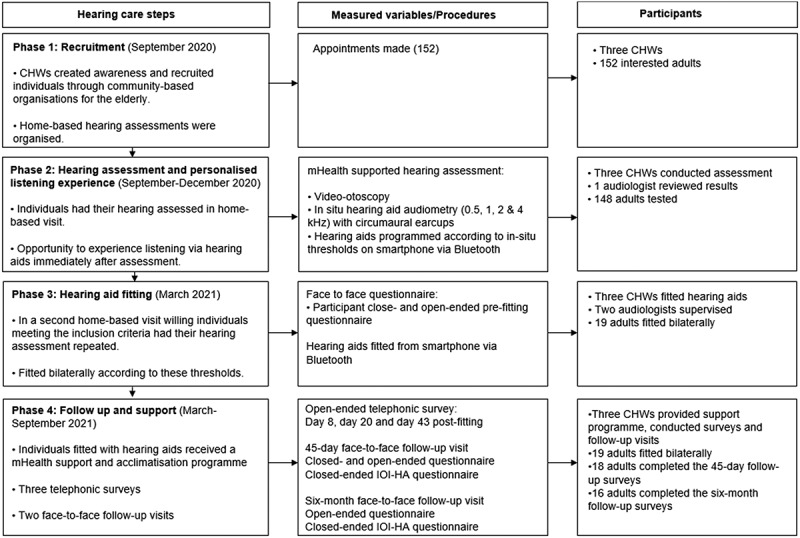
Between September 2020 and October 2021, hearing aid assessments and fittings were implemented for adults aged 18 and above in two low-income communities in the Western Cape, South Africa, using trained CHWs. A quantitative approach with illustrative open-ended questions was utilised to measure and analyse hearing aid outcomes. Data were collected through initial face-to-face interviews, telephone interviews, and face-to-face visits post-fitting. Responses to open-ended questions were analysed using inductive thematic analysis. The International Outcome Inventory - Hearing Aids questionnaire determined standardised hearing aid outcomes.
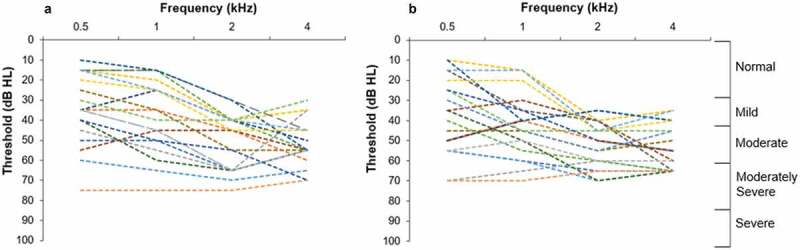
Of the 152 adults in the community who self-reported hearing difficulties, 148 were successfully tested by CHWs during home visits. Most had normal hearing (39.9%), 24.3% had bilateral sensorineural hearing loss, 20.9% had suspected conductive hearing loss, and 14.9% had unilateral hearing loss, of which 5.4% had suspected conductive loss. Forty adults met the inclusion criteria to be fitted with hearing aids. Nineteen of these were fitted bilaterally. Positive hearing aid outcomes and minimal device handling challenges were reported 45 days post-fitting and were maintained at six months. The majority (73.7%) of participants fitted were still making use of their hearing aids at the six-month follow-up.
Implementing a hearing healthcare service-delivery model facilitated by CHWs in low-income communities is feasible. mHealth technologies used by CHWs can support scalable service-delivery models with the potential for improved access and affordability in low-income settings.
听力损失的患病率不断上升是一个全球性的健康问题。在缺乏适当技能的中低收入国家,专业听力服务基本不存在。将任务转移到由移动健康技术支持的社区卫生工作者(CHW)是解决该问题的重要策略。
评估使用由移动健康技术支持的 CHW 为低收入社区的成年人提供助听器的基于社区的康复模式的可行性。
2020 年 9 月至 2021 年 10 月,在南非西开普省的两个低收入社区,使用经过培训的 CHW 为 18 岁及以上的成年人进行听力评估和适配。采用定量方法和说明性开放式问题来衡量和分析助听器的结果。数据通过初步的面对面访谈、电话访谈和适配后的面对面访问收集。使用归纳主题分析对开放式问题的回答进行分析。国际结果清单-助听器问卷确定了标准化的助听器结果。
在自我报告听力困难的 152 名社区成年人中,有 148 名在家庭访问中由 CHW 成功测试。大多数人听力正常(39.9%),24.3%有双侧感音神经性听力损失,20.9%有疑似传导性听力损失,14.9%有单侧听力损失,其中 5.4%有疑似传导性听力损失。有 40 名成年人符合佩戴助听器的纳入标准。其中 19 人双侧佩戴。在适配后 45 天报告了积极的助听器结果和最小的设备处理挑战,并且在六个月时仍保持不变。在六个月的随访中,大多数(73.7%)佩戴者仍在使用助听器。
在低收入社区中,由 CHW 实施听力保健服务交付模式是可行的。CHW 使用的移动健康技术可以支持可扩展的服务交付模式,有可能在低收入环境中提高可及性和负担能力。