Lubbers Jelle, Geurts Dirk, Hanssen Imke, Huijbers Marloes, Spijker Jan, Speckens Anne, Cladder-Micus Mira
Department of Psychiatry, Radboudumc Centre for Mindfulness, PO Box 9101, 6500 HB, Nijmegen, The Netherlands.
Depression Expertise Centre, Pro Persona Mental Health Care, Nijmeegsebaan 61, 6525 DX, Nijmegen, The Netherlands.
Int J Bipolar Disord. 2022 Aug 12;10(1):22. doi: 10.1186/s40345-022-00269-1.
Preliminary evidence suggests that Mindfulness-Based Cognitive Therapy (MBCT) is a promising treatment for bipolar disorder (BD). A proposed working mechanism of MBCT in attenuating depressive symptoms is reducing depressive rumination. The primary aim of this study was to investigate the effect of MBCT on self-reported trait depressive rumination and an experimental state measure of negative intrusive thoughts in BD patients. Exploratively, we investigated the effect of MBCT on positive rumination and positive intrusive thoughts.
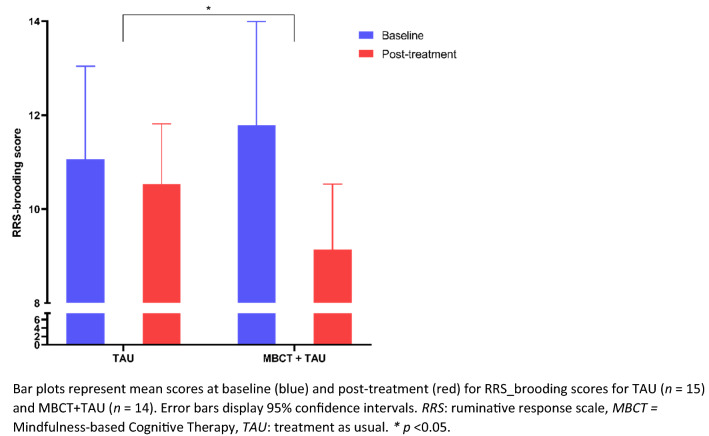
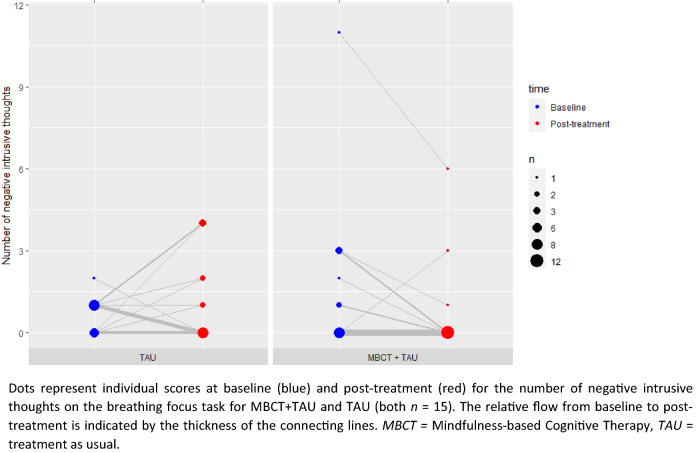
The study population consisted of a subsample of bipolar type I or II patients participating in a multicenter randomized controlled trial comparing MBCT + treatment as usual (TAU) (N = 25) to TAU alone (N = 24). Trait depressive rumination (RRS brooding subscale) and intrusive thoughts (breathing focus task (BFT)) were assessed at baseline (full subsample) and post-treatment (MBCT + TAU; n = 15, TAU; n = 15). During the BFT, participants were asked to report negative, positive and neutral intrusive thoughts while focusing on their breathing.
Compared to TAU alone, MBCT + TAU resulted in a significant pre- to post-treatment reduction of trait depressive rumination (R = .16, F(1, 27) = 5.15, p = 0.031; medium effect size (f = 0.19)) and negative intrusive thoughts on the BFT (R = .15, F(1, 28) = 4.88, p = 0.036; medium effect size (f = 0.17)). MBCT did not significantly change positive rumination or positive intrusive thoughts.
MBCT might be a helpful additional intervention to reduce depressive rumination in BD which might reduce risk of depressive relapse or recurrence. Considering the preliminary nature of our findings, future research should replicate our findings and explore whether this reduction in rumination following MBCT indeed mediates a reduction in depressive symptoms and relapse or recurrence in BD.
初步证据表明,基于正念的认知疗法(MBCT)是一种有前景的双相情感障碍(BD)治疗方法。MBCT减轻抑郁症状的一种假定作用机制是减少抑郁性沉思。本研究的主要目的是调查MBCT对双相情感障碍患者自我报告的特质性抑郁性沉思以及消极侵入性思维的实验状态测量指标的影响。探索性地,我们调查了MBCT对积极沉思和积极侵入性思维的影响。
研究人群包括参与一项多中心随机对照试验的I型或II型双相情感障碍患者的一个子样本,该试验将MBCT联合常规治疗(TAU)(N = 25)与单纯TAU(N = 24)进行比较。在基线(全子样本)和治疗后(MBCT + TAU;n = 15,TAU;n = 15)评估特质性抑郁性沉思(RRS沉思子量表)和侵入性思维(呼吸聚焦任务(BFT))。在BFT期间,要求参与者在专注呼吸时报告消极、积极和中性的侵入性思维。
与单纯TAU相比,MBCT + TAU在治疗前后导致特质性抑郁性沉思显著减少(R = 0.16,F(1, 27) = 5.15,p = 0.031;中等效应量(f = 0.19))以及BFT上的消极侵入性思维显著减少(R = 0.15,F(1, 28) = 4.88,p = 0.036;中等效应量(f = 0.17))。MBCT未显著改变积极沉思或积极侵入性思维。
MBCT可能是一种有助于减少双相情感障碍患者抑郁性沉思的额外干预措施,这可能降低抑郁复发或再发的风险。考虑到我们研究结果的初步性质,未来研究应重复我们的发现,并探索MBCT后这种沉思的减少是否确实介导了双相情感障碍患者抑郁症状以及复发或再发的减少。