Perestelo-Perez Lilisbeth, Barraca Jorge, Peñate Wenceslao, Rivero-Santana Amado, Alvarez-Perez Yolanda
Servicio de Evaluación del Servicio Canario de la Salud, Spain.
Red de Investigación en Servicios de Salud en Enfermedades Crónicas (REDISSEC), Spain.
Int J Clin Health Psychol. 2017 Sep-Dec;17(3):282-295. doi: 10.1016/j.ijchp.2017.07.004. Epub 2017 Aug 17.
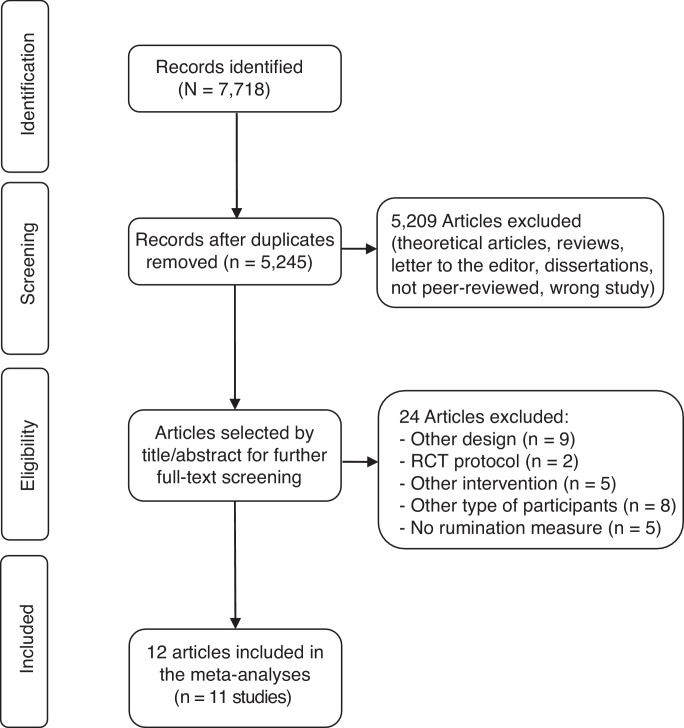
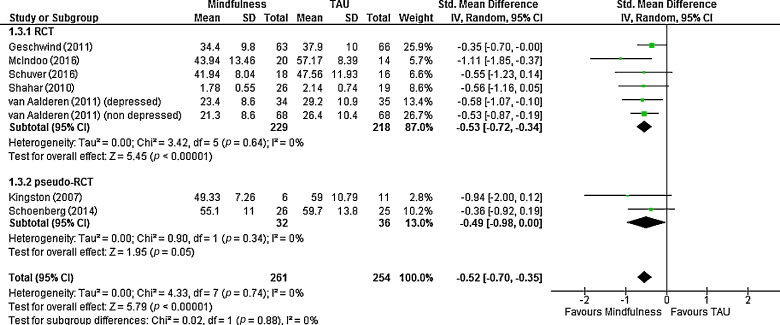
This systematic review aims to evaluate the effect of interventions based on the mindfulness and/or acceptance process on ruminative thoughts, in patients with depression. Electronic searches in Medline, Embase, Cochrane Central, PsycInfo, and Cinahl until December 2016, in addition to hand-searches of relevant studies, identified eleven studies that fulfilling inclusion criteria. A meta-analysis of the effect of the intervention compared to usual care showed a significant and moderate reduction of ruminative thoughts ( = -0.59, 95% CI: -0.77, -0.41; I = 0%). Furthermore, findings suggest that mindfulness/acceptance processes might mediate changes in rumination, and that they in turn mediate in the clinical effects of interventions. A meta-analysis of three studies that compared the intervention to other active treatments (medication, behavioral activation and cognitive-behavioral therapy, respectively) showed no significant differences. Mindfulness-based cognitive therapy compared to usual care, produces a significant and moderate reduction in rumination. This effect seems independent of the treatment phase (acute or maintenance) or the number of past depressive episodes, and it was maintained one month after the end of treatment. However, further controlled studies with real patients that compare the most commonly used cognitive-behavioral techniques to treat ruminative thoughts to the acceptance and mindfulness techniques are needed.
本系统评价旨在评估基于正念和/或接纳过程的干预措施对抑郁症患者反刍思维的影响。除了手工检索相关研究外,截至2016年12月,还对Medline、Embase、Cochrane Central、PsycInfo和Cinahl进行了电子检索,共识别出11项符合纳入标准的研究。与常规护理相比,干预效果的荟萃分析显示反刍思维有显著且适度的减少(= -0.59,95%CI:-0.77,-0.41;I = 0%)。此外,研究结果表明,正念/接纳过程可能介导反刍思维的变化,进而介导干预措施的临床效果。对三项分别将该干预措施与其他积极治疗方法(分别为药物治疗、行为激活和认知行为疗法)进行比较的研究进行的荟萃分析显示,没有显著差异。与常规护理相比,基于正念的认知疗法能显著且适度地减少反刍思维。这种效果似乎与治疗阶段(急性或维持期)或过去抑郁发作的次数无关,且在治疗结束后一个月仍能维持。然而,还需要进一步对真实患者进行对照研究,将治疗反刍思维最常用的认知行为技术与接纳和正念技术进行比较。