Department of Endocrinology, Huai'an First People's Hospital, Nanjing Medical University, Huai'an, 223300, People's Republic of China.
Division of Endocrinology, Diabetes and Nutrition, Department of Medicine, University of Maryland School of Medicine, Baltimore, MD, 21201, USA.
Mol Biotechnol. 2023 Mar;65(3):394-400. doi: 10.1007/s12033-022-00529-6. Epub 2022 Aug 12.
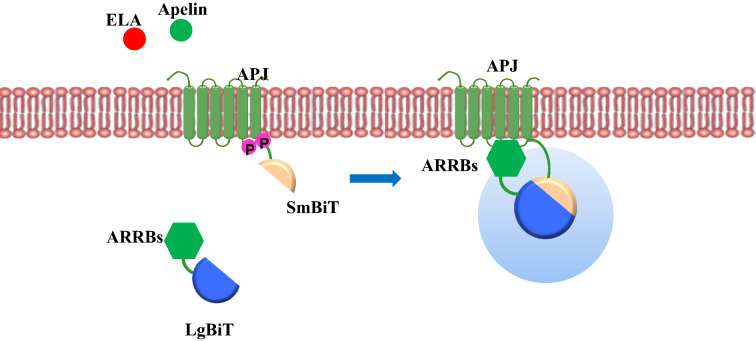
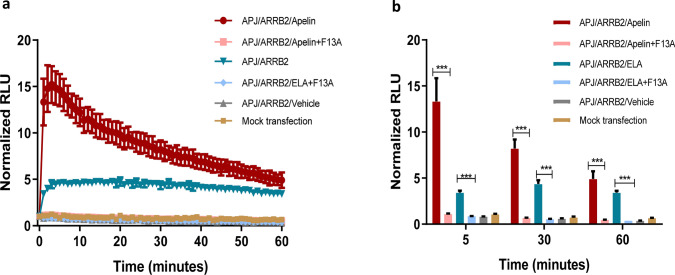
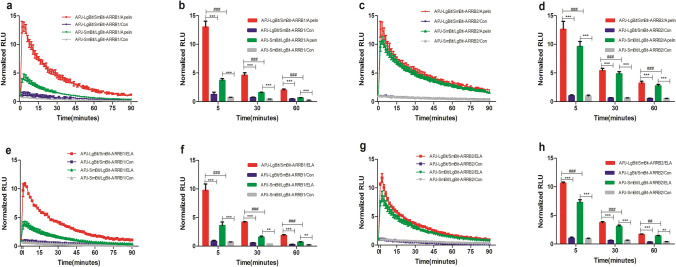
Apelin receptor (APJ) ligands elabela (ELA) and apelin have divergent distributions and function differently in vitro and in vivo. Whether differences exist in their capacity of recruitment of β-arrestins (ARRBs) to APJ remains unknown. The aim of the current study was to investigate the different effects of ELA and apelin on the interaction between APJ and ARRBs in live cells by NanoBiT®. NanoBiT® system is a new technology for studying protein-protein interaction in real-time in live cells, based on the emission of luminescence when two split components of NanoLuc luciferase, large Bit (LgBit) and small Bit (SmBit), complement each other to form an enzymatically active entity. We tagged the APJ and ARRBs with LgBit or SmBit and then evaluated their interactions in transiently transfected HEK293T cells, and determined the signal strength yielded as a result of the interaction. We also investigated the concentration-dependent response of the APJ-ARRB interaction in response to ELA and apelin. Finally, we assessed the effect of F13A, an APJ antagonist which is structurally very similar to apelin-13, on ELA- and apelin-mediated APJ-ARRB interactions. The NanoLuc® luciferase signal was highest in the pair of APJ-LgBit with SmBit-ARRB1 or SmBit-ARRB2. NanoLuc® luciferase signal increased in a concentration-dependent manner from 0.1 nM to 10 μM in response to ELA or apelin. Interestingly, ELA elicited weaker APJ-ARRB interaction signals than apelin. Pre-treatment with F13A potently reduced the APJ-ARRB interaction in response to both ELA and apelin. Our results demonstrated that both ELA and apelin promoted the interaction of APJ and ARRBs in a concentration-dependent manner, and ELA is less efficacious than apelin in inducing the recruitment of ARRBs to APJ, providing a biased functional aspect of ELA vs. apelin at the receptor signaling level. Additionally, ELA and apelin may share the same binding site(s) or pocket(s) at the APJ level.
Apelin 受体 (APJ) 配体 Elabela (ELA) 和 apelin 在体外和体内的分布不同,功能也不同。它们在招募β-arrestins (ARRBs) 到 APJ 方面的能力是否存在差异尚不清楚。本研究旨在通过 NanoBiT® 研究 ELA 和 apelin 对活细胞中 APJ 与 ARRBs 相互作用的不同影响。NanoBiT® 系统是一种新的实时研究活细胞中蛋白质-蛋白质相互作用的技术,基于当 NanoLuc 荧光酶的两个分裂成分,大 Bit (LgBit) 和小 Bit (SmBit) 互补形成具有酶活性的实体时,发光的发射。我们将 APJ 和 ARRBs 标记为 LgBit 或 SmBit,然后在瞬时转染的 HEK293T 细胞中评估它们的相互作用,并确定相互作用产生的信号强度。我们还研究了 APJ-ARR 相互作用对 ELA 和 apelin 的浓度依赖性反应。最后,我们评估了结构上与 apelin-13 非常相似的 APJ 拮抗剂 F13A 对 ELA 和 apelin 介导的 APJ-ARR 相互作用的影响。APJ-LgBit 与 SmBit-ARRB1 或 SmBit-ARRB2 配对的 NanoLuc® 荧光酶信号最强。NanoLuc® 荧光酶信号在 0.1 nM 至 10 μM 范围内呈浓度依赖性增加,以响应 ELA 或 apelin。有趣的是,ELA 引起的 APJ-ARR 相互作用信号比 apelin 弱。F13A 的预处理可显著降低 ELA 和 apelin 引起的 APJ-ARR 相互作用。我们的结果表明,ELA 和 apelin 均以浓度依赖性方式促进 APJ 和 ARRBs 的相互作用,ELA 在诱导 ARRBs 招募到 APJ 方面的效力低于 apelin,这在受体信号转导水平上提供了 ELA 与 apelin 之间的偏功能方面。此外,ELA 和 apelin 可能在 APJ 水平上共享相同的结合位点或口袋。