Department of Clinical Laboratory, The First Affiliated Hospital of USTC, Division of Life Sciences and Medicine, University of Science and Technology of China, Hefei, 230026, Anhui, China.
The Laboratory of Pediatric Infectious Diseases, Pediatric Translational Medicine Institute, Shanghai Children's Medical Center, Shanghai Jiao Tong University School of Medicine, Shanghai, 200127, China.
Commun Biol. 2022 Aug 12;5(1):813. doi: 10.1038/s42003-022-03752-8.
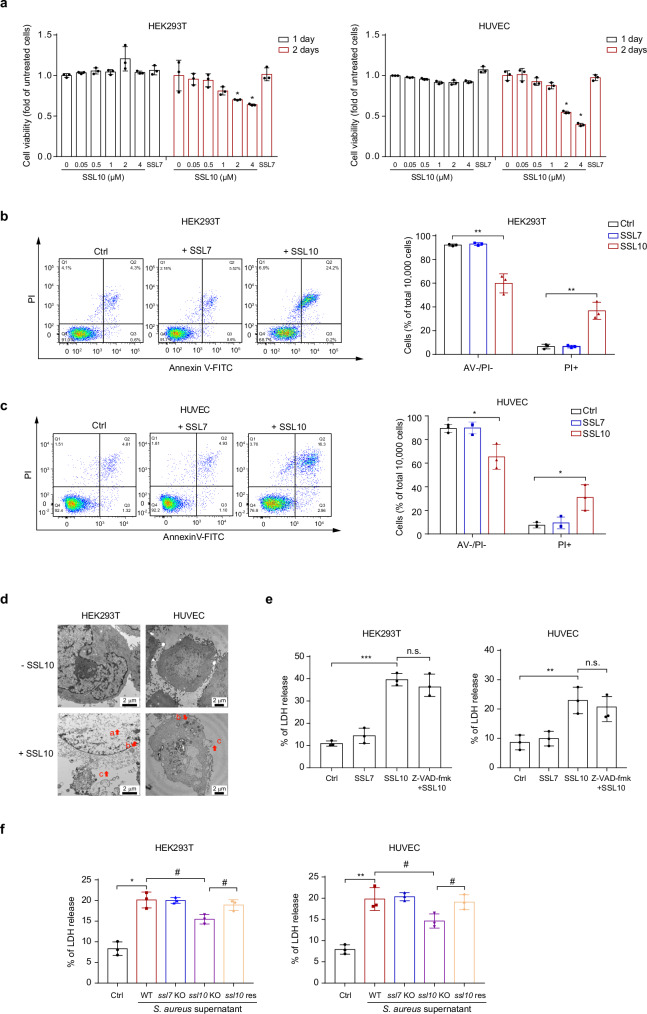
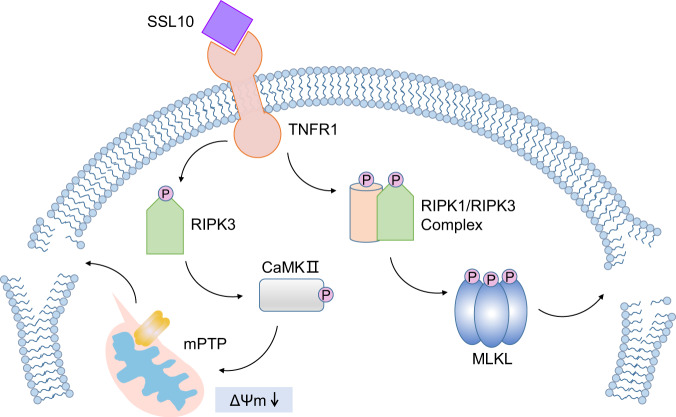
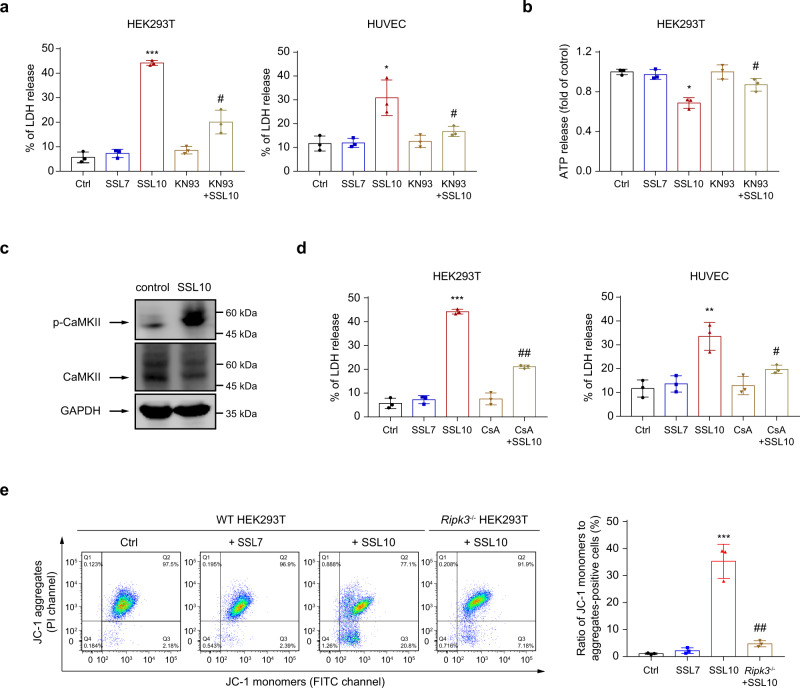
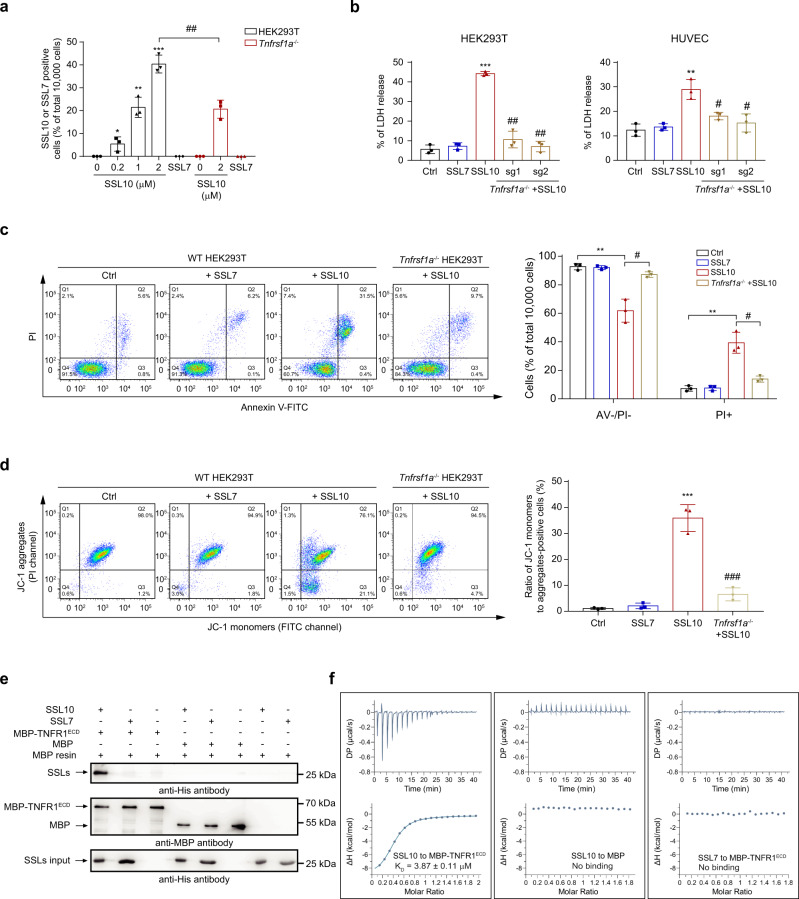
Staphylococcal aureus (S. aureus) infection can lead to a wide range of diseases such as sepsis and pneumonia. Staphylococcal superantigen-like (SSL) proteins, expressed by all known S. aureus strains, are shown to be involved in immune evasion during S. aureus infection. Here, we show that SSL10, an SSL family protein, exhibits potent cytotoxicity against human cells (HEK293T and HUVEC) by inducing necroptosis upon binding to its receptor TNFR1 on the cell membrane. After binding, two distinct signaling pathways are activated downstream of TNFR1 in a RIPK3-dependent manner, i.e., the RIPK1-RIPK3-MLKL and RIPK3-CaMKII-mitochondrial permeability transition pore (mPTP) pathways. Knockout of ssl10 in S. aureus significantly reduces cytotoxicity of the culture supernatants of S. aureus, indicating that SSL10 is involved in extracellular cytotoxicity during infection. We determined the crystal structure of SSL10 at 1.9 Å resolution and identified a positively charged surface of SSL10 responsible for TNFR1 binding and cytotoxic activity. This study thus provides the description of cytotoxicity through induction of necroptosis by the SSL10 protein, and a potential target for clinical treatment of S. aureus-associated diseases.
金黄色葡萄球菌(S. aureus)感染可导致多种疾病,如败血症和肺炎。所有已知的金黄色葡萄球菌菌株都表达的葡萄球菌超抗原样(SSL)蛋白,被证明参与金黄色葡萄球菌感染期间的免疫逃避。在这里,我们表明 SSL10,一种 SSL 家族蛋白,通过与细胞膜上的其受体 TNFR1 结合诱导坏死性凋亡,对人细胞(HEK293T 和 HUVEC)表现出强大的细胞毒性。结合后,TNFR1 下游以 RIPK3 依赖性的方式激活两条不同的信号通路,即 RIPK1-RIPK3-MLKL 和 RIPK3-CaMKII-线粒体通透性转换孔(mPTP)通路。金黄色葡萄球菌中 ssl10 的敲除显著降低了金黄色葡萄球菌培养上清液的细胞毒性,表明 SSL10 参与感染期间的细胞外细胞毒性。我们确定了 SSL10 的晶体结构,分辨率为 1.9 Å,并鉴定出 SSL10 上负责与 TNFR1 结合和细胞毒性活性的带正电荷表面。因此,本研究描述了 SSL10 蛋白通过诱导坏死性凋亡引起的细胞毒性,并为金黄色葡萄球菌相关疾病的临床治疗提供了一个潜在的靶点。