Institute of Multidisciplinary Research for Advanced Materials, Tohoku University, Katahira 2-1-1, Aoba-ku, Sendai, 980-8577, Japan.
Department of Chemistry, Faculty of Science, Tohoku University, Sendai, 980-8578, Japan.
Sci Rep. 2022 Aug 12;12(1):13718. doi: 10.1038/s41598-022-17829-1.
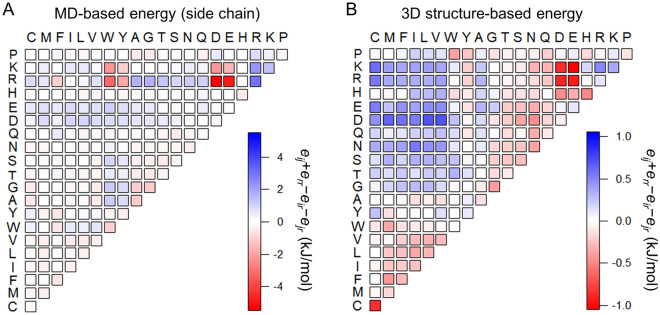
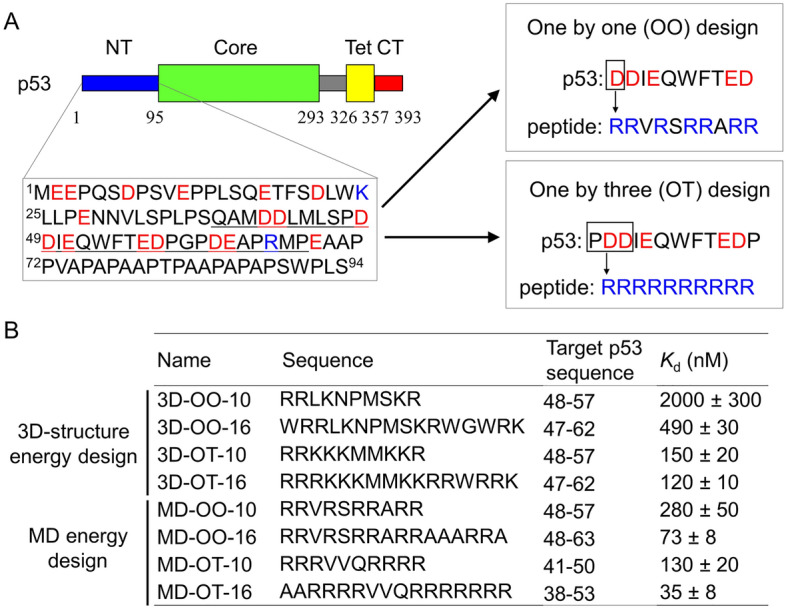
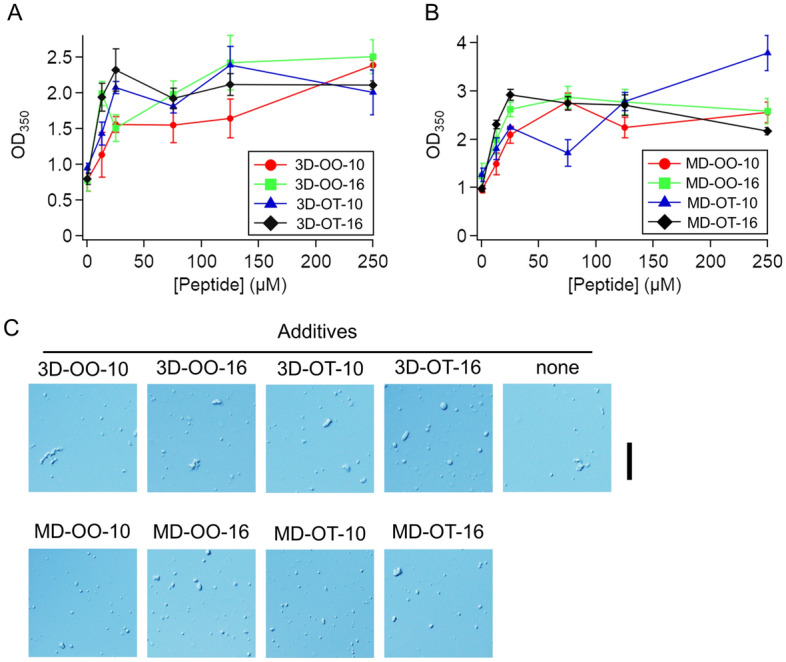
Since liquid-liquid phase separation (LLPS) of proteins is governed by their intrinsically disordered regions (IDRs), it can be controlled by LLPS-regulators that bind to the IDRs. The artificial design of LLPS-regulators based on this mechanism can be leveraged in biological and therapeutic applications. However, the fabrication of artificial LLPS-regulators remains challenging. Peptides are promising candidates for artificial LLPS-regulators because of their ability to potentially bind to IDRs complementarily. In this study, we provide a rational peptide design methodology for targeting IDRs based on residue-residue contact energy obtained using molecular dynamics (MD) simulations. This methodology provides rational peptide sequences that function as LLPS regulators. The peptides designed with the MD-based contact energy showed dissociation constants of 35-280 nM for the N-terminal IDR of the tumor suppressor p53, which are significantly lower than the dissociation constants of peptides designed with the conventional 3D structure-based energy, demonstrating the validity of the present peptide design methodology. Importantly, all of the designed peptides enhanced p53 droplet formation. The droplet-forming peptides were converted to droplet-deforming peptides by fusing maltose-binding protein (a soluble tag) to the designed peptides. Thus, the present peptide design methodology for targeting IDRs is useful for regulating droplet formation.
由于蛋白质的液-液相分离(LLPS)受其无规卷曲区域(IDR)的控制,因此可以通过与 IDR 结合的 LLPS 调节剂来控制。基于这种机制的人工设计的 LLPS 调节剂可应用于生物和治疗应用中。然而,人工 LLPS 调节剂的制造仍然具有挑战性。肽是人工 LLPS 调节剂的有前途的候选物,因为它们具有潜在地互补结合 IDR 的能力。在这项研究中,我们提供了一种基于使用分子动力学(MD)模拟获得的残基-残基接触能来针对 IDR 的合理肽设计方法。该方法提供了作为 LLPS 调节剂起作用的合理肽序列。使用基于 MD 的接触能设计的肽对肿瘤抑制因子 p53 的 N 端 IDR 的解离常数为 35-280 nM,明显低于基于常规 3D 结构的能量设计的肽的解离常数,证明了本肽设计方法的有效性。重要的是,所有设计的肽都增强了 p53 液滴的形成。通过将麦芽糖结合蛋白(可溶性标签)融合到设计的肽上,将形成液滴的肽转化为液滴变形的肽。因此,本研究中针对 IDR 的肽设计方法可用于调节液滴的形成。